Chapter 2 (Lecture): Observing and Recording Behavior
 Call Kai
 Learn
Learn Practice Test
 Spaced Repetition
 Match
Match Flashcards
 Knowt Play
1/42

There's no tags or description
Looks like no tags are added yet.
Name | Mastery | Learn | Test | Matching | Spaced | Call with Kai | Chat |
|---|
No analytics yet
Send a link to your students to track their progress
43 Terms
What are the ethical responsibilties that the APA follows?
Beneficence and Nonmaleficence: Benefit others and do no harm
Harm is measured by the outcome
Fidelity and Responsibiity: Establish relationships of trust, uphold professional standards, responsibilities, and obligations
Integrity: Promote accuracy, honesty, and truthfulness
Justice: Fairness and justice for all, equal access, benefit, and quality
Respect of People’s Rights and Dignity
How is behavioral intervention evidence based?
It is operationally defined
Measurement occurs at baseline (before intervention) and repeatedly over time to assess progress and to determine intevention efficacy (before and after assessments)
Intervention procedures are clearly specified (need to be reproducible)
What does it mean by behavior is “operationally defined”?
The behavior is turned from an abstract concept into something concrete, observable, and measurable for a scientific study
What is behavior?
Behavior is what people do and say
What are the 5 primary characteristics of behavior?
Behavior is:
Action
Multiple measurable dimensions
Observable by others
Produces an effect on the environment (what we can see in the external environment)
Is lawful (related to the environment)
Does behavior focus on overt behavior?
Yes, behaviorism, where a person’s behavior is influenced by the environment focuses on visible behavior
Not private events
What are the measurable dimensions of behavior?
There are multiple observable and measurable dimensions
Frequency (number of times the behavior occurs)
Duration (how long the behavior lasts)
Intensity (how much force is required)
Latency (how long does the behavior take to start)
Depending on the behavior, you look at the dimension you are the most interested in!
Target behavior
Behavior identified for change
Behavioral excess
Behavior targeted for reduction
Behavioral deficit
Behavior target for increase
Controlling variables
Factors in the immediate environment that influence behavior
How do you operationalize behavior?
To turn a behavior into something observable, and measurable for a scientific study:
You need to describe the behavior using active verbs
Use objective language
No unobservable internal states (emotions, intentions)
No labels
How can behavior be assessed?
Behavior can be assessed using:
Indirect assessment: questionaires and rating scales, interviews
Direct assessment: live or recorded observation
What are the strengths/ limitations of direct assessment?
Direct assessment is good for:
Giving context to the behavior
Good for frequent unnoticed behaviors (wouldn’t be good to self record)
Clear evidence and high accuracy
Limitations:
Resource and time costly
What are the strengths/ limitations of indirect assessment?
Indirect assessement is good:
Time efficient
Convenient
Limitations:
Subjective
Suspectable to bias
What are key considerations for choosing an observer?
Observer:
Either a professional or a person from the natural environment
Proximity to observe (unless using video)
Need sufficient time to observe and training
What are the recording considerations?
Need to decide:
When to record (Select a period when behavior is most likely to occur)
Where to record (Natural environment vs laboratory environment)
How to record (Structured vs unstructured recording)
Structured = options are given for activities/ directions are given, while unstructured, nothing is given
Whar are the types of recording procedures?
The types of recording procedures are:
Continuous Recording (can be frequency, duration, latency, intensity, or percentage of opportunities)
Interval Recording (Partial/ whole interval)
Time Sampling
Product Recording
Continuous Recording: Frequency
Continuously record each instance of behavior during the observation period
Need to define each instance of behavior and break down the definition of a behavior for reliability
Calculate:
Total frequency count
Rate (especially important if observation periods differ in length)
Continuous Recording: Duration
Continuously record the duration of each instance of the behavior during the observation period
Record the start and stop of the behavior
Calculate:
Average duration of behavior
Proportion of observation period with behavior
Continuous Recording: Latency
Continiously record latency for each instance of behavior during the observation period
Time from the stimulus to when the behavior occurs (the amount of time that lapses before behavior occurs)
How long does it take us to see the behavior?
Calculate:
Average latency of behavior
Latency is very specific and only applies to some behaviors
Continuous Recording: Intensity
Record each instance of behavior continuously during the observation for intensity
Look at intensity (magnitude + scaling)
Good for: aggression, yelling
Percentage of opportunities or % correct for recording
Out of the total number of times someone has the opportunity to respond, how often do they respond?
Percentage of times the person responds/ the number of times someone has the opportunity to respond
What are the strengths of continuous recording?
Strengths:
You’re measuring every instance of a behavior
More accurate (less measurement error) than discontinuous methods
Best for discrete behaviors (clear onset and offset)
What are the limitations of continuous recording?
Limitations:
May be less accurate when behavior has ambiguous start/stop or occurs at very high rates
Requires significant attention, effort, and time
May be difficult to record mulitple responses
What is discontinuous recording?
It is a behavioral observation method) where behavior is sampled in intervals rather than tracked continuously
Observation period is divided into intervals of 20-30 s
Only captures whether a behavior occured or not within that interval
What are the types of interval recording?
There is:
Partial Interval Recording: Record if the behavior happened during each consecutive interval
Whole Interval Recording: Record whether the behavior occured throughout the entire interval
Partial Interval Recording
Records whether the behavior occured at all during each interval
Divide the observation period into intervals (reduces the load)
Calculate:
Proportion (%) of intervals during which the behavior occured
What are the strengths of partial interval recording?
The strengths are:
It’s efficient and behavior is recorded once regardless of frequency
Helpful for low frequency behaviors
Useful if the behavior reduction goal is 0
What are the limitations of partial interval recording?
The limitations are:
It overestimates behavior (you mark the behavior as occurring if it happens at ANY point during the interval)
Not a good choice when you want to increase a behavior that should happen very often, because it can make the behavior look more successful than it really is
Whole Interval Recording
Record whether behavior occured throughout the entire interval
For behaviors with high frequency
Looking to see if the behavior occured for the entire duration
What are the strengths of whole interval recording?
It’s strengths are:
It’s useful if the behavior is expected to have a long duration
Infrequently used
What are the limitations of whole interval recording?
It’s limitations are:
It underestimates behavior because the behavior must occur for the entire interval to be recorded; behaviors that occur for only part of the interval are recorded as non-occurrences.
Not recommended when targetting behavior reduction, makes it look like less happened (underestimates the occurrence of a behavior)
Frequency-Within-Interval Recording
Record the frequency of the behavior within each interval
Provides frequency data and specific intervals within which behavior occured
Not used as much because of time and labor costs
Time Sampling
Record behavior only during part of each interval or at a specific time in the interval
Divide the observation period into intervals
Calculate:
Proportion (%) of intervals during which behavior occured
Can increase accuracy
Momentary Time Sample Recording
Behavior recorded only if it occurs at exact end of the interval
Strengths of Momentary Time Sample Recording
It’s strengths are:
It may provide a more accurate estimate of behavior than partial or whole interval recording
Recommended for use in targeting behavior increase (easy to tell if behavior is increasing over time)
Limitations of Momentary Time Sample Recording
It’s limitations are:
May have difficulty capturing low frequency behavior
May be less sensitive to small intervention effects
Not reccomended when target for behavioral reduction is 0, since you need to know that the behavior never occurred, not just that it wasn't happening when you checked.
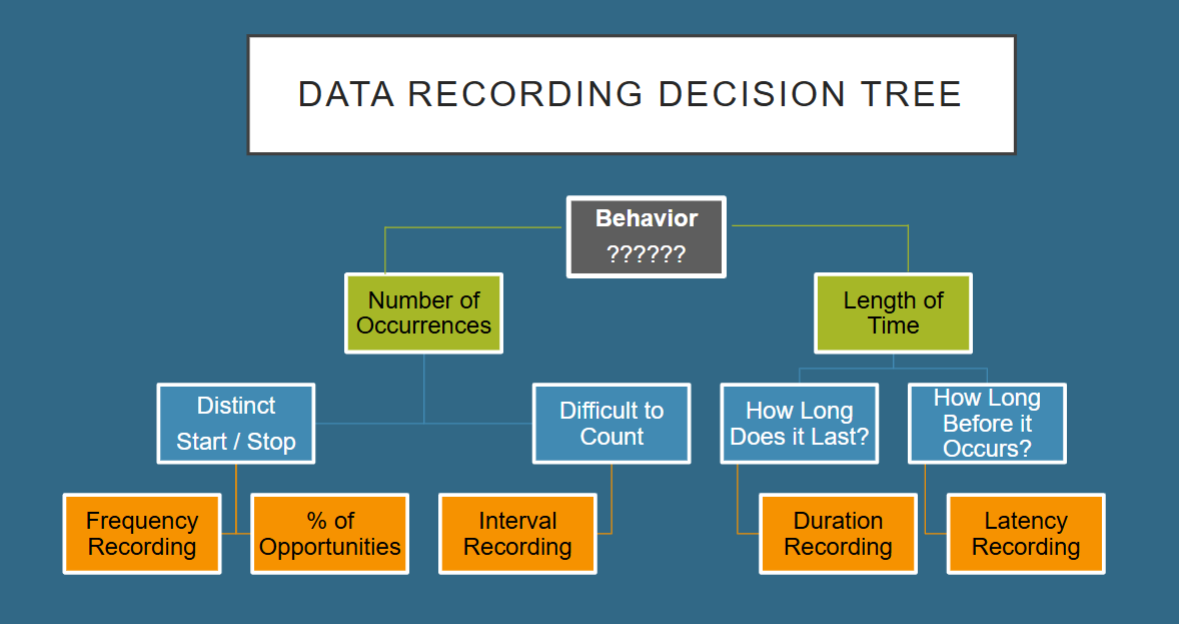
Data Recording Decision Tree
Product Recording
Indirect measure focused on the product of behavior
Ex. Number of homework sheets completed, number of injuries produced by aggression
However, there is uncertainity about factors not directly observed (ex. did the child complete homework independently
What is reactivity?
It ishow peoplechange their behavior when they know they are being observed
May reduce representativeness
Behavior change is typically temporary
How do you reduce reactivity?
Reactivity is reduced by:
Waiting until people are accustomed to observer’s presence
Observe without the individual’s knowledge (with consent)
Use video recording
Reactivity can be beneficial and induced by self monitoring
Interrater (interobserver) Reliability
Level of agreement between 2 or more observers/ raters
Ratings can’’t be valid if they are unreliable
Percent agreement may be applicable with small samples