Path 3100 Exam 1
 Call Kai
 Learn
Learn Practice Test
 Spaced Repetition
 Match
Match Flashcards
 Knowt Play
 Podcast
1/61

There's no tags or description
Looks like no tags are added yet.
Name | Mastery | Learn | Test | Matching | Spaced | Call with Kai | Chat |
|---|
No analytics yet
Send a link to your students to track their progress
62 Terms
Cocci
Sphere shaped bacteria.
Diplococci
Streptococci (chains)
Staphylococci (groups)
Bacilli
Rod shaped bacteria
Pleomorphic
The ability of some micro-organisms to alter their shape or size in response to environmental conditions
Spirochete
Spiral shaped bacteria
Flagella
Protein filaments on the outside of bacteria that provide locomotion.
Pili
Small protein fivers that allow bacteria to attach to a host.
Endospores
Bacterial DNA and cytoplasm produced during adverse conditions.
Are resistant to extreme temperature, chemicals, toxins, detergents, as well as radiation.
Produced by some gram positive bacteria.
Importantly, the Bacillus and Clostridium species produce spores.
Capsules
Covers the cell wall and shields the bacteria from immune and phagocytic responses.
Usually made of polysaccharides.
One of the most important virulence factors.
Think of it as the invisibility cloak.

Factors Affecting Microbial Growth
Temperature (30-35 C)
pH (6.0-8.0)
Osmotic pressure
Chemical requirements (i.e. carbon, H2O, nitrogen, sulfur, phosphorus, trace elements)
Atmosphere (O2 or CO2 concentrations)
Obligate Aerobes
Require O2
Obligate Anaerobes
Will not grow in presence of O2
Facultative Anaerobe
Grows with or without O2
Capnophilic
Grows best when atmosphere is enriched with extra CO2
Pattern of Microbial Growth
Lag Phase: growth is undetected
Log Phase: constant, maximal growth rate
Stationary Phase: cells dying= cells dividing
Death phase: most cells are dying

Cell structure of prokaryotes versus eukaryotes
Prokaryotes:
No nucleus
Haploid genome
Single, circular, double stranded DNA called a nucleoid
Energy is generated by the cell membrane
Cell wall
Ribosomes are 70s
Have plasmids (small circular DNA that can be passed on)
Eukaryotes:
Nucleus with double stranded DNA
Diploid genome
Nucleolus is site of ribosomal RNA synthesis
ER is where protein is synthesized
Mitochondria is site of energy production
Not common to have cell walls
Double lipid bilayer plasma membrane
Taxonomic Hierarchy and Example
Domain: Bacteria
Phylum: Proteobacteria
Class: Gammaproteobacteria
Order: Enterobacteriales
Family: Enterobacteriaceae
Genus: Escherichia
Species: coli
Notice that genus is capitalized and species is not.
Strain
Used to describe genetically identical or clonal representatives of species.
Isolate
A representative bacterial colony recovered from a particular source.
Gram Positive Cell Wall
Thick peptidoglycan layer
Teichoic acid and lipotechoic acid are unique to these cell walls.
Appears purple when stained.
Gram Negative Cell Wall
Thin peptidoglycan layer
Outer membrane is outside the peptidoglycan layer.
Appears pink when stained.
Acid-Fast Cell Wall
Gram positive cell wall structure but also has a waxy layer bound to the exterior of cell wall.
Examples: Mycobacterium and Nocardia
Do not stain well with gram stain.
Bacteria with no cell walls
Mycoplasma
Gram Stain Procedure
Crystal Violet: Net (+) charge is attracted to bacterial (-) charged cells
Iodine: mordant (dye fixative)
Alcohol: decolorizer; removes dye from gram negative cells but not gram positive cells
Safranin: counterstain (responsible for the pink coloring in gram negative cells)
Beta hemolytic species
Strep pyogenes (Group A)
Strep agalactiae (Group B)
Alpha hemolytic species
Streptococcus pneumoniae
Streptococcus bovis (Group D)
Enterococcus (Group D)
Non-hemolytic / gamma
S. bovis (Group D)
Enterococcus
Infections caused by Streptococcus pyogenes
Pharyngitis, tonsilitis, swollen lymph nodes
(Strep throat)
Otitis media
Scarlet fever
Impetigo
Cellulitis
Post-strep problems:
Rheumatic fever
Acute glomerulonephritis
Infections caused by Streptococcus agalactiae
(Produces capsules)
Infections:
Colonizes genital tract
Leading cause of meningitis, septicemia, and pneumonia in neonates
UTI
Post-surgical gynecologic infections
Streptococcus pneumoniae
Gram-pos. cocci
Abundant capsule producer: resists phagocytosis
Infections:
normal flora of upper resp. tract
otitis in children
bacterial pneumonia
meningitis
sinusitis
Viridans Streptococcus
AKA: Alpha-hemolytic Strep.
Predominant organisms of the upper resp. flora
Most common cause of subacute bacterial endocarditis
Enterococcus
Gram-pos cocci
Over 30 species
Two species responsible for human infection:
E. faecalis
E. faecium
Relatively low virulence
Infections:
Normal GI flora
UTI
Endocarditis
Wound infections
Gram Positive Cocci
Staph: aureus, epidermidis, saprophyticus
Strep: agalactiae, pneumoniae, pyogenes
Enterecoccus species: E. faecalis, E. faecium
Gram Positive Bacilli
Clostridium: perfringens, difficile, tetani, botulinum
Bacillus: anthracis, cereus
Listeria monocytogenes
Corynebacterium: diptheriae, jeikeium
Gardnerella vaginalis (gram-variable)
Nocardia spp.
Classification of Staphylococcus
Staphyle: Greek for "bundle of grapes"
Normal flora of the skin, mucous, feces
Facultative anaerobe
Tolerates high salt environments (skin)
Non-motile
Catalase (+)
Gram-Positive cocci in clusters
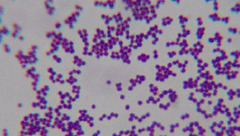
Staph. aureus
Most virulent Staph.
Found of skin, in nose, axillae and groin
Coagulase (+)
Leukocidin- exotoxin that kills neutrophils
6 types of enterotoxins
Lipases
Hyaluronidase- dissolves interceullular matrix of tissues
Protein A- binds to Fc portion of IgG and prevents phagocytosis
Hemolysins: alpha and delta
Diseases: skin infections, osteomyelitis, pneumonia, food poisoning, gastroenteritis, toxic shock syndrome
Staph. epidermidis
Low virulence
Inhabits skin of most people
Diseases: endocarditis (heart valves infected), prosthetic infections, IV site infections (sepsis)
Loves to form biofilms on plastic
Staph. saprophyticus
Strong association with UTI
Has a unique binding property to transitional epithelium
Areas of the human body that Staph. resides
Skin, mucous membrane, nose
Significance of MRSA
Most strains of S. aureus are resistant to penicillin, so methicillin/nafcillin/oxacillin is used.
A rise of MRSA has occurred.
Scary.
The only two gram-positive bacilli species that produce spores:
Clostridium
Bacillus
Listeria monocytogenes
Gram-pos. bacilli
Frequently found in the environment
Causes stillbirths and meningitis in animals. Human diseases appear in neonates, pregnancy, and immunocompromised.
CAN GROW IN REFRIGERATION and consequently has a higher mortality rate that other organisms.
Associated with food borne illness, especially from dairy.
Corynebacterium Species
Gram positive bacilli
All Corynebacterium are diptheroids
Environmental and normal flora of humans and animals.
Skin, oral cavity, and urogenital tract.
Opportunistic organism.
Considered contaminants when isolated
Pleomorphic, resembles "Ls" and "Vs" and may palisade
Corynebacterium diphtheriae
Corynebacterium jeikeium
Corynebacterium diptheriae
Produces an exotoxin when infected with a phage
The toxin affects myocardium and PNS, which causes death by asphyxiation or myocarditis
Diptheria the disease: pharyngitis with thick leathery-grey membrane, fever and malaise.
Treated with diptheria antitoxin and antibiotics.
Immunizations available.
Corynebacterium jeikeium
Normal flora of skin
Opportunistic
Causes diseases with prosthetic heart valves
Septicemia
Skin infections
Nocardia Species
Environmental
Not normal flora
Gram positive bacilli
Shows branching and beading
Strict aerobe
Smells like dirt
Opportunistic
Causes bronchopulmonary and cutaneous infections
Gardnerella vaginalis
Only species
Facultative anaerobe
Gram stain- variable
Fastidious organism
Causes bacterial vaginosis: green frothy discharge with foul odor
Clue cells
Bacillus species
Low virulence
Found in soil, water, dust, and animal products
Common laboratory contaminants
PRODUCES SPORES
Gram Stain- box car shaped gram-variable
Aerobe or facultative anaerobe
Bacillus anthracis
Bacillus cereus
Bacillus anthracis
Major pathogen
Causes Anthrax
Used for biological warfare
Three types of anthrax disease: pulmonary, cutaneous, GI
Bacillus cereus
Opportunist
Food poisoning especially with rice
Can also cause eye and wound infections but is less common

Clostridium species
Gram-positive bacilli
Inhabits soil, water, vegetation, and bowels
Significant pathogens of livestock and wildlife.
ANAEROBES
PRODUCE SPORES
Clostridium perfringens
Produces many exotoxins
Gram-positive bacilli, box car shaped
Rapid growth
Produces high amounts of gas
Gas gangrene
Food poisoning
Wound infections
Clostridium difficile
Normal bowel flora
Antibiotic therapy can cause this to overgrow
Produces toxins that cause blood diarrhea
Development of a pseudomembrane
Smells like horse manure
Colonies of it have a "ground glass" appearance
Treatment: stool transplant
Clostridium tetani
Gram-pos. bacilli
Found in soil, dust, and human/animal excreta
SPORES enter the body through wounds
Produces toxins that block relaxation of muscles
Causes tetanus
Treated with an antitoxin and penicillin
Preventable with an immunization
Clostridium botulinum
Spores are found in soil, water, and surface of vegetables
Diseases caused by inadequate food processing
Causes paralysis in muscles
The reason we don't give babies honey and certain food supplements.
Treated with an antitoxin and penicillin
Compare and Contrast Neisseria gonorrhoeae and Neisseria meningitidis
gonorrhoeae is always a pathogen, meningitidis may be found as commensal
Menigitidis is lethal, while gonorrhoeae is rarely lethal
gonorrhoeae is killed rapidly in the blood stream
gonorrhoeae is not encapsulated
Menigitidis causes systemic infection
Both :
gram-negative dipplococci
Both have pili
aerobic
require CO2 for growth
fav. temp is 33-37 C and moist
fastidious
non motile
affinity for mucous membranes
How to recover, isolate, and identify Neisseria and Moraxella catarrhalis
Neisseria Species
Many are isolated from humans
Many are flora of mucous membranes and respiratory tract and urogenital tract
Gonorrhoeae and meningitidis are primary pathogens
Neisseria gonorrhoeae
Gram-neg cocci
Spread with sexual contact
Very sensitive to atmosphere and temperature.
Only inoculated to selective nutrient dense media. Then brought to a high CO2 rich environment.
Oxidase positive- an enzyme that oxidizes a colorless reagent to form a deep purple color in 10 seconds.
Gonorrhoeae is often paired with clamydia
Treated with ceftriaxone and azithromycin
Many strains resistant to penicillin
Very fastidious organism.
Preferred method of identification is Nucleic Acid Amplification Tests (NAAT)
Neisseria meningitidis
Found in the nasopharynx
Spread by respiratory droplets
5-15% of teens and young adults are carriers
Common transmission in close quarters
Disease seen in children and young adults
Meningitis: fever, headache, stiff neck, photophobia, irritability
Meningococcemia: petechial rash, shock and disseminated intravascular coagulation
Specimen found in CSF or blood
Detected with PCR
Treated with penicillin
Moraxella catarrhalis
Gram-negative diplococci
Normal flora of upper respiratory tract
Grows well on lab media
Diseases: otitis media, sinusitis
Causes pneumonia and bronchitis in the immunocompromised
When cultured, similar to Neisseria
Treated with antibiotics and decongestants
Classification of Streptococcus
From the greek: "streptos" meaning "twisted"
Gram positive cocci
Oval or round, usually in chains
Normal flora in oral cavity, nasopharynx, and GI tract
Facultative anaerobes
Catalase negative
Non-spore forming
Alpha and beta hemolysis
Toxins: streptolysin O and S
Streptolysin O and S
O- oxygen labile (subsurface hemolysis)
S- oxygen stable (surface hemolysis)