Transcription and RNA
 Call Kai
 Learn
Learn Practice Test
 Spaced Repetition
 Match
Match Flashcards
 Knowt Play
1/20

There's no tags or description
Looks like no tags are added yet.
Name | Mastery | Learn | Test | Matching | Spaced | Call with Kai | Chat |
|---|
No analytics yet
Send a link to your students to track their progress
21 Terms
Finished transcripts are modified in 3 ways before they exit the nucleus:
Step 1: ___- Adding a modified guanine
Step 2: ___- Adding -AAAAAAA
Step3: ___- ‘Stitching’ the gene together
5’ capping : polyadenylation (3’ poly A tail) : gene splicing
Step I : 5’ Capping:
-Adding of modified __ to the 5’ end of the transcript (nucleotide is attached via __ triphopsphate bridge
-5’ Cap is needed for __ of translation (making protein) and it __ the transcript
-guanine : 5’ to 5’
-initiation : stabilizes
Step II: Polyadenylation:
-Adding of multiple adenine (poly-A tail). The poly-A tail increases __
-mRNA with little or no poly-A tail is quickly __
stability : degraded
Eukaryotic RNA must undergo further ___ in addition to the 5’ cap and poly(A) tail
processing
Eukaryotic RNA typically has noncoding sequences called __ that are interspersed in the coding sequences. The coding regions between introns are called __
introns : exons


Introns must be __, and exons stitched together to generate a functional mRNA molecule
removed
Small nuclear ribonucleoprotein particles ( snRNA - “__” ) form the core of a complex called a __, which carries out RNA splicing in the cell
-The spliceosome recognizes sequences common to introns, and cuts out the intron via a __ structure. The … structure involves a ‘branch point adenine
snurps: splicesome
-lariat

Intron Splicing by Lariat Structure: The 5’ end of the intron bonds to the __ position of the ribose of the adenine to form a lariat structure (the yellow loop). The __ of the exon joins with the 5’ end of the next exon to form a continuous __region
2’ OH : 3’ OH : coding
Why Would Cells Evolve __?
1.Transcripts can be spliced in several different ways to produce a variety of proteins from a single transcript (__ splicing) - i.e. many proteins can come from one gene
2.___ is much more likely with introns, which has probably led to many chimeras (combinations) of existing proteins; many current proteins resemble ‘patchworks’, which supports this theory (i.e. new proteins are more likely to be created)
Introns : alternative : Genetic Recombination

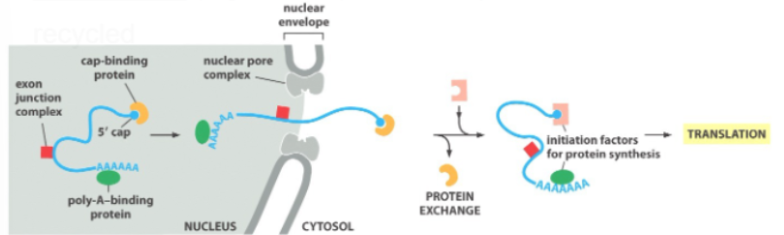
Export from the Nucelus
Mature mRNA is exported from the __ to the cytoplasm. Nuclear pores recognize the binding proteins associated with the poly(A) tails and 5’ cap. __ (e.g. introns) are not exported and are
nucleus : Waste RNA
mRNA Lifespan and Degradation
mRNA is eventually degraded after use by __. The lifespan of a transcript varies according to the mRNA __ and the type of __ is exists in
RNases : sequence : cell
mRNA Lifespan and Degradation
Bacterial mRNA lifespans can be as short as __ but Eukaryotic mRNA exists from ~30 min to __. In general, mRNA that code low-level proteins have __ lifespans, while those that code for high-level proteins (e.g. B-globin) last longer (e.g. 10h)
3 min : 10h : short


From RNA to ___
Recall the genetic code where _ nucleotides code for __ amino acids. A set of three nucleotides (known as a __) codes for a single amino acid. There are __ possible codons (4 x 4 x 4)
Protein : 4 : 20 : codon: 64
Each transcript has three possible __ frames. This is because mRNA is decoded by groups of three __. Each … frame produces a different protein. Generally there is only one ‘correct’ reading frame
reading : nucleotides

Translation from genetic code to protein requires the help of __ RNA (tRNA). tRNA are __ nucleotides long with an amino acid attachment site (top) and an __ site (bottom)
transfer: 80 : anticodon
When a tRNA is coupled to its specific amino acid, it is said to be ‘__’. There are twenty individual __ that link each type of amino acid to tRNA molecules
charged : aminoacyl-tRNA synthetases

may be acc


