Multiphase Liquid Dosage Forms: Suspensions
 Call Kai
 Learn
Learn Practice Test
 Spaced Repetition
 Match
Match Flashcards
 Knowt Play
1/85

There's no tags or description
Looks like no tags are added yet.
Name | Mastery | Learn | Test | Matching | Spaced | Call with Kai | Chat |
|---|
No analytics yet
Send a link to your students to track their progress
86 Terms
Disperse systems (dispersions)
They are heterogeneous systems – systems containing particulate matters or
globules distributed throughout a medium.
What are the two phases of disperse systems?
dispersed phase (internal phase) and continuous phase (dispersing phase/dispersion medium)
dispersed phase (internal phase)
suspended particles
continuous phase (dispersing phase/dispersion medium)
suspension liquid
Classification of liquid dispersion systems
molecular dispersion, colloidal dispersion, fine dispersion, coarse dispersion
molecular dispersion characteristics
Particles invisible in electron microscope, undergo rapid diffusion
colloidal dispersion characteristics
Particles invisible in ordinary microscope but seen under electron microscope, diffuse very slowly
fine dispersion characteristics
Particles visible under microscope, particles do not diffuse
coarse dispersion characteristics
Particles visible under microscope, particles do not diffuse
molecular dispersion particle size
< 1 nm
colloidal dispersion particle size
1-500 nm
fine dispersion particle size
0.5-10 μm
coarse dispersion particle size
10 -50 μm
molecular dispersion examples
glucose solution, saline
colloidal dispersion examples
milk, fog, paint, colloidal polymer dispersions
fine dispersion examples
magmas and gels
coarse dispersion examples
blood, suspensions and emulsions
tinctures
alcoholic or hydro alcoholic solutions prepared from vegetable materials or chemicals
how much alcohol do tinctures contain?
15-80% alcohol
tinctures differ by ____
methods of preparation (percolation vs maceration)
strength of drug
alcoholic content
mixing tinctures with other solutions may cause
precipitation
what should you protect tinctures from?
high temperature
tinctures should be stored in what kind of container?
light resistant containers
Suspensions
A dispersion of finely divided solid materials suspended in a liquid medium in
which the drug has ____________ solubility.
Oral suspensions have
2.5-10 % (w/v) of solids e.g. antacids, antibiotics
Externally used suspensions have
20% (w/v) of solids. e.g. calamine lotion
Parenteral suspensions
generally used for intra-muscular injections and have 0.5- 30% (w/v) solids. e.g. antibiotics, steroids.
Topical suspensions
used for delivery of drugs to the eye e.g. anti-inflammatory drugs (Nevanac suspension)
Rectal suspension
used for radiologicals and for treating intestinal disorders
Aerosols
formulated as suspensions - solid particles dispersed in a volatile propellant.
DESIRED FEATURES OF SUSPENSIONS
▪ Should settle slowly but re-disperse quickly upon only mild shaking.
▪ Should avoid forming hard cake.
▪ Easy to pour (from bottle), easy to spread (on the skin) or easy to flow (through syringe needle).
▪ Must remain sufficiently uniform for at least the period between shaking the container
and removing the required doses.
▪ Sufficient physical, chemical and microbiologic stability.
▪ Pleasant taste.

Flocculation

Deflocculation
Types of suspensions: flocculated suspensions
Types of suspensions: deflocculated suspensions

Viscosity (η)
The ratio of force applied (shearing stress, F) to the rate of flow (rate of shear, G) of a liquid
What does viscosity influence in suspensions?
physical stability

Classification of flow: newtonian flow

Classification of flow: non-newtonian flow
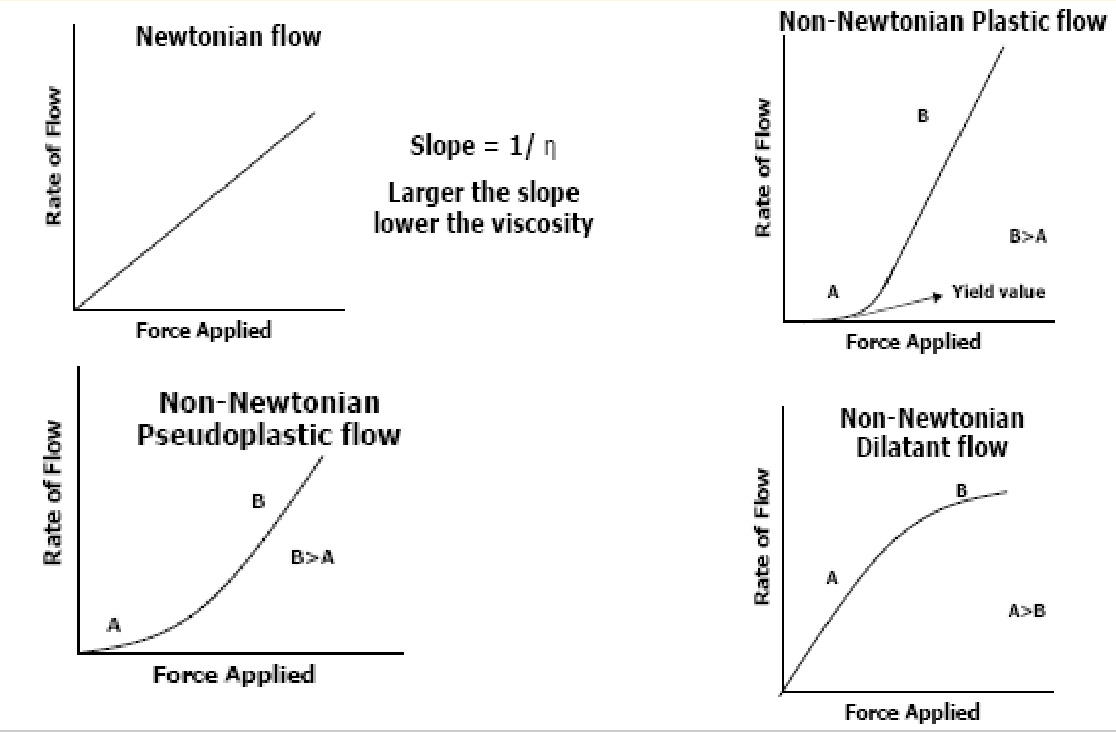
Classification of flow: non-newtonian pseudoplastic flow

Classification of flow: non-newtonian dilatant flow

thixotropic flow
methods of preparation of suspensions
1) Deflocculated suspension: Using a suspending agent to prepare deflocculated suspensions.
2) Controlled flocculation using flocculating agents
3) Flocculated suspension in a structured vehicle
Deflocculated suspension preparation
Using a suspending agent to prepare deflocculated suspensions
Controlled flocculation preparation
using flocculating agents
Flocculated suspension formulation
in a structured vehicle

THE MAIN STEPS IN THE PREPARATION OF SUSPENSION
.
Wetting
vehicle completely touching solute particles
advantages of suspensions
insoluble drugs disperse evenly
reasonably smaller volume than solutions
greater stability against hydrolysis and oxidation compared to aqueous solutions
masking of disagreeable taste of drug
easier to swallow compared to a solid osage form
depot therapy- for sustained effect
disadvantages of suspensions
difficulty maintaining uniformity and accuracy of doses
sedimentation followed by compaction of particles
loss on storage and transport
usually more difficult manufacturing process compared to simple solid dosage forms
Main issues with suspensions
inadequate dispersion of particles in the vehicle
settling of the dispersed particles
caking of these particles in the sediment that resists re-dispersion
desired features of suspensions
easy to pour, spread, flow
avoids forming hard cake
settles slowly
redisperses quickly upon mild shaking
must remain uniform for at least the period between shaking the container and removing the required doses
sufficient physical, chemical and microbiologic stability
pleasant taste
What route of drug administration does not involve application of pharmaceutical suspensions?
intravenous
Contact angle (θ)
Angle between a liquid and the surface over which it spreads.
▪ Ranges from 0 to 180 degrees
Low contact angle means ______ wetting
high
Wetting is most important for the ____ during the preparation of an insoluble powder in a vehicle
initial dispersion
suspending agents are used to ____ the rate of sedimentation and enhance the appearance of the suspension
increase
the concentration of suspending agents is usually ___ % w/v
0.5-5
The suspending agent should preferably exhibit _____________ flow
types of suspending agents
▪ Natural hydrophilic polymers e.g. tragacanth, xanthum gum, acacia.
▪ Synthetic hydrophilic polymers e.g. methyl cellulose, carboxy methyl cellulose.
▪ Clays e.g. bentonite, veegum.
Why are flocculating agents added?
to reduce and control the particle surface charge to an optimum level
controlled flocculation assures that
particle dispersion for sufficient period of time and prevent formation of a compact sediment that is difficult to redisperse.
flocculating agents
electrolytes, surfactants, polymers
Electrolytes act by ____________ the electrical barrier between the particles.
Important points when choosing flocculating agents
▪ The surface charge of the drug particles
▪ The valency of the electrolyte
▪ Electrolyte concentration
polymers as flocculating agents
high molecular weight compounds, particularly useful for drugs that do not carry a charge
polymers act as flocculating agents by ____ while the remaining parts of the polymer chain project outside
adsorbing onto the surface of particles (or bridging)
Interaction between the polymers and projected polymer chains forms _____________
forms bridges that link the particles into larger aggregates (flocs)
what do polymers mask on drug particles that are charged?
they can mask the charge
Ionic surfactants act as flocculating agents by _________ the charges on the particle
surface e.g. Docusate sodium
Non-ionic surfactants act as flocculating agents by forming a _______________ around
the particles e.g. Tweens or Spans

EVALUATION OF SUSPENSIONS – STOKE'S LAW
• d is the diameter of dispersed particle
• η is the viscosity of the dispersion medium
• g is the gravitational acceleration (m/s2)
• ρs is the mass density of the particles (the dispersed phase) (kg/m3)
• ρo is the mass density of the fluid (the dispersion medium) (kg/m3)
SUSPENSION STABILITY
▪ The suspension should be redispersible on shaking.
▪ A relatively narrow particle size distribution forms a good stable suspension.
▪ Drugs in suspension can undergo polymorphic conversion on storage.
▪ Change in pH of the dispersion medium can cause precipitation.
▪ Drastic changes in temperature can alter the stability of suspensions
PACKAGING AND STORAG
▪ All suspensions should be packaged in wide-mouth containers having adequate
airspace above the liquid to permit thorough mixing by shaking and ease of pouring.
▪ Most suspensions should be stored in tight containers protected from freezing,
excessive heat, and light.
▪ It is important that suspensions be shaken before each use to ensure a uniform
distribution of solid in the vehicle and thereby uniform and proper dosage.
Classify liquid dispersion systems based on their particle size and list their related characteristics.
Describe the rationale for developing suspension dosage forms.
compare flocculation and deflocculation. Are these desirable phenomenon? If yes, why? If no,
why?
Describe classification of flow with examples
List potential disadvantage(s) associated with flocculated suspensions and how it can be
overcome while preparing suspensions?
Describe three main flocculating agents and their mechanism in promoting flocculation.
Why is a wetting agent needed in the preparation of suspension?
Explain the role of various parameters on the rate of sedimentation using Stoke’s law.
Flocculated suspensions
• Particles are in the form of flocs or aggregates
• Weakly bonded
• Rapid sedimentation
• Easily resuspendable
• Resists complete settling
• Less prone to compaction
Deflocculated suspensions
• Particles are in a finely divided state
• Settle slowly
• Closely packed arrangement
• Form hard cake
• Difficult to redisperse if caking occurs
which of the following accurately characterizes colloidal dispersions?
particles diffuse very slowly