Medicinal chem
 Call Kai
 Learn
 Practice Test
 Spaced Repetition
 Match
 Flashcards
 Knowt Play
1/58

There's no tags or description
Looks like no tags are added yet.
59 Terms
How much of the total cost of developing a new drug is dedicated to clinical triels?
80% or more
How does taxol act as an anticancer drug?
stabilizes microtubules which are needed for cell division, and must be able to move around to perform their functions
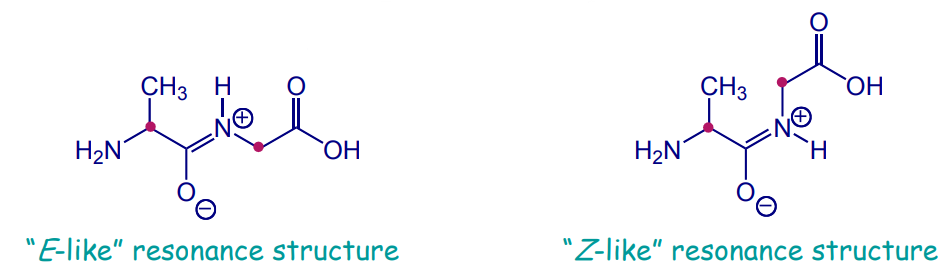
protein resonance structures
α-helix structure
R groups pointing outside
H-bonding between CO and NH in amide bonds

β-sheet structure
H-bonding between CO and NH in amide bonds (in plane)
R sticking away at alternating peaks and troughs (E-configuration)

Levels of Protein Structure (4)
primary: amino acid sequence
secondary: inter-chain α-helix & β-sheet interactions
tertiary: structure formed by assembly of secondary structures
quaternary: interactions with other polypeptides/polymer
What are the mechanisms of inhibitor binding? (3)
competitive: same site as substrate
non-competitive: binds allosterically
uncompetitive: can only bind after substrate has bound
Anatomy of a direct enzyme kinetics plot
Vo= amount of product ÷ time
S= substrate
Km= [S] at 0.5(Vmax)
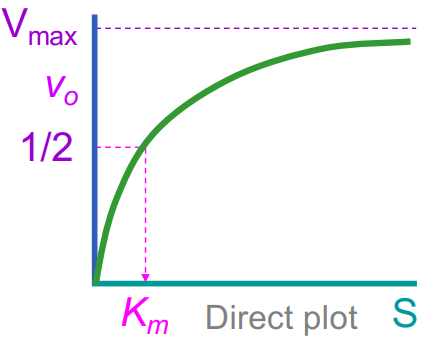
Anatomy of a direct enzyme kinetics plot
remember: higher values in direct plot= lower values in reciprocal plot and vice versa
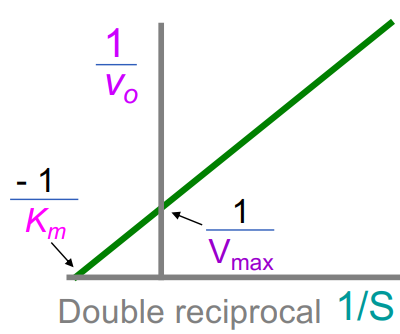
How does a competitive inhibitor impact a) Vmax and b) Km and c) is reflected on reciprocal plot?
a) no change
b) increase
c) intersect plot of [I]=0 plot at 1/Vmax

How does a non-competitive inhibitor impact a) Vmax and b) Km and c) is reflected on reciprocal plot?
a) decrease
b) no change
c) intersect plot of [I]=0 plot at 1/Km

How does an uncompetitive inhibitor impact a) Vmax and b) Km and c) is reflected on reciprocal plot?
a & b) decrease
c) runs parallel to gradient of [I]=0 plot

a) What groups are on either side of the b) cleavage site of proteases?
a) S1 towards N-terminus, S1’ towards N-terminus
b) between C and N of amide/peptide bond

a) Cbz can protect b) what group from participating in peptide bond formation (how)?
a) image
b) RNH2 + Cbz-X → R-NH-Cbz

Using what conditions/ methods is Cbz a) attached and b) removed?
a) basic
b) acidic or by hydrogenolysis
Acidic removal of Cbz

Hydrogenolysis removal of Cbz

a) FMOC can protect b) what group from participating in peptide bond formation (how)?
a) image
b) RNH2 + FMOC-X → R-NH-FMOC

Using a) what conditions/ methods is FMOC removed and b) why?
a) basic
b) The CH2R2 carbon cannot react with acid because it would form a primary carbocation in SN1 and the R groups are too bulky for SN2

What direction is peptide synthesis a) in vivo and b) in vitro?
a) N→C terminus
b) C→N terminus
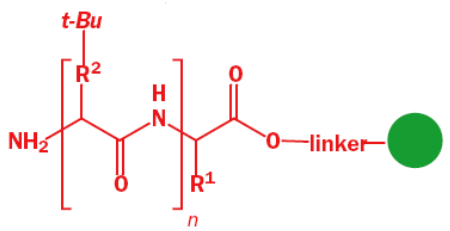
What groups are protected and how in solid phase synthesis?
C-terminus of initial amino acid is fixed to a resin bead
N-terminus of reagents protected with chemical group, typically FMOC
Apart from protecting the non-reactive group(s), what modification must be made to the amino acids in solid phase synthesis and How + why?
protect acidic (R= CO2-) and basic (R= NH3+) R groups with t-Bu or t-BOC to protect them from the basic wash

Solid phase synthesis procedure (5 steps)
a linker connects the C-terminus of the final peptide to a resin bead; commercially available
protected R and N-terminus amino acids added to column
N-terminus protecting group washed off using base
steps 2 and 3 repeated
95% TFA acid (F3CO2H) used to deprotect R-groups and release peptide from resin
What problem a) affects peptides in solid phase synthesis and b) how can it be resolved?
a) peptide chains may fold to shield Hydrophobic sites from solvent
b) ligation: make shorter fragments and connect them at Cys (R-SH) residues
ligation of peptide fragments mechanism


Serine proteases mechanism

Active site groups of serine proteases
Serine, Histidine, Aspartic acid

Active site groups of a) metal, b) Aspartic
a) zinc ion
b) Aspartic acid
The active site of (…) proteases has a site to the left (towards N-term.) of the catalytic site that help the substrate coordinate well to the active site; this site called (…)
The active site of serine proteases has a site next to the catalytic site that help the substrate coordinate well to the active site; this site called specificity site

What charge can the side chain of a) acidic and b) basic amino acids carry?
a) negative
b) positive
What is the a) characteristics and thus b) types of amino acids accepted by the specificity site of trypsin?
a) deep and negative charged
b) long and positive charged (image)

What is the a) characteristics and thus b) types of amino acids accepted by the specificity site of chymotrypsin?
a & b) large and non-polar (b; image)

What is the a) characteristics and thus b) types of amino acids accepted by the specificity site of elastase?
a) shallow and non-polar
b) very short and non-polar (image)

General shape and traits of a serine protease inhibitor
electrophile for Serine
forms inhibiting C=O
forms electrophile for R-:XH
prevents -OR fragment from dissociating
specificity group
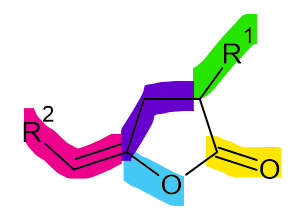

What can act as a R2 for a serine protease inhibitor?
halogen
alkyne
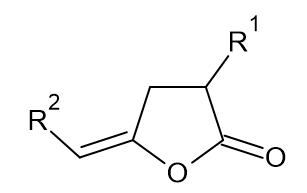
Mechanism for serine protease inhibitor when R2= halogen


Mechanism for serine protease inhibitor when R2= alkyne

irreversible inhibitor
binds to active site and permanently alters it making it unreactive
mechanism based inhibitor
group responsible for creating an inhibitory effect is formed upon binding to the enzyme
Lossen rearrangement for inhibition
where HO- and Br- come from active site
Br- can be substituted for another nucleophile

What kind of protease is HIV protease?
aspartic acid
What are the key features of the shape of HIV protease? (3)
Dimer with a C2 axis of symmetry and “flaps“ that fold down to hold substrate in place et active site

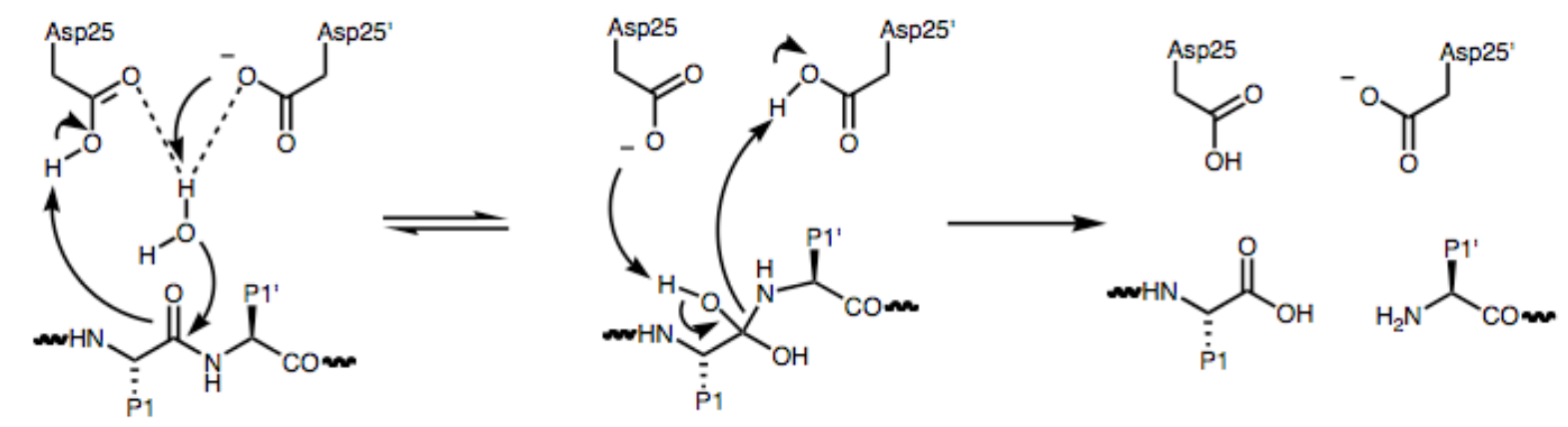
Aspartic acid proteases mechanism
What is the structural relationship between substrates and inhibitors?
isosteres: similar shape and electronic properties
Cysteine protease clans
papain superfamily (CA)
caspases (CD)
picornaviridae family (PA)
What kind of protease is calpain?
Cysteine proteases, specifically from Papain-like family
Cysteine proteases have functions in…(4)
Cell motility
Signal transduction pathways
Apoptosis
Regulation of gene expression
Active site groups of Cysteine proteases
Cystine, Histidine, asparagine
Cysteine protease action

How is calpain activated?
binding of Ca2+ brings cysteine and histidine close together
What does biotin protein ligase do (and mechanism)?
biotin + ATP → biotinoyl-AMP + PPi
biotinoyl-AMP + Lys-R → Biotin-CONH-R + AMP

Bergman cyclisation

identify the delivery agent, trigger, and warhead for calicheamicin
delivery agent: sugar that inserts into minor groove of DNA
trigger: trisulfide undergoes nucleophilic attack→ brings alkynes closer
warhead: enediyne that undergoes Bergman cyclization→ radical abstracts H from DNA
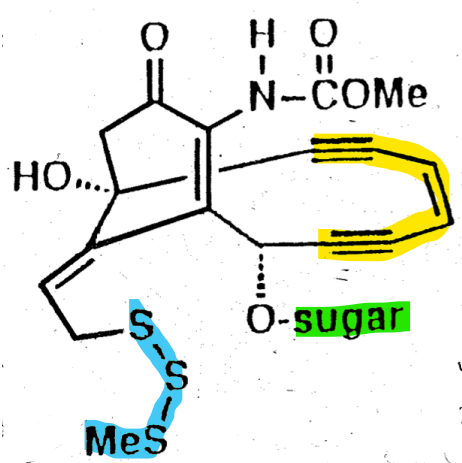
DNA strand cleavage initiated by enediyne


Where does an enediyne attack?

Activation of calicheamicin

process of mix and split synthesis
different peptides added to linker beads
all beads combined and then split up
an amino acid is added to every group
2 and 3 repeated
What can be used to keep track of the amino acids added in mix and split synthesis?
nucleotides (amplified by PCR)
Binary code (from electrophoric tag)