Dislocations and Strengthening
 Call Kai
 Learn
 Practice Test
 Spaced Repetition
 Match
 Flashcards
 Knowt Play
1/47

There's no tags or description
Looks like no tags are added yet.
48 Terms
One-sentence link between dislocations and strength?
Plastic deformation is the motion of large numbers of dislocations, so strength is increased by making dislocation motion difficult.
When does plastic deformation occur (bond picture)?
When bonds are permanently broken during increasing strain.

Define slip (as a deformation process).
Plastic deformation in which one plane of atoms slides over an adjacent plane by dislocation motion.

In which class of materials are dislocations observed primarily?
Metals and alloys
Along what, and in which direction, does a dislocation move?
Along the slip plane, in the slip direction.
How is the slip direction related to the Burgers vector?
The slip direction is the same direction as the Burgers vector.
How does an edge dislocation line move relative to the shear stress?
In the direction of the shear stress (parallel to it).

How does a screw dislocation line move relative to the shear stress?
Perpendicular to the stress direction.
Define slip plane.
The crystallographic plane along which the dislocation line travels.
Define slip direction.
The direction in which the dislocation moves.
Define slip system.
The combination of slip plane and slip direction; it is set by the crystal structure.
Which plane is the slip plane, and why?
The plane with the highest planar density (most densely packed), which also has the widest interplanar spacing, so it slips most easily (path of least resistance).

Which direction is the slip direction?
The direction of highest linear density in the slip plane.

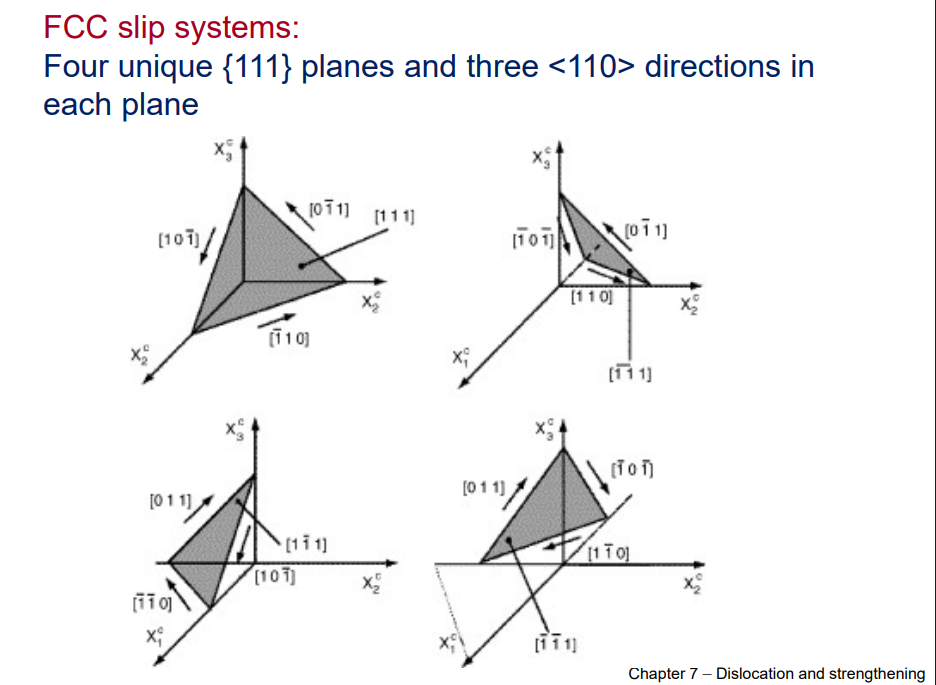
FCC slip system (plane family and direction family)?
{111} planes and ⟨110⟩ directions, both close-packed.
How many slip systems does FCC have, and why?
12: 4 unique {111} planes × 3 ⟨110⟩ directions in each.
Write the resolved shear stress equation.
τ_R = σ cos λ cos φ

In τ_R = σ cos λ cos φ, what is λ?
The angle between the applied force (tensile axis) and the slip direction.

n τ_R = σ cos λ cos φ, what is φ?
The angle between the applied force and the slip plane normal (n_s).
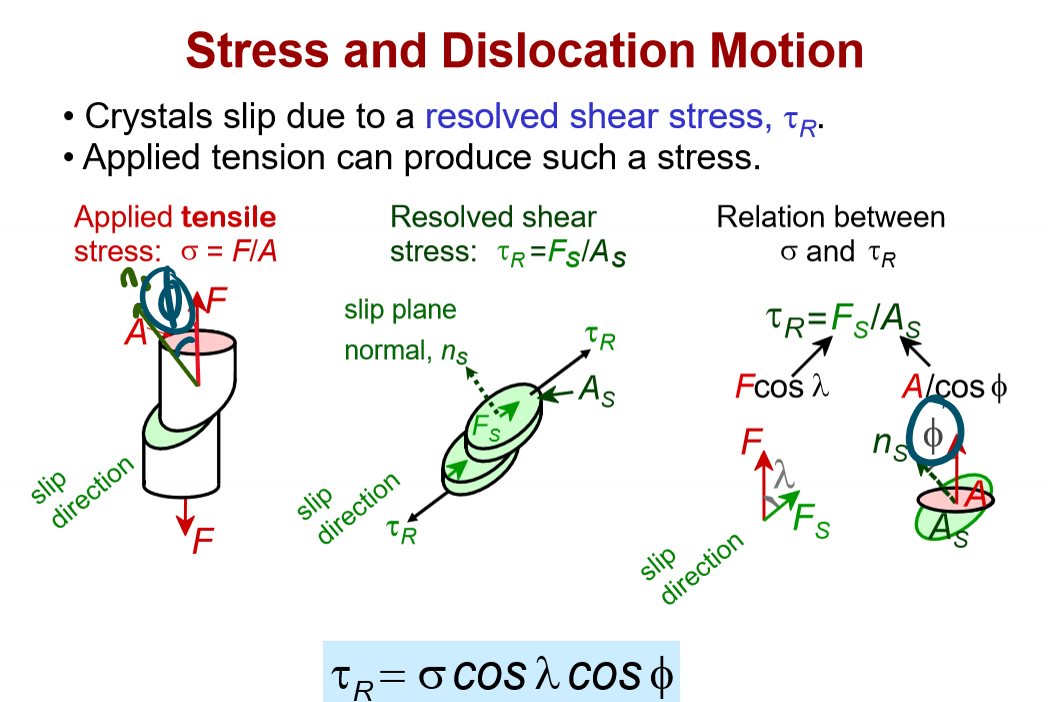
What kind of stress makes crystals slip?
A resolved shear stress τ_R on the slip plane in the slip direction (applied tension can produce one).

Condition for slip to start in a slip system?
τ_R > τ_CRSS (critical resolved shear stress).


τ_R when λ = 90°?
0, because cos 90° = 0 (force perpendicular to the slip direction).

τ_R when φ = 90°?
0, because cos 90° = 0 (force lies in the slip plane).
At what angles is τ_R maximum, and what is its value?
λ = φ = 45°, giving τ_R = σ/2.

Why does τ_R vary from grain to grain in a polycrystal?
Slip planes & directions (λ, φ) change from one crystal to another.
Which grain in a polycrystal yields first?
The grain with the largest τ_R (most favourably oriented); others yield later.
Why are polycrystals stronger than single crystals? (2 reasons)
Grain boundaries pin deformation, and each grain's deformation is constrained by its neighboring grains.
What happens to the grain structure when a polycrystalline metal is rolled?
The grains become elongated in the rolling direction.

Three ways slip is hindered in polycrystalline metals (strengthening methods)?
Reducing grain size;
solid solutions;
cold working.
Why are grain boundaries barriers to slip?
The slip plane changes orientation across the boundary, so a dislocation cannot simply continue into the next grain.
Barrier "strength“ increases with increasing angle of misorientation.
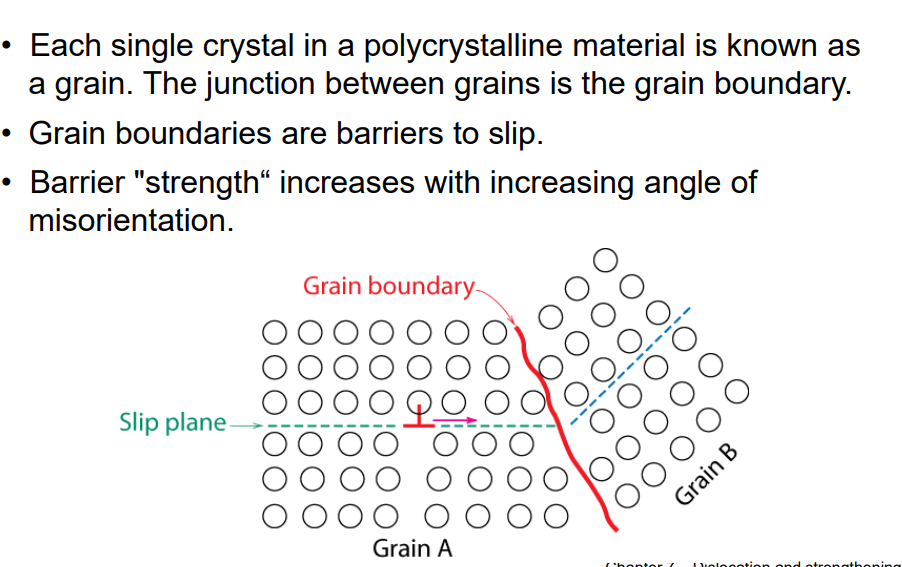
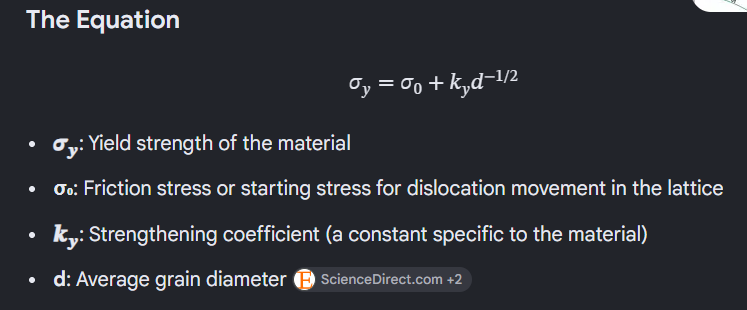
Why do smaller grains give a stronger metal?
more barriers to slip.

Write the Hall-Petch equation and define the terms.
How do impurity atoms strengthen a metal (in one line)?
Impurity atoms distort the lattice & generate stress.
Stress can produce a barrier to dislocation motion.
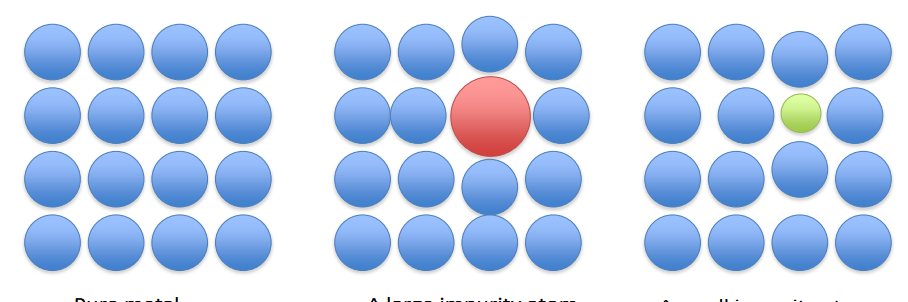
What strain does a large substitutional impurity create around itself? A small one?
Large: compressive strain (pushes neighbours out).
Small: tensile strain (pulls neighbours in).
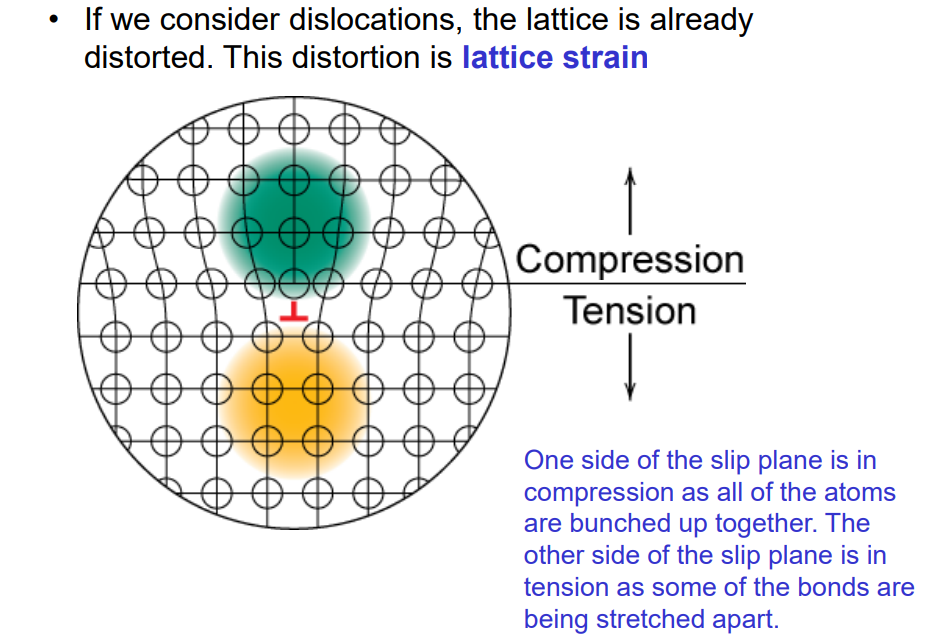
Where do large impurity atoms sit at an edge dislocation?
Large impurities concentrate at dislocations on low density side

Where do small impurity atoms sit at an edge dislocation?
On the compressed side, where atoms are bunched up (above the slip plane in the slide picture).

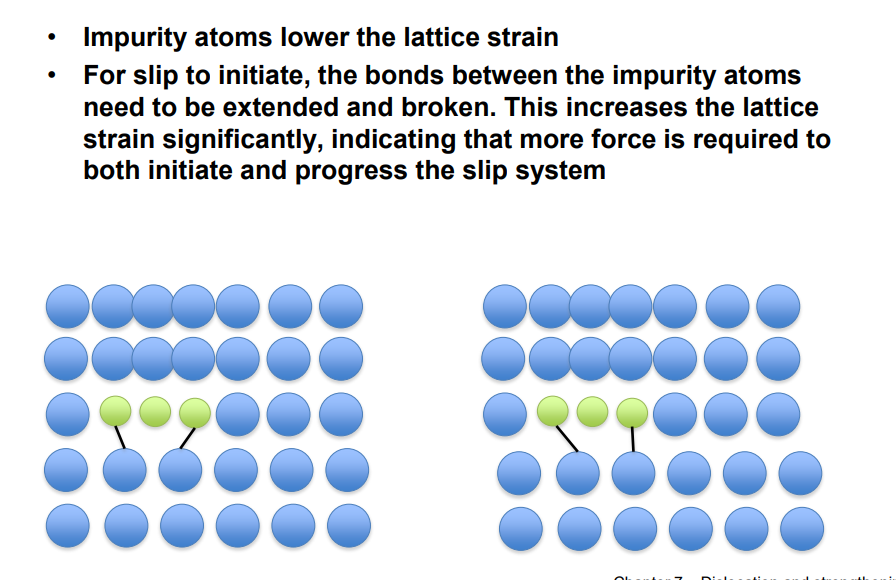
Why do impurity atoms at a dislocation reduce slip?
They lower the lattice strain, pinning the dislocation; to slip, the bonds to the impurities must be extended and broken, which raises lattice strain a lot, so more force is needed to start and continue slip.
Define dislocation density ρ_d and its units.
Total dislocation length per unit volume; mm/mm³ = mm⁻².
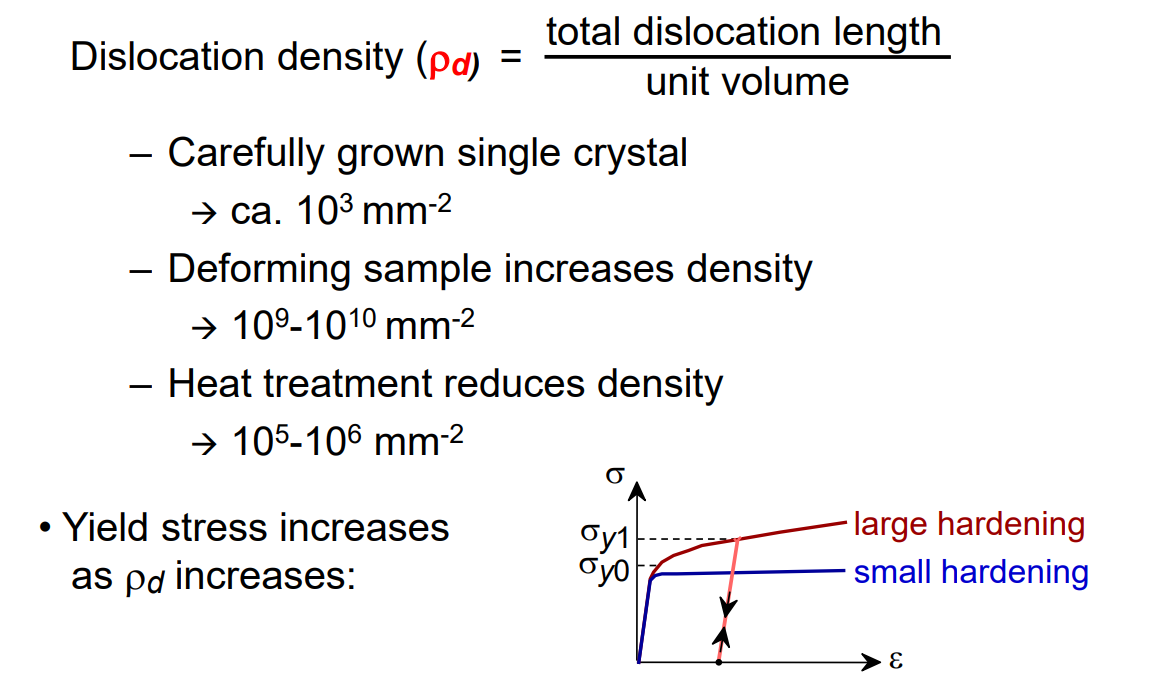
Define cold working (strain hardening).
Plastically deforming a metal at room temperature (below T_R), which increases its strength.
Why does cold work increase strength?
The number of dislocations increases after cold working.
As the dislocation density increases, the chances of dislocations being closer to one another increases.
Dislocations can repulse or cancel out one another.

As %CW increases, what happens to σ_y(yield strength), TS and ductility?
σ_y increases, TS increases, ductility (%EL or %AR) decreases.

%CW for a round bar in terms of diameters?
%CW = (D_0² − D_d²)/D_0² × 100 (π cancels). Use squared diameters, not diameters.

What does annealing a cold-worked metal do to strength and ductility?
Reverses cold work: strength decreases, ductility increases.

Name the 3 annealing stages in order.
Recovery, recrystallisation, grain growth.

What happens during recovery?
Thermal energy allows diffusion, which reduces the number of dislocations and removes some lattice strain.
What happens during recrystallisation?
Annealing at elevated temperature allows atoms to move and form new crystals.
These new crystal grains are small, relatively defect free and consume cold worked grains that possess a high dislocation density.

How can recrystallisation refine grain structure?
Cold work then recrystallise: the new grains are small, giving a fine grain size.
Define recrystallisation temperature T_R.
temperature at which recrystallization is complete within 1 h

What happens during grain growth and why?
At longer times, larger grains consume smaller ones.
Why? Grain boundary area (and therefore energy) is reduced
