embryo exam 3 complete
 Call Kai
 Learn
 Practice Test
 Spaced Repetition
 Match
 Flashcards
 Knowt Play
1/128

There's no tags or description
Looks like no tags are added yet.
129 Terms
the paraxial mesoderm will become what
Dermis of skin, bone and cartilage
The somatic lateral mesoderm will become what
Parietal pleura, arm and leg soft tissue
the visceral lateral mesoderm will become
Muscle wall of gut, heart and part of blood vessel wall
The intermediate mesoderm will become what
Adrenal glands and parts of they kidney and gonad
What is the purpose of neurulation
to form the future brain and spinal cord (CNS)
what are the main two actions at the neural tube
cell communication and cell movement
what causes the overlaying ectoderm to undergo cellular and molecular changes
mesoderm
neural plate cell actions
cells increase their rate of mitosis, cells being to activate new mRNA segments producing new proteins, cells begin to exhibit varying shape and behaviors to form new body structures
What does the myelencephalon form
medulla oblongata
What does the metencephalon form
pons and cerebellum
what does the telencephalon form
cerebral hemispheres
what does the mesencephalon form
midbrain
what does the diencephalon form
thalamus and hypothalamus
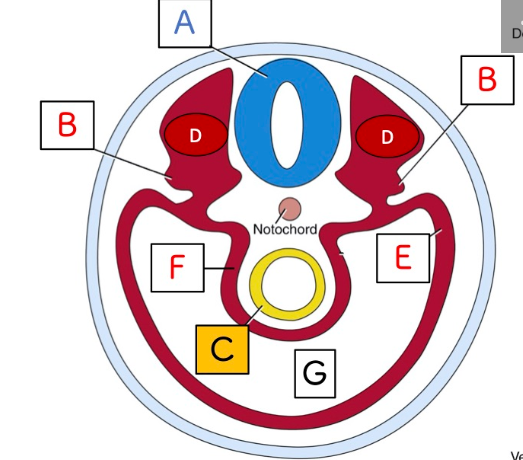
A
Neural tube

B
intermediate mesoderm

C
gut

D
somite
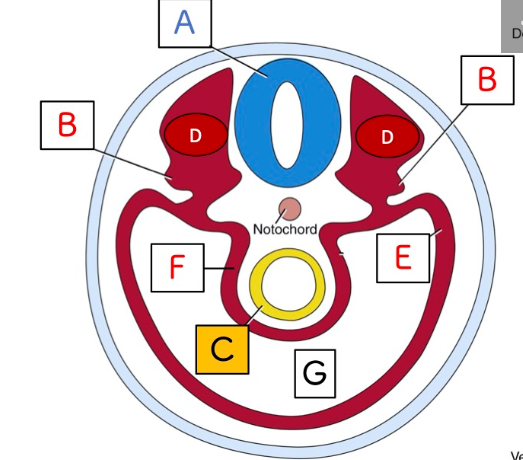
E
somatic mesoderm

F
visceral mesoderm

G
coelom

what view is this?
cross sectional
Where is the pontine flexure located?
Between the two hindbrain vesicles, metencephalon and myelencephalon
Where is the cranial (cephalic) flexure located?
at or within the midbrain (mesencephalon)
Where is the cervical flexure located?
between the hindbrain and spinal cord
What process forms the 3 primary brain vesicles?
primary neurulation, during weeks 3-4 of gestation
what process is associated with formation of 5 secondary brain vesicles
secondary neurulation, during weeks
What embryonic structure gives rise to the retina
the eye cup, which develops within the diencephalon
name the 3 primary brain vesicles
prosencephalon (forebrain), mesencephalon (midbrain), and rhombencephalon (hindbrain)
What are the 5 secondary brain vesicles
telencephalon, diencephalon, mesencephalon, metencephalon, and myelencephalon
What are the three sections of a somite
dermatome, myotome, and sclerotome
what does the dermatome become
the dermis of the skin
what does the myotome become
muscle
what does the sclerotome become
bone and cartilage
How do somites develop
three at a time, paired on either side of the notochord
What forms first in the neurulation sequence
the primitive streak and groove
what forms after the primitive streak and groove
the primitive node and pit
What does the notochord release during neurulation
SHH (sonic hedgehog)
What froms after the notochord/axial mesoderm step?
the neural plate replaces the primitive streak
What happens as neural folds develop
the form, increase in size and push upward
What occurs after the neural folds push upward
neural hinging
What happens when the neural folds meet
the fuse to form the neural tube
what happens to neural crest cells during neurulation
they detach from the tube and become wandering mesenchymal cells
which hinge point occurs first
the median hinge point
which hinge point helps close the neural folds into a tube
the lateral hinge point
which neuropore closes last
the posterior neuropore
name of the remaining yolk stalk
Meckel’s diverticulum
Which nervous system includes cranial and peripheral nerves
PNS
which germ layer forms the epithelial lining of the gut
endoderm
which germ layer forms the gallbladder
endoderm
which germ layer forms the epidermis
ectoderm
which germ layer forms the thymus
endoderm
What germ layer forms hair, nails, and sweat glands?
ectoderm
what germ layer forms inner ear structures
ectoderm
What germ layer forms the respiratory tracts epithelial lining
endoderm
which germ layer forms the lens and cornea of the eye
ectoderm
which germ layer is associated with thyroid development
endoderm
which germ layer forms mammary glands
ectoderm
what is columnarization
cells themselves elongate
what is convergent extension
cells replicate and shift forward
what is apical constriction
top or superficial surface of a cell narrows
what is cellular crawling
cells move into position
what is another name for the forebrain
prosencephalon
what is another name for the midbrain
mesencephalon
what is another name for the hindbrain
rhombencephalon
what two vesicles develop from the prosencephalon
telencephalon and diencephalon
what happens to the mesencephalon
it remains the mesencephalon and does not subdivide further
what two vesicles develop from the rhombencephalon
metencephalon and mylencephalon
what are the three initial types of mesoderm
paraxial mesoderm, intermediate mesoderm, and lateral plate mesoderm
wat is the relationship between paraxial mesoderm and somites
somites develop from paraxial mesoderm
what two layers form the oral plate at week 4
endoderm and ectoderm
what week does the anal opening form
7
what shape does the developing endoderm form during body development
a tube
what are the three regions of the gut tube
foregut, midgut, hindgut
where is the midgut positioned in relation to the yolk sac/stalk
at the yolk sac/stalk
which cells pass through the primate groove during the node sequence
cells travel crainally to contribute to the perchordal plate and notochord
What do cells at the cranial end of the neural plate do
they proliferate, causing the plate to elongate
what germ layer is related to the neural plate process
ectoderm
What two planes does the embryo fold on
Median plane and horizontal plane.
Where do the embryo's ectodermal layers meet during body folding
At the ventral surface.
What happens when the ectodermal and mesodermal tissue meet
They fuse.
Which pharyngeal arch forms the malleus and incus
Arch I.
Which pharyngeal arch forms most of the laryngeal cartilage
Arch IV.
Which pharyngeal arch divides into maxillary and mandibular processes
Arch I.
Which arches form the lesser horns of the hyoid bone
Arches II and III, according to the quiz key.
Which pharyngeal arch forms the stapes
Arch II.
Which pharyngeal arch forms the carotid arteries
Arch III.
Which pharyngeal arch forms the skin of the upper/lower lips and cheeks
Arch I.
Which process forms the malleus and incus
Mandibular process.
Which process gives rise to the parotid salivary glands
Maxillary process.
Which process forms the sublingual and submandibular glands
Mandibular process.
Which process forms the zygomatic bone, palate, vomer, and parts of temporal bones
Maxillary process.
Which process forms the enamel of the lower-jaw teeth
Mandibular process.
Which process contributes to portions of the tongue
Mandibular process.
Which process is associated with Meckel's cartilage
Mandibular process.
Which pharyngeal pouch forms the ultimobranchial bodies and part of the parathyroid structures
Pouch IV.
Which pharyngeal pouch forms the thymus and parathyroid glands
Pouch III.
Which pharyngeal pouch forms the palatine tonsils
Pouch II.
Which pharyngeal pouch forms the Eustachian tube and part of the eardrum
Pouch I.
What does rupture of the oral plate create
The mouth orifice.