Oral Bio Exam 4 - Virology III: Viruses with Oral Manifestations (HPV, Coxsackievirus, MMR)
 Call Kai
 Learn
 Practice Test
 Spaced Repetition
 Match
 Flashcards
 Knowt Play
1/201

There's no tags or description
Looks like no tags are added yet.
202 Terms
What is the most common sexually transmitted infection in the US
Human Papillomaviruses (HPV)
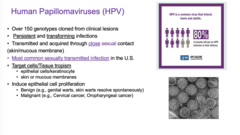
HPV has over ______ genotypes cloned from clinical lesions
Over 150 genotypes

TRUE/FALSE
HPV are acute and transforming infections
FALSE
HPV are persistent and transforming infections

How is HPV transmitted and acquired?
Transmitted and acquired through close sexual contact (skin/mucous membrane)
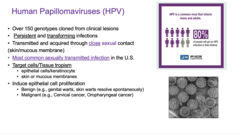
What are the target cells/tissue tropism of HPV?
- Epithelial cells/keratinocyte
- Skin or mucous membranes

HPV induces epithelial cell _______________
Proliferation
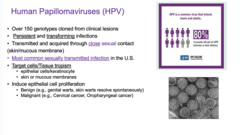
What are the two types of epithelial cell proliferation in HPV?
1. Benign (e.g., genital warts, skin warts resolve spontaneously)
2. Malignant (e.g., Cervical cancer, Oropharyngeal cancer)
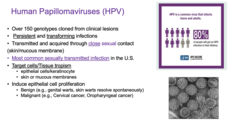
HPVs are very successful infectious agents. They induce ___________ infections that have virtually no systemic sequelae, rarely _____ the host, and periodically ________ large amounts of infectious virus, over weeks and months, for transmission to naive individuals.
- Chronic
- Kill
- Shed
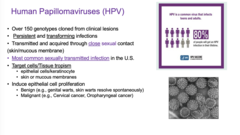
HPV can be passed from one person to another by _______-____-_______ _____________, such as occurs with ___________ activity including vaginal, anal, and oral sex
- Skin-to-skin contact
- Sexual activity

TRUE/FALSE
HPV can be spread even when an infected person has no visible signs or symptoms
TRUE

TRUE/FALSE
HPV is so common that nearly all men and women get it at some point in their lives
TRUE

*Don't need to know*
Is the virion of HPV enveloped or non-enveloped?
Non-enveloped

*Don't need to know*
What is the symmetry of HPV?
Icosahedron

*Don't need to know*
What is the genome of the virion of HPV?
ds DNA

*Don't need to know*
TRUE/FALSE
Virion of HPV is a non-enveloped icosahedron with ds DNA
TRUE

TRUE/FALSE
The virion of HPV is susceptible to acid, ether, and heat
FALSE
The virion of HPV is stable to acid, ether, and heat
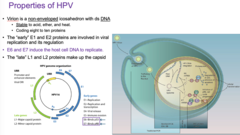
The virion of HPV codes ____ to ____ proteins
8 to 10 proteins
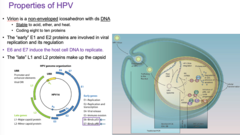
In HPV, the "early" ____ and ____ proteins are involved in viral replication and its regulation
E1 and E2 proteins

In HPV, ____ and ____ induce the host cell DNA to replicate.
E6 and E7

E6 binds _______
E7 binds _______
Results in the overriding of cell cycle checkpoints and allows for viral DNA replication in noncycling cells
- E6 binds p53
- E7 binds pRB (Retinoblastoma)

In HPV, the "late" ____ and ____ proteins make up the capsid
L1 and L2

The _____________ _____ _________ are different levels of viral permissiveness and replication
Epithelial cell layers

Which epithelial cell layer(s) is characterized by:
Infection occurs following abrasions and exposure of basement membrane/basal cells.
Basal cells
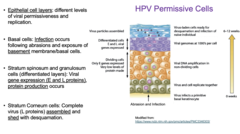
Which epithelial cell layer(s) is characterized by:
Viral gene expression (E and L proteins), protein production occurs
Stratum spinosum and granulosum cells (differentiated layers)

Which epithelial cell layer(s) is characterized by:
Complete virus (L proteins) assembled and shed with desquamation.
Stratum Corneum cells

What 4 HPV are involved in mucosal infections?
1. HPV 6
2. HPV 11
3. HPV 16
4. HPV 18

HPV 6 and HPV 11 have a _____ risk for malignant conversion
Low risk

*Know this for sure*
HPV 16 and HPV 18 have a _______ risk for malignant conversion
High risk

What 5 HPV are involved in cutaneous infections?
1. HPV 1
2. HPV 2
3. HPV 3
4. HPV 4
5. HPV 10

Are HPV 1, HPV 2, HPV 3, HPV 4, and HPV 10 benign or malignant?
Benign

HPV is incorporated in the basal layer and affects the _____________ cells and results in the skin ______ or ________________
- Maturing cells
- Skin wart
- Papilloma

TRUE/FALSE
All HPVs have a short incubation period
FALSE
All HPVs have a long incubation period from weeks to years

What are the 3 types of benign HPV-induced Cutaneous Lesions?
1. Common (Hand) warts
2. Plantar warts
3. Flat/plane warts

Which benign HPV-induced cutaneous lesion is:
- Found on finger, palm, nail bed
- Raised papillomas with a rough surface
Don't need to know:
- Caused by HPV Type 2/4 (Don't need to know)
Common (Hand) warts

Which benign HPV-induced cutaneous lesion is:
- Can be readily picked up from the wet floors of public swimming pools and bathrooms
- Painful deep warts found on the weight-bearing regions of the heel and sole of the foot
Don't need to know:
- Caused by HPV Type 1 (Don't need to know)
Plantar Warts

Which benign HPV-induced cutaneous lesion is:
- Found on arms, face, knees of youngsters
- Smaller, flatter, smoother, and more numerous warts
Don't need to know:
- Caused by HPV Type 3/10 (Don't need to know)
Flat/Plane warts

Perhaps 10% of all schoolchildren and young adults experience a crop of warts on the skin, probably acquired in the course of close contact recreational activities. Generally, warts regress within two years due to effective ___ _______ ______________ immune response.
T cell mediated immune response

TRUE/FALSE
7.5% of healthy population has detectable non-malignant HPV
TRUE

What are the 5 types of Benign Oral HPV lesions
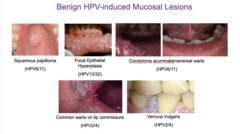
1. Squamous Papilloma
2. Verruca vulgaris
3. Focal Epithelial Hyperplasia (Heck's disease)
4. Condyloma acuminata/venereal warts
5. Laryngeal papillomas
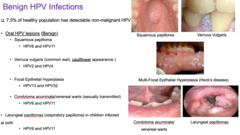
Which benign oral HPV lesion is described as a common wart and a cauliflower appearance?
Verruca vulgaris

Which benign oral HPV lesion is sexually transmitted?
Condyloma acuminata/venereal warts

Which benign oral HPV lesion is a respiratory papilloma in children infected at birth?
Laryngeal papillomas

*Don't need to know*
What 2 HPV causes Squamous Papilloma?
HPV 6 and HPV 11
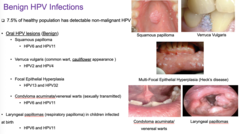
*Don't need to know*
What 2 HPV causes Verruca vulgaris?
HPV 2 and HPV 4

*Don't need to know*
What 2 HPV causes Focal Epithelial Hyperplasia?
HPV 13 and HPV 32

*Don't need to know*
What 2 HPV causes Condyloma acuminata/venereal warts?
HPV 6 and HPV 11

*Don't need to know*
What 2 HPV causes Laryngeal papillomas?
HPV 6 and HPV 11
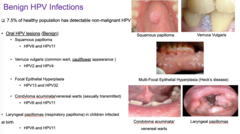
Benign HPV-induced Mucosal Lesions (Just a photo)
What are the 2 types of HPV-Associated Cancers?
1. Oropharyngeal cancers
2. Anogenital cancers
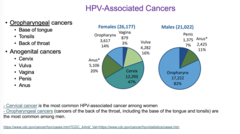
What 3 places can Oropharyngeal cancers be found?
1. Base of tongue
2. Tonsils
3. Back of throat

What 5 places can Anogenital cancers be found?
1. Cervix
2. Vulva
3. Vagina
4. Penis
5. Anus

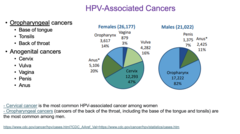
Which cancer is the most common cancer HPV-associated cancer in women?
Which cancer is the most common HPV-associated cancer in men?
- Women: Cervical cancer
- Men: Oropharyngeal cancer

TRUE/FALSE
Oropharyngeal cancer cases has taken over cervical cancer cases in recent years
TRUE
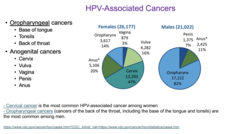
Female genital mucosa has a ______________ HPV viral load compared with males and could partly explain the high rates seen in males
Higher
What are the 2 subgroups of oral cancer?
1. HPV positive (~70%)
2. HPV negative (~30%)

HPV positive oral cancer is localized to _______________
Oropharynx

Do HPV positive oral cancers tend to occur in older or younger individuals?
Younger individuals

HPV positive oral cancers have a _________ prognosis (usually _________ for ___/___ tumor suppressors)
- Better prognosis
- Positive for p53/p16 tumor suppressors

How is HPV positive oral cancer transmitted?
Which HPV causes it?
Sexually transmitted HPV 16/18

HPV positive oral cancer has increased incidence by 225% between 1988-2004 likely due to changes in human ___________ behavior
Human sexual behavior

HPV negative oral cancers are generally associated with ___________ use of alcohol and tobacco
Prolonged use

HPV negative oral cancers have a 5-year survival rate = 50% (often __________ for ___/___ tumor suppressors
Negative for p53/p16 tumor suppressors

TRUE/FALSE
- HPV negative oral cancers had an increase incidence by 225% between 1988-2004
- HPV positive oral cancers had a decreased incidence by 50% between 1988-2004
FALSE
- HPV positive oral cancers had an increase incidence by 225% between 1988-2004
- HPV negative oral cancers had a decreased incidence by 50% between 1988-2004

HPV is thought to cause ____% of oropharyngeal cancers in the United States. Changes in human ___________ behavior over the past 50 years may account for this rise in HPV positive oral cancer incidence.
- 70%
- Sexual behavior

Oropharyngeal cancers are located:
- Base of the ___________
- Back of the ___________
- The __________ and _____________
- Base of the tongue
- Back of the throat
- The tonsils and pillars
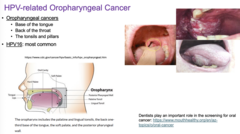
Which HPV is the most common in oropharyngeal cancers?
HPV 16

Who is at risk for getting Genital HPV?
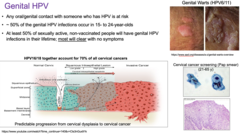
Any oral/genital contact with someone who has HPV is at risk
TRUE/FALSE
~ 50% of the genital HPV infections occur in 15- to 24-year-olds
TRUE

TRUE/FALSE
At least 50% of sexually active, non-vaccinated people will have genital HPV infections in their lifetime; most will not clear with many symptoms
FALSE
At least 50% of sexually active, non-vaccinated people will have genital HPV infections in their lifetime; most will clear with no symptoms

HPV ___/___ together account for 70% of all cervical cancers
HPV 16/18

Which HPV causes genital warts?
HPV 6/11

TRUE/FALSE
Genital warts are life threatening
FALSE
Genital warts are not life threatening but they can cause emotional stress and their treatment can be very uncomfortable.

____________ usage reduces but does not eliminate transmission of genital warts. Safe sex practices when undertaken to reduce HIV and other STDs, do bring the additional benefit of reducing genital HPV infection.
Condom usage

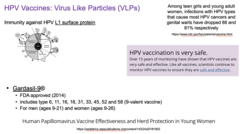
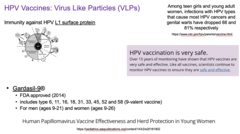
_______________ _____________ are multiprotein structures that mimic the organization and conformation of authentic native viruses but lack the viral genome, potentially yielding safer and cheaper vaccine candidates.
Virus-like particles (VLPs)
TRUE/FALSE
HPV Vaccines utilize Virus-Like Particles (VLPs)
TRUE

HPV Vaccines (Virus-like Particles) have immunity against HPV ____ __________ protein
HPV L1 surface protein

TRUE/FALSE
Among teen girls and young adult women, infections with HPV types that cause most HPV cancers and genital warts have dropped 88 and 81% respectively
TRUE

TRUE/FALSE
HPV vaccination is very risky, dangerous, and ineffective
FALSE
- HPV vaccination is very safe
- Over 15 years of monitoring have shown that HPV vaccines are very safe and effective. Like all vaccines, scientists continue to monitor HPV vaccines to ensure they are safe and effective

What HPV vaccine is:
- FDA approved (2014)
- Includes type 6, 11, 16, 18, 31, 33, 45, 52 and 58 (9-valent vaccine)
- For men (ages 9-21) and women (ages 9-26)
Gardasil-9®
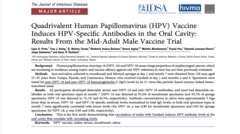
Vaccination of males with Gardasil induces HPV antibody levels at the ________ _________ that correlates with circulating levels
Oral cavity
HPV vaccination is the best protection (>90%) against __ types of cancers.
6 types of cancer

What are the 2 barriers of HPV vaccination among males?
1. A "lack of perceived benefit"
2. Little public knowledge regarding the connection between HPV and oral cancer

TRUE/FALSE
Parents assume their children do not need HPV vaccine until they are sexually active, and parents are concerned that vaccination will encourage sexual behavior and therefore choose not to vaccinate
TRUE

TRUE/FALSE
Vaccination is highly recommended for everyone older than age 26 years.
FALSE
Vaccination is not recommended for everyone older than age 26 years.

Why is the HPV vaccine not recommended to everyone older than 26?
HPV vaccination of people in this age range provides less benefit, for several reasons, including that more people in this age range have already been exposed to HPV

What ages are routine HPV vaccination usually done?
Age 11-12 years; can be started at age 9 years

What ages are catch-up HPV vaccinations usually done?
Age 13-26 years if not adequately vaccinated

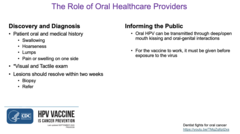
What are the 3 roles of oral healthcare providers in terms of discovery and diagnosis of HPV?
1. Patient oral and medical history
- Swallowing
- Hoarseness
- Lumps
- Pain or swelling on one side
2. Visual and Tactile exam
3. Lesions should resolve within two weeks. If not, then:
- Biopsy
- Refer

What are the 2 points that oral healthcare providers make to inform the public about HPV?
1. Oral HPV can be transmitted through deep/open mouth kissing and oral-genital interactions
2. For the vaccine to work, it must be given before exposure to the virus
*Don't need to know*
The Nobel Prize in Physiology or Medicine 2008 was divided, one half awarded to Harald zur Hausen "for his discovery of _______ _________ viruses causing ________ cancer", the other half jointly to Françoise Barré-Sinoussi and Luc Montagnier "for their discovery of human immunodeficiency virus."
- Human papilloma viruses
- Cervical cancer

Picorna virus is also know as __________________
Coxsackievirus

TRUE/FALSE
The virus family was given the name Coxsackie based on Coxsackie, NY, a small town on the Hudson River where the first fecal specimens containing the virus were collected.
TRUE

*Don't need to know*
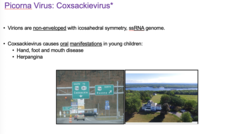
Are Coxsackievirus virions enveloped or non-enveloped?
Non-enveloped

*Don't need to know*
What is the symmetry of Coxsackievirus virions?
Icosahedral symmetry
*Don't need to know*
What is the genome of Coxsackievirus virions?
ssRNA genome

*Don't need to know*
TRUE/FALSE
Coxsackievirus virions are non-enveloped with icosahedral symmetry, ssRNA genome.
TRUE

Coxsackievirus causes _____ manifestations in young children
Oral manifestations

What 2 oral manifestations does Coxsackievirus cause?
1. Hand, foot, and mouth disease
2. Herpangina

The _______________ comprises one of the largest families of viruses. _____________ is one of the most studied viruses under this family.
- Picornaviridae
- Poliovirus

*Don't need to know*
TRUE/FALSE
Coxsackieviruses A9, A16 and Enterovirus 71 cause Hand, Foot, and Mouth Disease
TRUE
