Hole's Human Anatomy & Physiology - Chapter 10: Nervous System I
 Call Kai
 Learn
 Practice Test
 Spaced Repetition
 Match
 Flashcards
 Knowt Play
1/77

Earn XP
Description and Tags
Comprehensive practice flashcards defining anatomical, physiological, histological, and neurochemical terms from Chapter 10 (Nervous System I) of Hole's Human Anatomy & Physiology.
78 Terms
Sensory Function
The nervous system function that receives information from internal or external environments; specialized sensory receptor cells detect changes and convert sensations into neural impulses carried to the CNS.
Integrative Function
The central nervous system process of coordinating and interpreting sensory information to create sensations, thoughts, memory, and make decisions.
Motor Function
The nervous system function that acts upon decisions by carrying neural impulses from the CNS via peripheral nerves to effectors, such as muscles or glands.
Central Nervous System (CNS)
The division of the nervous system composed exclusively of the brain and the spinal cord.
Peripheral Nervous System (PNS)
The division of the nervous system consisting of cranial nerves and spinal nerves that connect the CNS to the rest of the body.
Sensory Division
The subdivision of the PNS that uses sensory receptors to detect environmental changes and conduct impulses toward the CNS.
Motor Division
The subdivision of the PNS in which neurons transmit impulses from the CNS outward to effectors; divided into somatic and autonomic subdivisions.
Somatic Nervous System
The subdivision of the motor PNS that transmits voluntary instructions to skeletal muscles.
Autonomic Nervous System
The subdivision of the motor PNS that transmits involuntary instructions to effectors, including viscera, smooth muscle, cardiac muscle, and glands.
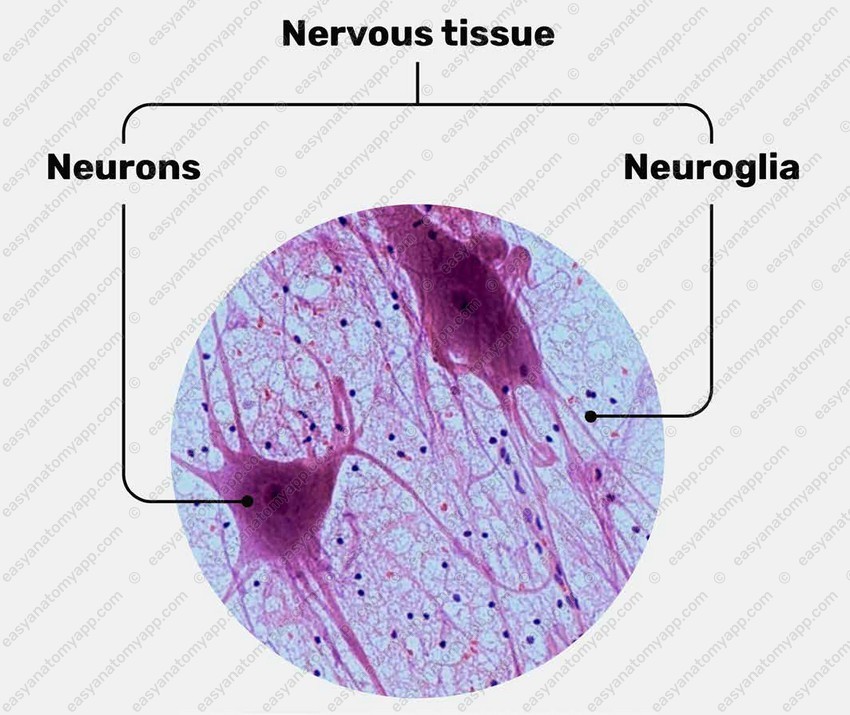
Neuron
The specialized, impulse-conducting functional cell type of the nervous system, typically consisting of a cell body, dendrites, and an axon.
Neuroglial Cells (Neuroglia)
Non-conducting nervous tissue cells that provide physical support, nourishment, protection, and maintenance for neurons.
Cell Body (Soma / Perikaryon)
The central region of a neuron containing the cytoplasm, organelles, nucleus, a large nucleolus, neurofibrils, and chromatophilic substance.
Neurofibrils
A network of fine filaments extending throughout the neuron cell body and into the axon to provide structural support.
Chromatophilic Substance (Nissl Bodies)
Specialized membranous packets of rough endoplasmic reticulum located within the neuron cell body responsible for synthesizing proteins, including neurotransmitters.
Dendrites
Highly branched, receptive cellular extensions of a neuron specialized to receive electrochemical signals from other neurons or receptors and carry them toward the cell body.
Axon
A long, single cellular process that originates from the axon hillock and conducts impulses away from the neuron cell body to target cells or effectors.
Axon Hillock
The conical elevation of the neuron cell body from which the axon originates and where action potentials are typically initiated (trigger zone).
Synaptic Knob
The expanded distal terminal of an axon that contains membrane-bound synaptic vesicles filled with neurotransmitter molecules.
Myelin Sheath
A multilayered, lipid- and protein-rich coating produced by neuroglia that wraps tightly around axons to insulate them and increase impulse conduction velocity.
Neurilemma
The outermost nucleated cytoplasmic layer of a Schwann cell surrounding the myelin sheath in peripheral nerve fibers.
Nodes of Ranvier
Narrow gaps in the myelin sheath along the axon between adjacent Schwann cells or oligodendrocytes where ion channels are concentrated.
White Matter
Nervous tissue characterized by dense groupings of myelinated axons, giving it a distinctive pale, glistening appearance.
Gray Matter
Nervous tissue containing unmyelinated structures, including neuron cell bodies, dendrites, and unmyelinated axons.
Bipolar Neuron
A structural class of neuron possessing only two cellular processes (one dendrite and one axon) emerging from opposite ends of the cell body; found in sensory organs like the eyes, nose, and ears.
Unipolar Neuron
A structural class of neuron with a single process that divides into two branches (peripheral process and central process) functioning together as an axon; cell bodies reside in PNS ganglia.
Multipolar Neuron
A structural class of neuron characterized by many processes (a single axon and numerous dendrites); the most common type found within the CNS.
Sensory (Afferent) Neuron
A functional class of neuron that conducts nerve impulses from peripheral sensory receptors into the brain or spinal cord; predominantly unipolar with some bipolar types.
Interneuron
A multipolar neuron located entirely within the brain or spinal cord that links, integrates, and transfers information between other neurons.
Motor (Efferent) Neuron
A multipolar neuron that conducts nerve impulses away from the brain or spinal cord to effectors such as muscles or glands.
Astrocytes
Star-shaped CNS neuroglia positioned between neurons and blood vessels that provide structural support, form scar tissue, form the blood-brain barrier, regulate extracellular ions and neurotransmitters, and induce synapse formation.
Oligodendrocytes
CNS neuroglial cells with few cellular processes arranged in rows along axons that produce myelin sheaths and nerve growth factors within the brain and spinal cord.
Microglia
Small CNS neuroglia with few processes that provide structural support and act as phagocytes to clear cellular debris and microorganisms (immune protection).
Ependyma (Ependymal Cells)
Cuboidal or columnar ciliated CNS neuroglia that form a porous epithelial lining in the brain ventricles and the central canal of the spinal cord, allowing diffusion between interstitial fluid and cerebrospinal fluid.
Schwann Cells
PNS neuroglial cells with lipid-rich membranes that wrap around peripheral axons to form the myelin sheath, clear excess ions and neurotransmitters, and support PNS axonal regeneration.
Satellite Cells
Small, cuboidal PNS neuroglial cells that surround and support neuron cell bodies clustered within ganglia while regulating ion and neurotransmitter levels.
Multiple Sclerosis (MS)
A CNS autoimmune disorder in which the immune system destroys myelin sheaths, leaving hardened scars (scleroses) that obstruct neural impulses and cause muscle weakness or atrophy.
Tay-Sachs Disease
A genetic condition caused by an inherited deficiency of a lysosomal enzyme needed to degrade myelin, leading to an excess accumulation of myelin that impairs nerve impulse transmission.
Myasthenia Gravis
An autoimmune disorder characterized by the progressive destruction of acetylcholine receptors at neuromuscular junctions, causing muscle weakness.
Resting Membrane Potential (RMP)
The electrical potential difference across the plasma membrane of an unstimulated, polarized neuron, typically measuring −70mV with a negative interior relative to the exterior.
Sodium/Potassium (Na+/K+) Pump
An active transport membrane protein that maintains the resting potential gradient by expelling three Na+ ions from the intracellular fluid for every two K+ ions it imports.
Threshold Potential
The critical membrane potential level (approximately −55mV) that must be reached by local depolarizing graded potentials to open voltage-gated Na+ channels and initiate an action potential.
Depolarization
The phase of an action potential triggered when threshold is reached, during which voltage-gated Na+ channels open and Na+ rapidly enters the cell, shifting the membrane potential toward positive values.
Repolarization
The phase following peak action potential when voltage-gated Na+ channels inactivate and voltage-gated K+ channels open, allowing K+ to diffuse out and restore the negative interior resting charge.
Hyperpolarization
A brief overshoot at the end of repolarization where excess K+ efflux causes the membrane potential to drop momentarily below the resting potential of −70mV.
All-or-None Response
The physiological principle stating that if a neuron axon responds to stimulation, it conducts a complete action potential of maximal and uniform strength; stronger stimuli increase impulse frequency rather than impulse magnitude.
Absolute Refractory Period
The interval during an action potential when voltage-gated Na+ channels are fully open or inactivated, making it impossible for any subsequent stimulus to trigger another action potential.
Relative Refractory Period
The period during repolarization when K+ channels are open and resting permeability is returning, during which only a stimulus of greater-than-threshold intensity can initiate a second action potential.
Saltatory Conduction
The rapid form of action potential propagation along myelinated axons in which the bioelectric current jumps from one Node of Ranvier to the next.
Synapse
The functional junction between the axonal terminal of a presynaptic neuron and the receptive surface of a postsynaptic neuron or effector across which communication occurs.
Synaptic Cleft
The narrow extracellular fluid-filled space separating the presynaptic membrane and the postsynaptic membrane at a chemical synapse.
Excitatory Postsynaptic Potential (EPSP)
A graded, local depolarization of a postsynaptic membrane produced by the opening of chemically gated ion channels that brings the membrane closer to threshold and makes an action potential more likely.
Inhibitory Postsynaptic Potential (IPSP)
A graded, local hyperpolarization of a postsynaptic membrane that drives the membrane potential farther away from threshold, decreasing the probability of an action potential.
Summation
The integration and arithmetic combining of multiple excitatory (EPSP) and inhibitory (IPSP) synaptic potentials at the trigger zone (axon hillock) of a postsynaptic neuron.
Acetylcholine
A neurotransmitter that controls skeletal muscle actions in the CNS and stimulates skeletal muscle contraction at neuromuscular junctions in the PNS, while exciting or inhibiting autonomic synapses.
Norepinephrine
A biogenic amine neurotransmitter that creates a sense of well-being in the CNS (low levels are linked to depression) and excites or inhibits autonomic actions in the PNS depending on receptors.
Dopamine
A biogenic amine neurotransmitter in the CNS that generates a sense of well-being, whose deficiency in specific brain areas is associated with Parkinson disease.
Serotonin
A primarily inhibitory biogenic amine neurotransmitter in the CNS that induces sleepiness; its action is blocked by LSD and enhanced by selective serotonin reuptake inhibitor (SSRI) antidepressants.
Histamine
A biogenic amine neurotransmitter whose release by neurons in the hypothalamus promotes alertness.
Neuromodulators
Substances, such as neuropeptides, that alter a postsynaptic neuron's response to a neurotransmitter or modulate the release of a neurotransmitter from presynaptic knobs.
Enkephalins and Endorphins
Neuropeptides produced by the brain and spinal cord that act as natural pain-relieving agents and mood elevators, binding to the same receptors targeted by opiates.
Substance P
A neuropeptide that functions as a neurotransmitter/neuromodulator primarily involved in transmitting pain sensations into the spinal cord and brain.
Neuronal Pools
Interconnected groups of interneurons within the CNS that work cooperatively to process, integrate, and forward incoming signals.
Facilitation
A state in which subthreshold excitatory synaptic inputs make a neuron more excitable and closer to threshold, enabling it to respond more readily to subsequent stimuli.
Convergence
A neural circuit pattern where a single postsynaptic neuron receives axon terminals and input from multiple presynaptic neurons, enabling sensory integration from multiple sources.
Divergence
A neural circuit pattern where impulses from a single presynaptic neuron branch to stimulate multiple postsynaptic neurons, amplifying the signal to recruit multiple motor units.
afferent
carry impulse to CNS
Efferent
carry impulses away from CNS
microglia
protection
ependyma
has little cilia
found in ventricles of cells
neuriglia
schwann cells
help you transmit nerve impulses in the PNS.
how does an action potentiol move
minus 70 is the begining its resting not doing anything yet
depolorization
then sodium goes in and potassium out sodium is + so 70 gets more positive
when the process starts
-55 mv
later it goes from +35 back to -70mv as we lose the pottsaium
repoleration
explain the action potential - on final
it accurs when theres a rapid change in the voltage first depolareiztion from -70 to positive then ma channel opens allowing some in then resting phase and…

whats diffrence btwn action potential and sodium pump
concentrations
high to low - action potentiol
nerve impulse