Micro Lab Midterm
0.0(0)
Studied by 10 people Call Kai
 Learn
 Practice Test
 Spaced Repetition
 Match
 Flashcards
 Knowt Play
Card Sorting
1/83

Earn XP
Description and Tags
84 Terms
1
New cards
autochthonous
referring to a microorganism that is native to a location
2
New cards
allochthonous
referring to a microorganism that is NOT native to a site
3
New cards
aerobe
a microorganism that needs oxygen for growth
4
New cards
anaerobe
a microorganism that can thrive in the absence of oxygen
5
New cards
facultative anaerobe
a microorganism that can grow under aerobic or anaerobic conditions
6
New cards
anaerobic chamber/glove box, anaerobic jar, roll tube, thioglycolate broth tube
what are 4 different methods for growing anaerobes? (one has two different names)
7
New cards
moist, nutrient dumped
what environments see the most growth in microorganisms? (2 descriptions)
8
New cards
type of nutrients, type of medium present (some grow better on certain mediums), temperature, pH, gases/O2
what are important factors for the type of growth seen? (5)
9
New cards
actinomycetes
phylum of all gram positive bacteria, anaerobic and aerobic, found in aquatic/terrestrial environments
10
New cards
colony
large group of cells produced from one cell
11
New cards
pure culture
culture of only one strain
12
New cards
flame
microbiologists frequently work under this which provides an updraft so microbes in the air don’t fall inside materials such as tubes and plates
13
New cards
no - cross contamination, mutations
do colonies look identical? give reasons why
14
New cards
aseptic technique
a method that involved target-specific practices and procedures under controlled conditions to reduce the contamination from microbes
15
New cards
mixed culture
the growth medium which can grow more than one type of microbes in a sterile medium like agar, the inoculum always consists of two or more organisms
16
New cards
contaminant
\-the non-intended or accidental introduction of infectious materials like bacteria, yeast, mold, fungi, virus, prions, or their toxins and by-products
\-onto a cell culture during sampling, holding, processing, storing, transferring, packaging, or transporting
\-onto a cell culture during sampling, holding, processing, storing, transferring, packaging, or transporting
17
New cards
stain or dye
an organic compound with a chromophore group (gives color) and a autochrome group (gives positive or negative charge)
18
New cards
crystal violet, safrainin (red), malachite green, methylene blue
what are the 4 basic dyes
19
New cards
basic dyes
used in staining because cells have chemical groups with a negative charge
20
New cards
heat fixing kills the bacteria in the smear, which firmly adheres the smear to the slide and allows the sample to more readily take up stains
what is the purpose of heat-fixing bacteria to a slide for staining
21
New cards
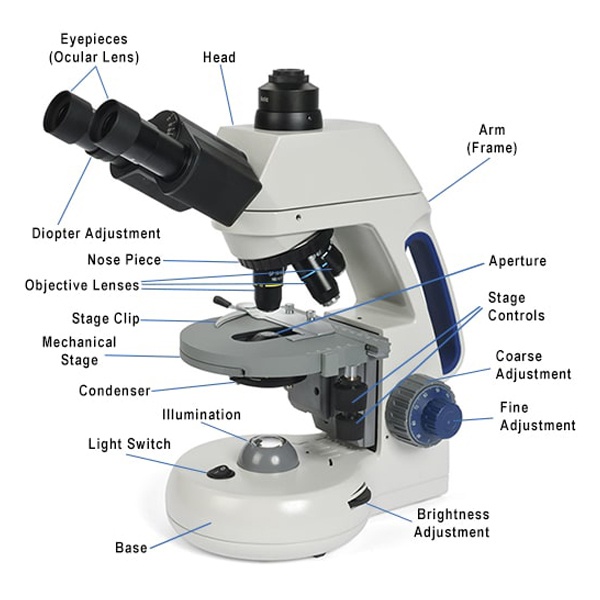
\*know functions too
Be familiar with all names of the basic components of the compound microscope and their function (flip or image)
22
New cards
resolving power
the ability of a lens to show two adjacent objects as discrete entities
23
New cards
numerical aperture
the measure of its ability to gather light and to resolve fine specimen details while working at a fixed object/specimen distance
24
New cards
parfocal
multiple structures that all lie on the same focal plane
25
New cards
oil immersion
a technique used to increase the resolving power of a microscope
26
New cards
multiply the magnification of eyepiece by magnification of objective lens
\-ex: if eyepiece is 10x magnification - 4x = 40x, 10x = 100x, 40x = 400x, 100x = 1000x
\-ex: if eyepiece is 10x magnification - 4x = 40x, 10x = 100x, 40x = 400x, 100x = 1000x
how do you calculate the power of a microscope lens
27
New cards
cell configuration
how bacteria are arranged (single, pair, chains, clusters, combination)
28
New cards
no - bacteria are so small and their refractive index is close to water so there is not much contrast (stains addd contrast)
are unstained bacteria easier to observe, why?
29
New cards
autoclaving
steam under pressure in a chamber (121C, 15 pounds per square inch, 15 min minimum) will destroy ALL microbes
30
New cards
pasteurization
heating in a water bath at 63C for 30 min destroys MOST pathogens
31
New cards
dry heat
baking 160-180C for 1-2 hours will destroy all microbes
32
New cards
filtration
sterile nitrocellulose filters with 0.45 um pores are good to remove cells from heat sensitive liquids
33
New cards
ultraviolet light
these lamps are used frequently used to disinfect laboratory surfaces
34
New cards
ultrasound
high frequency sound is used in machines to clean instruments or break cells but does NOT sterilize
35
New cards
autoclave - most cost effective
what physical agents are most effective against killing bacteria?
36
New cards
gamma rays
what other types of radiation besides ultraviolet light can be used to kill microbes
37
New cards
phenols, chlorine, glutaraldehyde
what three chemicals are used as disinfectants
38
New cards
ethanol and isopropanol
what two chemicals are used as antiseptics
39
New cards
ethylene oxide gas
what one chemical is used for sterilization
40
New cards
soap and detergents
what two chemicals are used to remove microorganisms
41
New cards
bleach
what chemical agent is most effective in removing microbes
42
New cards
antiseptic
antimicrobial substances nondamaging to skin/tissue while reducing possibility of infection, sepsis, or putrefaction
\-slows/stops growth or microorganisms
\-slows/stops growth or microorganisms
43
New cards
disinfectant
substance that is used primarily on nonliving objects to kill germs (microorganisms) that can cause infection/disease
44
New cards
sterilization
process that destroys or eliminates all forms of microbial life
45
New cards
differential staining techniques
\-gram stain and acid-fast/Ziehl-Neelsen stain
\-procedure where more than one dye is used to differentiate between different types of microorganisms on a slide
\-procedure where more than one dye is used to differentiate between different types of microorganisms on a slide
46
New cards
structural staining techniques
\-spore stain and flagella stain
\-helps in the visualization of a bacterial structure
\-helps in the visualization of a bacterial structure
47
New cards
peptidoglycan, lipids, capsule polysaccharides
what three cell biochemicals effect staining
48
New cards
escherichia coli
pink, gram negative, high in fat
49
New cards
staphylococcus epidermidis
purple, gram positive, high in carbs
50
New cards
allow the characterization of gram positive bacteria, test determines if a sample of tissue is infected with the bacteria that causes TB/other illnesses
what is the purpose/nature of acid-fast staining
51
New cards
colony count
samples of diluted culture are spread over surfaces of agar in Petri plates. After incubation, the number of colonies can be used to calculate cell concentration
52
New cards
Petrol-Hausser counter
an engraved grid in a microscope slide is used for counting cells in a known volume
53
New cards
Coulter counter
cell number and size can be determined in this machine which measures electrical resistance
54
New cards
spectrophotometer
the cell concentration can be determined in this device by measuring the light absorbed
55
New cards
cell mass
dry or wet weight gives an estimate of the number of cells
56
New cards
metabolic methods
oxygen consumed or carbon dioxide produced can indicate microbial growth
57
New cards
no - some are dead, some cells stick together so colonies are produced from multiple cells, stop growing at 10^9 (run out of food, pollution)
does cell concentration assay method detect every cell body spread on a plate and why
58
New cards
colony
a group of bacteria/microogranisms grown on a solid agar medium
59
New cards
Coulter counter, spectrophotometer, petrol-hauser, cell mass
what are some methods of measuring cell concentration that may be faster than the colony count assay (4)
60
New cards
boils, scalded skin syndrome, toxic shock syndrome, food poisoning (staphylococcus aureus)
what are 4 major illnesses caused by staphylococci
61
New cards
contagious skin disease, sore throat, rheumatic fever, glomerulonephritis (streptococcus progenies - flesh eating bacteria), pneumonia (streptococcus pneumoniae)
what 5 major diseases are caused by streptococci
62
New cards
beta-hemolysis in staphylococci
this activity produces the lysis of red blood cells in agar plate medium
63
New cards
blood agar
prepared by mixing 5% sterile defibrillated sheep blood with a nutritional base that has been cooled to 45C after autoclaving, medium then dispensed into tubes or plates
64
New cards
hemolysis in streptococci
lysis of red blood cells in agar (beta-hemolysis), conversion of red blood cells to green (alpha-hemolysis), no effect on red blood cells (gamma-hemolysis)
65
New cards
selective medium
medium to prevent growth of some species but permitting others to thrive
66
New cards
differential medium
medium that enables the investigator to distinguish one species from another
\-usually done through chemical reactions which cause the color of the medium or colonies to change
\-usually done through chemical reactions which cause the color of the medium or colonies to change
67
New cards
mannitol salt agar (staphylococcus)
plate medium helps identify s. aureus because the species often formats this carbohydrate
\-phenol red is used as a ph indicator
\-NaCl helps to inhibit other microbes
\-phenol red is used as a ph indicator
\-NaCl helps to inhibit other microbes
68
New cards
staphylococcus 110 agar (staphylococcus)
plate medium contains gelatin because some strains of s. aureus can produce gelatinase
\-NaCl helps to inhibit other microbes
\-lactose and mannitol are added as nutritional sugars
\-NaCl helps to inhibit other microbes
\-lactose and mannitol are added as nutritional sugars
69
New cards
citrated rabbit plasma (staphylococcus)
can test for the enzyme coagulase because it will cause the liquid to clump or gel
\-only s. aureus makes the enzyme but not s. epidermis
\-only s. aureus makes the enzyme but not s. epidermis
70
New cards
bile sculpin azide agar (streptococcus)
plates of this agar are used for the selection and enumeration of fecal streptococci
\-oxgall, sculpin, ferric ammonium citrate, azide as a selective agent
\-oxgall, sculpin, ferric ammonium citrate, azide as a selective agent
71
New cards
tacos A disc (streptococcus)
contains bacitracin, is used to distinguish group A beta-hemolytic streptococci (s. progenies) which is bacitracin sensitive from other beta-hemolytic streptococci on an agar plate
72
New cards
tacos P disc (streptococcus)
contains optochin, inhibits streptococcus pneumoniae but not other types of alpha-hemolytic streptococcus on an agar plate
73
New cards
staphylococcus - small chains cell config.
graffyka tetragonal - grow in groups of 4
graffyka tetragonal - grow in groups of 4
how do you differentiate staphylococcus and graffkya tetragonal under a microscope
74
New cards
hydrogen peroxide is decomposed to water and oxygen
what is the chemical reaction mediated by the enzyme catalase
75
New cards
coagulase test - staphylococcus in hydrogen peroxide bubbles (strep does not)
what test can differentiate staphylococcus and streptococcus
76
New cards
peptides bind to and activate prothrombin and converts fibrinogen to fibrin → causes clotting
describe the mechanism by which staphylococcal coagulase causes plasma to clot
77
New cards
meningitis, gonorrhea, rare pneumonia
what are the 3 major diseases of gram negative cocci
78
New cards
diplococci
what is the configuration of neisseria species
79
New cards
indophenol oxidase (cytochrome oxidase)
neisseria produce this enzyme and other gram negative cocci do not
80
New cards
chocolate agar (gram - cocci)
brown agar plate medium that contains heated blood
\-isolates of n. meningitis and n. gonorrhaeae can grow on this medium but not ordinary mediums
\-isolates of n. meningitis and n. gonorrhaeae can grow on this medium but not ordinary mediums
81
New cards
CTA fermentation tube (gram - cocci)
semisolid agar medium to test for fermentation of dextrose, sucrose, maltose
\-contains sugars, cystine, tryptose, phenol red (ph indicator)
\-bright yellow color indicates positive reaction
\-contains sugars, cystine, tryptose, phenol red (ph indicator)
\-bright yellow color indicates positive reaction
82
New cards
upper respiratory tract
where on the body would B. catarrahlis or M. catarrhalis likely be found
83
New cards
gonococcal ophthalmia neonatorum
an infection that is transmitted by contact of the eyes with infected genital secretions from a person with gonorrhea
84
New cards
pelvic inflammatory disease
acute infection of upper genital tract structure in females (uterus, oviducts, ovaries)