laceration and suturing
 Call Kai
 Learn
 Practice Test
 Spaced Repetition
 Match
 Flashcards
 Knowt Play
1/39

There's no tags or description
Looks like no tags are added yet.
40 Terms
tetanus status
in all wounds, assess ___ status
booster if it has been more than 5 years since vaccine
in a dirty wound with UTD tetanus vax, give
vaccine + TIG
in a dirty wound with unknown/incomplete tetanus status, give
bupivacaine
longest duration local anesthetic (4-8 hours)
lidocaine + epi
lidocaine + ___ makes a longer duration local
1-2 hours
duration of lidocaine
Fingers
Toes
Nose
Penis
avoid administering epinephrine in these areas
vertical mattress
what suture type?
Eversion of wound edges
High tension wounds

horizontal mattress
what suture type?
Spreads tension
Fragile skin
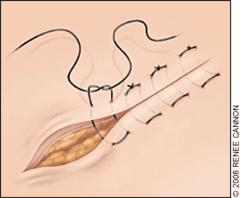
Subcuticular
what suture type?
Cosmetic closure
Face

Vicryl
Chromic gut
Monocryl
name the absorbable sutures
Deep layers
Mucosa
the absorbable sutures are indicated for
Nylon
Prolene
-used for skin closure
name the non-absorbable sutures
Fine (5-0, 6-0) non-absorbable
preferred suture type for the face
Staples or 3-0/4-0
preferred suture type for the scalp
4-0/5-0
preferred suture type for the extremities
5-7 days
removal timing for sutures of the face
7-10 days
removal timing for sutures of the scalp
10-14 days
removal timing for sutures of extremities
irrigation
most important step of laceration evaluation
Deep (muscle, tendon, nerve, vessel)
Heavily contaminated (soil, feces, bites)
Crush injury or devitalized tissue
Delayed presentation (>12-24 hrs; face >24 hrs)
Associated fractures or foreign body
Functional deficit (↓ movement/sensation)
exampleas of "complicated laceratios"
amoxicillin-clavulanate
best abx for bite wounds
primary closure
Surgical closure of a fresh, clean wound, leading to primary intention healing.
primary intention
primary union of the edges of a wound, progressing to complete scar formation without granulation
delayed primary closure
a combination of primary and secondary healing, where the wound is left open for 5-10 days before it is closed with sutures
-indicated for contaminated wounds
secondary intention
Wound healing where edges can't be easily approximated and wound fills with granulation
-healing indicated in infection/abscess
7-10 days
time of suture removal in lac to trunk
10-14 days
timing of suture removal in lac to legs
10-14 days
timing of suture removal in lac to hands/feet
10-14 days
timing of suture removal in lac to joints
more tension= longer time til removal
general rule for timing of suture removal
prevent scarring
why do we remove sutures earlier on face
Small, superficial lacerations (
indications for dermabond
~5-10 days
when does tissue adhesive fall off?
↓ tension
↓ scar formation
Better cosmetic outcome
why is it imporant to do incisions parallel to relaxed skin tension lines?
Keep clean and dry for 24-48 hrs
Then gentle washing allowed
Apply topical antibiotic ointment
Cover with clean dressing
most common wound care instructions
Incision and drainage
Most important step (NOT antibiotics alone)
most important step in abscess management
Systemic symptoms
Large abscess
Immunocompromised
Surrounding cellulitis
when are antibiotics indicated for abscesses
MRSA coverage
TMP-SMX
Doxycycline
Clindamycin
abx coverage for abscesses
dermabond
Skin "glue" used to repair simple lacerations that are not very deep.