Gentetics 2153 Larkin Test 2
 Call Kai
 Learn
 Practice Test
 Spaced Repetition
 Match
 Flashcards
 Knowt Play
1/53

There's no tags or description
Looks like no tags are added yet.
54 Terms
Cytogenetics
microscopic study of chromosomes
Karyotype
rearranged microscopic m=image of a persons's chromosomes, usually used to identify certain chromosomes.
Polyploid
extra complete sets of chromosomes
1n=1 set
Aneuploidy
a change in a set of one chromosome (addition or subtraction)
ex. trisomy 21
kleinfelter XXY
Turner XO
Nondisjunction
Whenever homologous chromsomes don't separate correctly during metaphase I or II
Metaphase I = chromosomal
Metaphase II = chromitid
Changes in Chromosome Structure
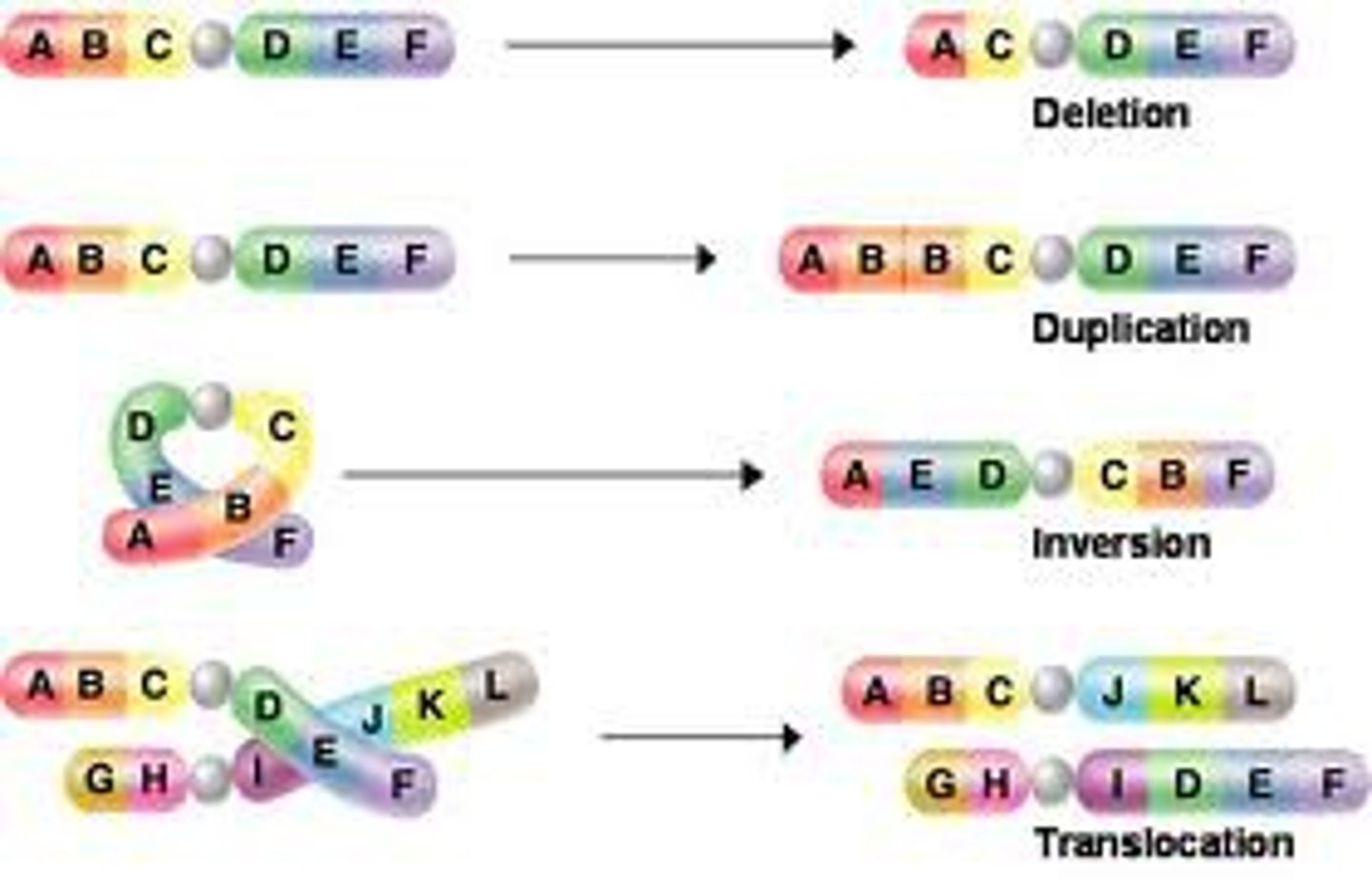
Original: ABCDEF
Deletion (Deficiency): ABEF (Ex. Cri-du-chat deletion of fifth chromosome)
Duplication: ABABCDEF
Inversion: ABDCEF
Translocation: Exchange between two different chromosomes
Chromosomal Inversion
Sometimes a chromosome will form a loop to match the inverion
Reciprocal
Translocations involving 2 chromosomes
altered pairing of translocation homologues in meiosis can cause missegragation (ex. Burkitt's Lymphoma b/t 8 and 14)
Crossing over occurs...
in prophase I of meiosis
Crossing over
exchange of DNA b/t chromosomes homologues
Genes on the same chromosome often do not assot independently. (T/F)
True
With crossing over how many more gametes can we create than without?
Two more with a total of 4 gametes:
AB Ab aB ab
Genetic Map Distance
# of recombinants/ total progeny * 100 =
measured in centiMorgans or cM
How do you test for Recombination?
See if it assorts independently according to the null hypothesis. Use X^2 test
Wild-type
the "normal" variation of an organism (none for humans)
Alfred H. Sturtevant
studied enetic linkage under T. H. Morgan
Figured out that you could estimate the didstance b/t genes by recombintion frequency
Two crossing over sites are always detectable? T/F
False
Mximum recombination is
50% (identicl to independent assortment)
Recombination classes
smallest classes
Double recombination classes
usually single digit # progeny
Seawall Wright, JBS Haldane, and RA Fischer
people of population genetics
Where does variation in populations come from?
Mutation
Hardy-Weinburg Equallibrim
p+q=1
p^2+2pq+q^2=1
p= dominant allele
q= recessive allele
P^2 = AA
2pq = Aa
q^2=aa
Do allele frequencies change from generation to generation?
It only doesn't in HW Equalibrium
Heterozyygots among dominant phenotypes
2pq/(1-q^2)
Assumptions of HW Equalibrium
Large Population size
no migration
no mutations
no selection
Random mating
Evolution
change of allele frequencies in populations
Mutation
only way new alleles are introduced into populations but the slowest at changing allele frequencies
selection
fastest way to change allele frequencies in populations. Also only HW exception that leads to adaptations
Fitness (W)
average number of offspring given in a given population or genotype
Relative fitness
genotype with the largest population is assigned W_>=1.
and the relative fitness of the other genotypes is determined relative to the most fit.
selection coefficient
The differenc e in relative fitness between the most fit and a genotype
stands for the difference in how many fewer offspring the genotype create relative to the most fit
Fitness can be different in different environments. (T/F)
True
Balancing selection
in sickle cell the selection for the heterozygotes is strong enough to preserve the recessive s and counter the selectin against recessive homozygotes
In 1900...
Nucleus was discovered that it contained a large amounts of a P, N, and carbohydrates- otherwise known as DNA (less complex than proteins)
Most people in 1900 believed this was genetic material?
Protein
F. Griffith
Discovered genetic transformation in sterptococcus
pneuminiae
something in heat killed bacteria
caused a pheotypic change in bacteria
transformation
getting a genetic change in a cell or organism
Who discovered that the DNA was probably the transforming substance?
Avery, Macleod, and McCarty
E. coli Virus
T4 Bacteriophage
Viral Life Cycle
Absorption by cell
entry of viral gnetic material
synthesis of viral compounds
maturation of virions
lysis of cell when done
Alfred Hersheyand Martha Chase
Discovery that DNA was the material that bacteriophages used to infect cells
they used ionic markers of P32 and S35 o discover this
HIV
RNA core
reverse transcriptase
Envelope (lipid bi-layer)
HIV life cycle
reverse transcription of RNA to DNA
Integration into DNA host genome
Prodution viral mRNA, Viral protein, and viral RNA genome
assembly of mature viruses and budding off surface
3 main parts to DNA
Sugar
phosphate
nitrogen base
DIfferences with RA
Riboe sugar (hydroxyl group on 3 carbon atom)
Uracil instead of thymine
usually single stranded
Structure of a nucleotide chain
Phsphodiester bond (phsophat with RC--OOR
5' (Nitrogen base) to 3' (Phosphorous)
Watson and Crick
Discovered DNA structure
Chagaff
Discovered adenine and thymine concentrations were the same, and thus concluded the same was true for guanine and cytosine
Rosalind Franklin and Maurice Wilkins
Had X-Ray Diffraction data for DNA structres
concluded double helix
concluded 3.4 nm per spiral
DNA has...
antiparallel bonding and base pairing held together through H-Bonds
Eukaryotes have a ...
larger genome than prokaryotes and thus need a higher compaction of DNA
E. coli genome length
1 mm long
Human genome length
2 meters long