BIO2 Reading 10
 Call Kai
 Learn
 Practice Test
 Spaced Repetition
 Match
 Flashcards
 Knowt Play
1/12

There's no tags or description
Looks like no tags are added yet.
Name | Mastery | Learn | Test | Matching | Spaced | Call with Kai | Chat |
|---|
No analytics yet
Send a link to your students to track their progress
13 Terms
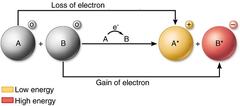
Why are redox reactions important in biology?
Electron transfer is involved in the building, breakdown, and conversion of molecules as well as the transfer of energy
Reduction
Gain of electrons

Reduced State
Condition of electron carriers after accepting electrons; have the potential to donate electrons

Reducing Agent/Reductant
Reduces another species (electron donor); is itself oxidized

Oxidation
Loss of electrons

Oxidized State
Condition of electron carriers after donating electrons; have the potential to accept electrons

Oxidizing Agent/Oxidant
Oxidizes another species (electron acceptor); is itself reduced

Reduction Potential
Empirically determined quantitative measure of the ability of a molecule to gain or lose electrons; as electronegativity is to atoms, reduction potential is to molecules

Standard Reduction Potential (E˚')
Relative reduction potential intrinsic to each molecule measured and reported in volts (V); lower E˚' -> better electron donor, higher E˚' -> better electron acceptor

Redox Tower
Table of standard reduction potentials organized in half reactions as [Oxidized/Reduced]

How do you find the ΔE˚' and what does this value imply?
ΔE˚' = E˚'[oxidant] - E˚'[reductant]
Higher ΔE˚' -> more spontaneous reaction

How can ΔG˚' be determined from ΔE˚'?
ΔG˚' = -nFΔE˚' where n = mol electrons and F = Faraday's constant (96.485 kJ/(V*mol))
(Inversely proportional)

How do the number of C-H bonds relate to how reduced a molecule is?
More C-H bonds -> more reduced
