Anatomy of Articulation and Resonance part 0
 Call Kai
 Learn
 Practice Test
 Spaced Repetition
 Match
 Flashcards
 Knowt Play
1/67

There's no tags or description
Looks like no tags are added yet.
68 Terms
Nasal passages, oral cavity, and larynx
Vocal tract definition
Pharynx
Tube that connects the nasal and oral cavities
Source-filter theory
Explains how speech sounds are produced using a source and a filter
Source
Where the sound comes from
Larynx (voiced phonemes)
Constriction in the vocal tract (voiceless phonemes/noise).
Sources of sound ARE
Filter
How the sound is shaped
Oral, pharyngeal, and nasal passages and cavities
The filter consists of:
yes
Can voiced and voiceless sources occur simultaneously?
Articulation (general)
Process of joining or moving two elements together
Articulation (speech)
Bringing two or more structures together to form speech sounds
They form differently shaped spaces in the vocal tract
How do articulatory movements affect speech?
The size and shape of spaces in the vocal tract
What determines phoneme quality?
Articulators
Structures used to produce speech sounds
Mandible (lower jaw), including lower teeth
Lips
Tongue
Velum
Vocal folds
Mobile articulators are
Maxillae (upper jaw), and including the upper teeth
Hard palate
Alveolar ridge
Immobile articulators are
muscle attachments for speaking/swallowing, resonating chambers, and craniofacial/neural importance
Why study the bones of the face and cranium?
Communication and swallowing difficulties
What can developmental malformations cause?
Cleft lip, cleft palate, and other craniofacial abnormalities
Examples of developmental malformations
Mandible, maxillae, nasal bones, palatine bones, vomer, zygomatic bone
Facial bones: list
Frontal, parietal, occipital, temporal, ethmoid, sphenoid
Cranial bones: list
Ramus
Coronoid process
Condylar process
Mylohyoid line
Mental symphysis
Dental alveoli (alveolar process)
Mandible: Important features
Ramus
Vertical portion of the mandible
Corpus
Body of the mandible
Angle
Corner where the corpus and ramus meet
Coronoid process
Anterior projection of the mandible
Condylar process
Posterior projection of the mandible
Mandibular notch
Indentation between the coronoid and condylar processes
Mylohyoid line
Anatomical feature on the inner surface of the mandible
Mental symphysis
Midline region where the two halves of the mandible join
Dental alveoli (alveolar process)
Areas of the mandible that contain the teeth
Mental foramen
Opening visible on the anterior mandible.
Mandibular foramen
Opening on the inner surface of the mandible.
Lingula
Small projection near the mandibular foramen
Occlusion
movement 1

Mandible lowered (hinge-like action)
movement 2
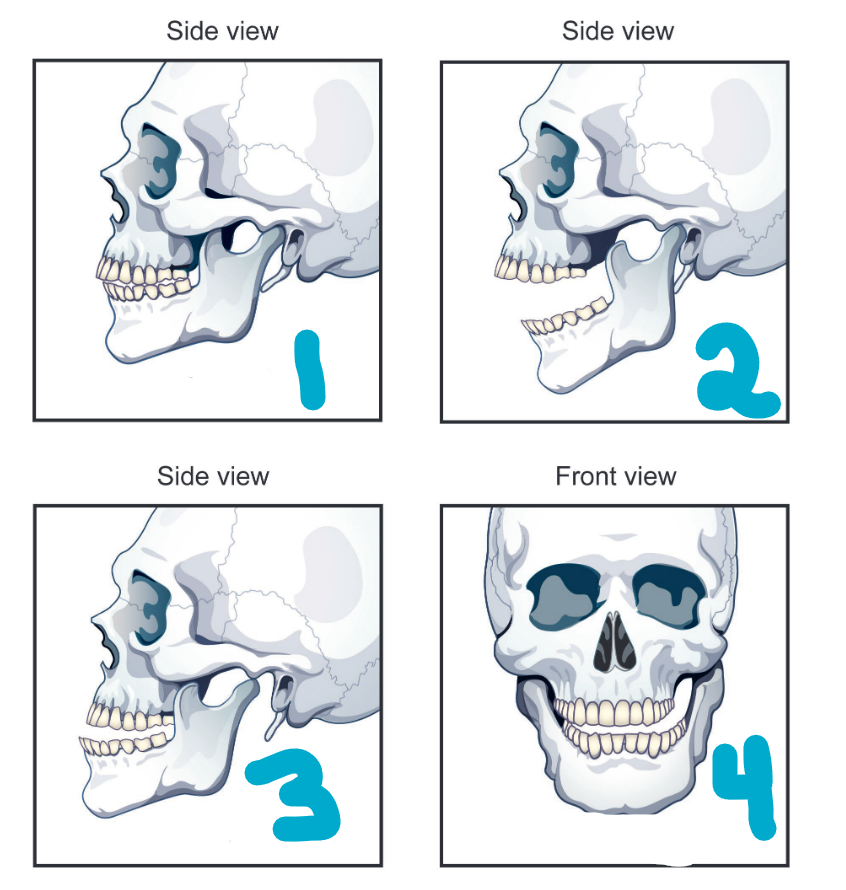
Mandible moved forward (gliding action
movement 3
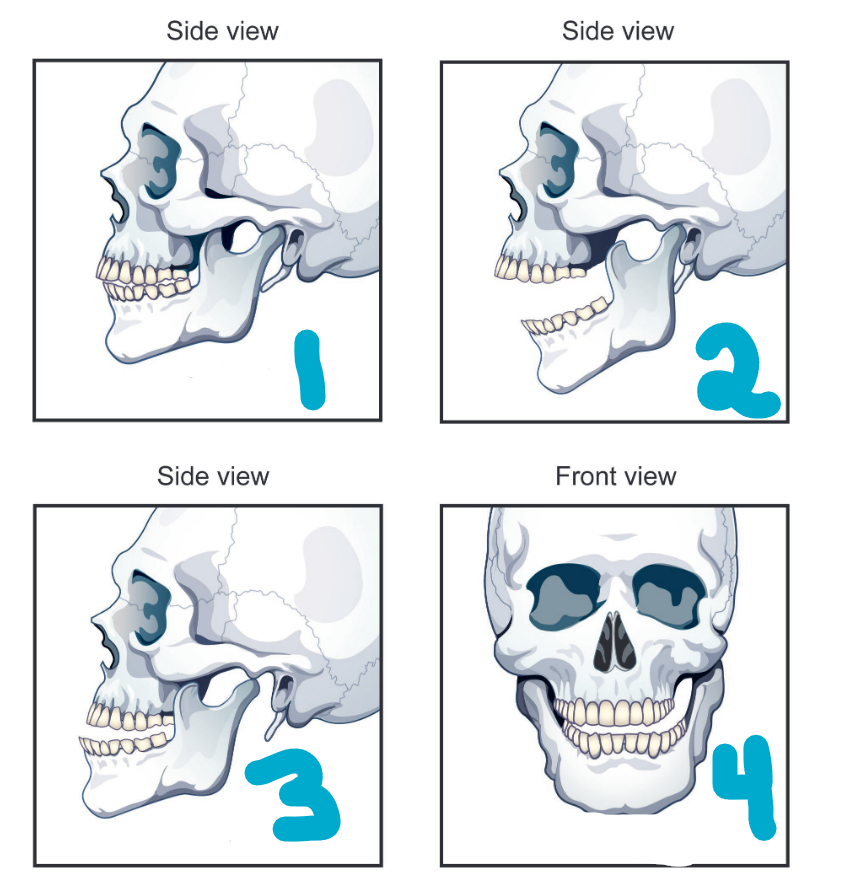
Front of mandible moved to side (gliding action)
movement 4

Palpation order (medial to lateral):
Mental symphysis
Corpus
Angle
Ramus
Mandibular notch
Condylar and coronoid processes
Temporomandibular joint; joint connecting the mandible to the temporal bone
TMJ
Condyle of the mandible
What fits into the cavity of the temporal bone?
Articular disk
Structure separating the mandibular condyle from the cavity in the temporal bone
Fibrous capsule
Surrounds the TMJ
Synovial fluid
Lubricates the TMJ
Temporomandibular ligament
Ligament associated with the TMJ
Sphenomandibular ligament
Ligament associated with the mandible and sphenoid
Stylomandibular ligament
Ligament associated with the mandible and styloid region
Occlusion
Teeth are together
Depression
Mandible moves downward (hinge-like action)
Protrusion
Mandible moves forward (gliding action)
Lateral excursion
Mandible moves from side to side (gliding action)
Micrognathia
Developmental condition involving a small mandible or retrognathia
Retrognathia
Described in the slides alongside a small mandible
There may not be enough room for the tongue on the floor of the mouth
What happens to tongue space with micrognathia?
Tongue may move upward into the maxillary/palatine area during development, resulting in cleft palate.
How can micrognathia contribute to cleft palate?
Yes, it may still cause functional articulation problems
Can micrognathia cause problems without cleft palate?
Maxillae
Bones of the upper jaw and parts of the nose and palate
Singular of maxillae
Maxilla
Maxillary processes
Named according to the structures with which they articulate
Frontal process
Identifiable process of the maxilla
Infraorbital margin
Identifiable margin of the maxilla
Zygomatic process
Identifiable process of the maxilla
Nasal crest
Identifiable feature of the maxilla
Alveolar process
Part of the maxilla associated with the teeth
Palatine process
Part of the maxilla forming part of the palate
Incisive foramen
Opening identified on the maxilla
Canine fossa
Depression identified on the maxilla
Intermaxillary suture
Suture between the maxillae
Premaxillary suture
Suture identified in the maxillary region