Revenue Management
 Call Kai
 Learn
 Practice Test
 Spaced Repetition
 Match
 Flashcards
 Knowt Play
1/48

There's no tags or description
Looks like no tags are added yet.
49 Terms
How do you maximise profit?
Increase the price
Increase rooms sold
Both
CRS
Computerised reservation system/ central reservation systems, are computerized systems used to store and retrieve info and conduct transactions related to air travel, hotels, car rental, or other activities.
GDS
Global distribution system eg. Amadeus, Sabre
Computerized network connecting travel service providers—like airlines, hotels, and car rental companies—with travel agencies and booking platforms in real time
-acts as a single digital hub where travel agents and corporate bookers can compare prices and check live inventory.
Historical Evolution of Revenue Management
Airline liberalisation - GDS/CRS - Internet - Revenue Management Systems
Governments stopped controlling ticket prices. Airlines now competed with each other & low-cost airlines entered market.
Marketing automation & product distribution through (CRS) and communication networks
Revenue growth & improved customer service through guest history & marketing databases: enabling proactive distribution, revenue & targeted marketing management
Minimizing denials & revenue losses through yield management systems and concepts
Yield management systems/ Revenue management
Managerial approach for the maximization of the use of our resources in the lodging industry
Revenue
The total amount of sales achieved in a specified time period, before deducting costs
RM Objectives
1) Maximize revenue per available time - based inventory unit
RevPATI = average rate × capacity utilization
Earn as much money as possible from each available unit (e.g., hotel room, restaurant table) during time it is available.
2) Gain higher market share percentage
Get a bigger share of the customers/revenue in your market compared with competitors.
3) Maximize use of resources
Make sure the resources you have are used as efficiently as possible. For example, if a hotel has 100 rooms but only 50 are occupied, half of its room capacity is unused.
For revenue management to work effectively, several conditions need to exist: (7)
Each condition creates a reason to change prices, or makes changing them possible. Take one away and revenue management either isn’t needed or doesn’t work.
Segmented demand: different customers pay different prices
Fixed capacity: can’t add rooms quickly
Perishable inventory: an unsold night is lost
Low marginal cost: one extra sale costs little
Booked in advance: bought before it’s used
Uncertain demand: hard to predict
Same product, different prices: e.g. one room type, business vs leisure rate
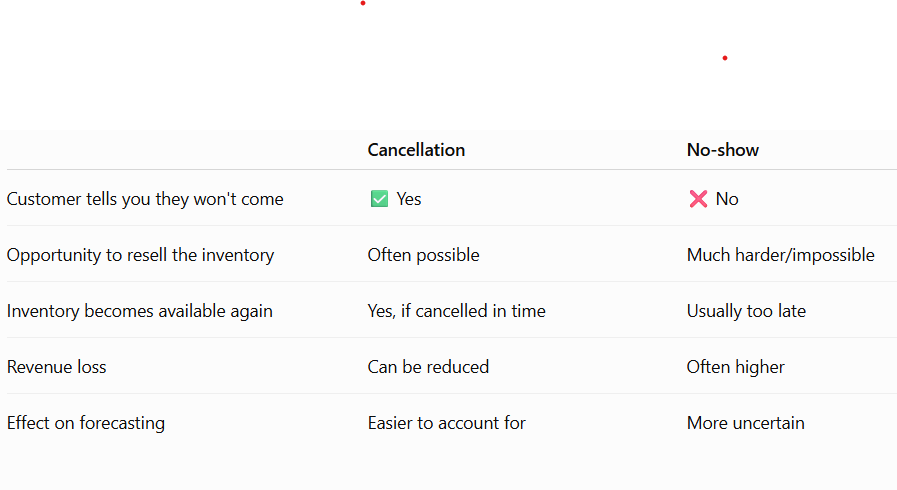
What is worse, cancellation or a no-show? No-show, why?
Revenue Management Myths (3)
An info system is required - You can use basic tools such as spreadsheets, booking records, and manual analysis to monitor demand, prices, and occupancy.
RM is only useful for large production - RM is useful for businesses of all sizes, not just large establishments. The key requirement is having limited, perishable capacity & ability to vary prices or availability according to demand
A large historical database is needed - It is helpful, but not necessary to begin applying RM. Businesses can make decisions using current bookings, market trends, competitor prices, seasonality, and professional judgment.
Core Concepts of RM (7)
Price over cost when balancing supply and demand
Market-based pricing over cost-based
Sell to segmented micro -markets over mass markets
Save your products for yourmost valuable customers
Decisions based on knowledge over supposition
Exploit each product’s value cycle
Re-evaluate your revenue opportunities
5 stages of revenue management
Set prices - Determine optimal pricing strategies
Demand Forecast - Predict future customer demand
Manage inventory - Optimise room sales
Manage distribution - Ensure usage of right platform
Evaluate results - Analyse performance and adjust
Typical Revenue Manager Responsibilities
Full service resorts/ hotels - Guest rooms, meeting space, F&B operations
Limited service hotels - Guest rooms
Conduminiums - Guest units, F&B operations
Cruise ships- Cabins, F&B operations, activities
Commercial restaurants- F&B services, meeting space
Convention centres - meeting space, F&B operations
Sports & entertainment venues- Tickets, meeting & event space, F&B
Casinos- Guest rooms, F&B operations
Private clubs- Tea times, F&B, meeting space
Private clubs (dining/ social)- F&B + meeting space
RM Fundamentals of a revenue manager

Dimensions of Service - Use of Strategic RM Levers
Every service delivered to a customer has two key dimensions:
Time: how long it takes to deliver or consume service, it’s fixed
Price:what customer pays at end of service delivery/consumption, it is variable, so you manipulate this more

How Can You Manage RM Levers? How Can You Make Duration More Predictable? (4)
Being clear about measuring a stay.
A guest checks in Monday and checks out Thursday → 3-night stay.
Predict when & how many guests will arrive
Reservations & booking data help hotel predict these arrivals.
Why? Hotel can decide how many rooms to sell and at what price
Predict how long guests stays.
Why? Length of stay affects future room availability and pricing decisions.
Use booking history, customer segments, minimum-stay restrictions & booking conditions to influence/predict LOS.
Reduce timebtw one guest check out & next check in.
Why? Less downtime = more opportunities to sell room.
Make rooms available through housekeeping, early check-out procedures & better coordination btw reception & housekeeping
Managing price - Proper price mix
Price elasticity→ How does demand change when we change price?
Hotel needs to understand how customers react to price changes.
Competitive price→ look at what other hotels are charging.
Know your competitors' prices & position your price appropriately.
Optimal pricing policies→ having rules for when to increase or decrease prices based on demand.
Don't have one fixed price; adjust price according to demand.
→ Logical mix of prices: Differentiation → a hotel doesn't necessarily charge everyone same price for the same room.
Classical RM vs. Customer-Centric RM

Key performance indicators (KPI)
Quantifiable measures a company uses to assess performance over time.
These metrics determine a company’s progress in achieving its strategic goals & to compare a company’s performance against other businesses within its indust to implement benchmarking strategies
Financial KPIs
ADR
Occupancy
RevPAR
TRevPAR
ADR (Average Daily Rate)/ ARR
TOTAL ROOMS REVENUE (OF THE PERIOD)/NUMBER OF ROOMS SOLD (OF THE PERIOD)
The average price a hotel receives for each room it sells in a day.
Occupancy %
TOTAL OCCUPIED ROOMS/NUMBER OF AVAILABLE ROOMS × 100
RevPAR
TOTAL ROOMS REVENUE FOR PERIOD/NUMBER OF ROOMS AVAILABLE FOR PERIOD
Or
ADR × % Occupancy
Consider rooms “OOO” – Out of Order. They need to be deducted from total number of rooms available / number of rooms the hotel has
Average amount earned from each available room - "How well did the hotel use all the rooms it had available?"
TRevPAR (Total revenue per available room)
TOTAL REVENUE (ALL SERVICES) FOR PERIOD/NUMBER OF ROOMS AVAILABLE FOR PERIOD
average total revenue a hotel earns for each available room, including money from more than just room sales.
Rooms available (100×100) Formula
Rooms in the hotel x days in the month
Occupied rooms
Rooms avl. (100×100) x Occ%
If ADR = RevPAR then…
That means the hotel has 100% occupancy
If ADR > RevPAR, it means the hotel has some rooms that are empty
Visual Representation of Occupancy, ADR and Rev PAR

ARPAR (Adjusted RevPAR)
(ADR – Variable Cost per Occupied Room + Additional Revenue per Occupied Room) × Occupancy
Measures room revenue per available room after adjusting for certain costs, such as distribution commissions, booking fees, or other costs associated with selling rooms. The exact formula can vary by hotel or course.
PROFIT: GOPPAR (Gross Operating Profit per Available Room)
Gross Operating Profit: earnings before interest and taxes
REVENUE – EXPENSES/NUMBER OF AVAILABLE ROOMS
You don’t do this as often because you have to wait until the end of the accounting period to collect the expenses
FMS (Fair Market Share) %
ROOMS AVL HOTEL/TOTAL ROOMS AVL. COMPETITIVE SET × 100
the percentage of hotel demand a hotel should receive compared with its competitors, based on its size and capacity.
AMS (Actual Market Share) %
OCCUPIED ROOMS HOTEL/TOTAL OCCUPIED ROOMS COMPETITIVE SET × 100
The share your hotel actually gets.
MPI (Market Penetration Index)
AMS/FMS
AMS > FMS → the hotel has a larger share of occupied rooms than its share of available rooms.
AMS < FMS → the hotel has a smaller share of occupied rooms than its share of available rooms.
AMS = FMS → its occupied share is exactly proportional to its room share.
ARI (Average Rate Index)
If the result is above 1, the ADR is above the comp. Set
If the result equals 1, the ADR is in line with the market
If the result is less than 1, the hotel’s ADR is under market.

RGI (Revenue Generation Index)
If the result is above 1, the RGI is above market performance
If the result equals 1, the RGI is in line with the market
If the result is less than 1, the hotel’s RGI is under market.

Benchmarking
A measurement of the quality of an organization’s policies, products, programs, and strategies, compared with standard measurements or similar measurements of its peers/competitors.
Objectives:
Determine what and where improvements are needed
Analyze how other organizations achieve their high performance
Use this info to improve our performance
Variables to benchmark:
Product
Level of Service → Reviews
Location → Amplify your location, transportation etc
Distribution Channels → rate, cancellation policy etc
Tactical vs. Strategic RM
Strategic RM focuses on long-term goals such as identifying target markets and creating factors for differentiation from competitors.
Tactical RM focuses on operations that should support strategic goals:
Forecast demand → should be very detailed
Application of rate structures
Run scenarios for booking comparison
Demand definitions: demand, demand generator, drainer, unconstrained & constrained
Demand (customer) → The number of potential buyers with the interest and ability to purchase the products sold by a business at the specific price offered
Demand Generator example: a major global event increases city-wide demand (e.g. a World Cup or large convention).
Demand Drainer example: a global crisis reduces travel demand industrywide (e.g. a pandemic’s impact on tourism)
Unconstrained Demand: the hotel can fully meet total demand.
Constrained Demand: the level of requested reservations rises above the capacity of the hotel, only a certain portion of the demand can be accommodated
What is a forecast and its charcteristics?
A projection based on the data available at the moment of its preparation, an anticipation of units sold and revenue generated in the sale.
Helps management anticipate periods of constrained and unconstrained demand.
Foundation for making operational decisions, scheduling workers, purchasing supplies, managing cash flow and better pricing decisions
Important relationship with budgets.
The forecast is never static.
The shorter the term, the more accurate the forecast
Historical, Current & Future data
Historical data: data describing events that have already occurred, also known as actual data or results data. Helps to learn from past performance.
Current data: data describing what is currently happening, up-to-date data. Helps to understand present.
Future Data: data describing events that might be happening in the future. Factor(s) affecting future demand:
Demand generators: event increasing the demand ▪ Demand drain: event producing a decrease of demand
Types of forecasts and their charcteristics

When Do Segments Book?
Price-sensitive segments generally book earlier: leisure travelers
Less price-elastic, more time-sensitive segments tend to book later: individual and business travelers.
Space needs to be protected for high-yield segments to avoid selling price-sensitive rooms to less price-sensitive clients.
Reservations Management
Lead Time
The time in advance that bookings are made.
Important to look at market segmentation for forecasting and rate controls.
Booking Pace
How quickly reservations are coming into the hotel?
If the booking pace is unusually fast, there might be an event.
Best results come from looking at booking pace by market segment
Pick-up
Number of reservations picked up from a given point in time to a different point in time over the booking process.
Main idea of the pickup method is to estimate increments of bookings to come, and then aggregate these increments to obtain a forecast of total demand.
Forecast formula
FORECAST = ROH + EXPECTED PICKUP
How do you find if your forecast is positive or negative?
Forecast - Target (Avg. Occ)
What to do when a forecast is positive
Maximize revenue and profit.
Raise prices gradually
Limit discounts and manage inventory
Push direct bookings
Prepare staff and supplies
Upsell extras
Watch competitor rates
What to do when a forecast is negative
Stimulate demand and protect profitability.
Targeted promotions or packages, don’t automatically discounting every room.
More marketing to key segments
Work with agents, OTAs and corporates
Create packages - bundle rooms + breakfasts, spa etc
Control costs
Analyze pace, cancellations and market
Boost spend in F&B, spa and even