2.10 Enzymes and enzyme practical
 Call Kai
 Learn
 Practice Test
 Spaced Repetition
 Match
 Flashcards
 Knowt Play
1/21

There's no tags or description
Looks like no tags are added yet.
22 Terms
Define the following terms:
biological catalyst
activation energy
biological catalyst - an enzyme is a biological catalyst that speeds up the rate of reaction without being used up by lowering the activation energy
activation energy - minimu amount of energy needed for reaction to occur by causing bonds to break
Define what is meant by an enzyme
enzymes are biological catalysts that speed up a reaction without being used up
they do this by providing an alternative energy pathway that has a lower activation energy
Describe the structure of enzymes
enzymes are globular proteins made of many different polypeptide chains joined together by different bonds e.g ionic bonds, hydrophobic and hydrophilic interactions between R groups to form a 3D tertiary structure
enzymes can have more than one polypeptide chain or 4 subunits so has a quaternary structure —→ as proteins with prosthetic groups (non-proteins) have a quaternary structure
Explain how the primary structure of an enzyme determines it’s three-dimensional (tertiary) structure and it’s properties (3)
a specific sequence of amino acids codes for a specific protein, the order of the amino acids ultimately dtermines the positioning of the folding which leads to the shape and properties of the active site
the active site and substrate are complementary
the outside of an enzyme has it’s hydrophilic R groups whilst the inside has hydrophobic R groups —→ enzymes are soluble
Describe what an intracellular enzyme is and give examples
intracellular enzymes are produced and function inside the cell
e.g catalase —→ catalase converts the harmful by-product of hydrogen peroxide into water and oxygen preventing any damage to cells or tissues
Describe what an extracellular enzyme is and give examples
extracellular enzymes are secreted by cells and catalyse reactions outside cells
e.g amylase —→ involved in carbohydrate digestion where it hydrolyses starch into simple sugars, it is secreted by the salivary glands and pancreas
Describe and explain the lock and key theory to explain enzyme action
the active site of the enzyme is highly specific which binds to the shape of the substrate - they are complementary
this forms an enzyme substrate complex
whereby the enzyme lowers the activation energy
catalysing the reaction to form products

Describe and explain the induced fit model to explain enzyme action
the substrate is not complementary to the active site of the enzyme
the substrate enters the enzyme’s active site
the active site undergoes a conformational change to allow the substrate to bind to the active site forming an enzyme substrate complex
the enzyme then catalyses the reaction forming an enzyme-product complex where the product is released from the enzyme’s active site

What are the four factors that an enzyme-controlled reaction is affected by?
temperature
pH
enzyme concentration
substrate concentration
Explain why increasing the temperature of an enzyme-controlled reaction changes the rate of reaction. (3)
enzymes have a higher kinetic energy therefore there are more frequent collisions between substrate and active site → so more enzyme-substrate complexes are formed
at very high temperatures the rate decreases due to denaturation —→ because of bond changes in the enzyme alterating the highly specific shape of the active site
so the substrate no longer complementary to the active site so the rate of product formation decreases
Explain the affect of pH on the rate of an enzyme-controlled reaction
pH must be controlled :
this is because a change in the pH affects the shape of the active site
changes in the pH change the ionic bonds within the enzyme
therefore the rate of reaction changes
Explain the affect of enzyme concentration on the rate of an enzyme-controlled reaction
an increase in enzyme concentration increases the number of active sites available —→ thus the greater likelihood of enzyme-substrate complex formation
however, if substrate concentration is limited the rate of reaction increases at a slower rate as the substrate is being used up - until there is no more substrate available so the reaction levels off

enzymes reduce the activation energy
increase in enzymes would increase the number of collisions between enzymes and substrates
increase in enzyme concentration increases the number of active sites available
therefore more active sites become occupied forming enzyme substrate complexes
the rate of reaction levels off when substrate becomes limitting factor
Explain the affect of substrate concentration on the rate of an enzyme-controlled reaction, draw and label a diagram
an increase in substrate concentration increases the rate of reaction
this is because there are more frequent collisions between enzyme and substrate, so the more likely an active site will be used by a substrate
this occurs until the saturation point - where all active sites have been occupied and thus increasing the substrate concentration would not affect the rate of reaction
this means the inital rate of reaction will be fastest

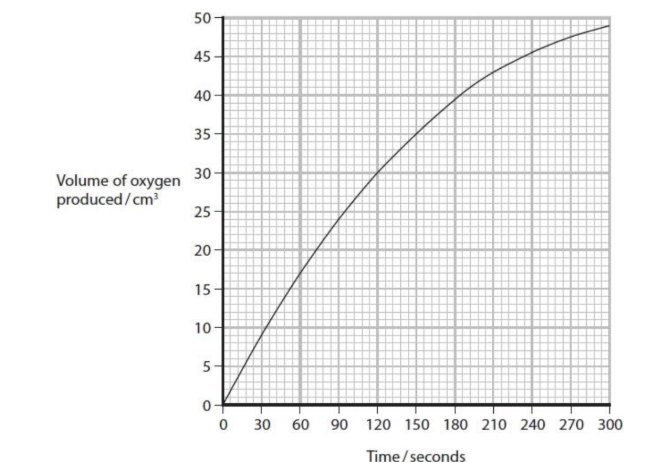
Explain why the rate of reaction decreases over time
concentration of substrate decreases as the substrate is being used up
substrate becomes a limitting factor
so less substrates available to collide with enzymes and so fewer enzyme-substrate complexes form
State the difference between competitive and non-competitive inhibitors
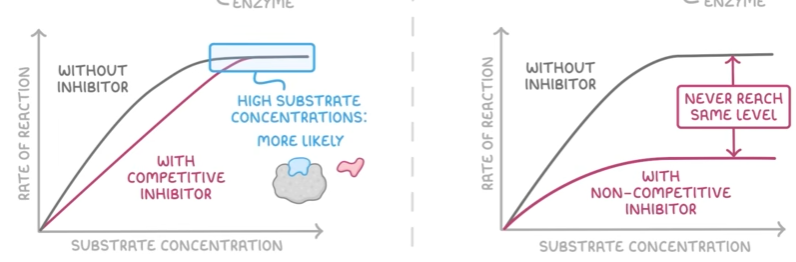
competitive inhibitors have a similar shape to the substrate where they bind directly to the active site of the enzyme blocking the active site so the substrate cannot bind —→ cannot form an enzyme-substrate complex.
non-competitive inhibitors bind to the allosteric site on the enzyme which causes the active site to change shape, thus the substrate can no longer bind to the active site of the enzyme as they are no longer complementary
Draw each of the graphs for a competitive inhibitor and a non-competitive inhibitor
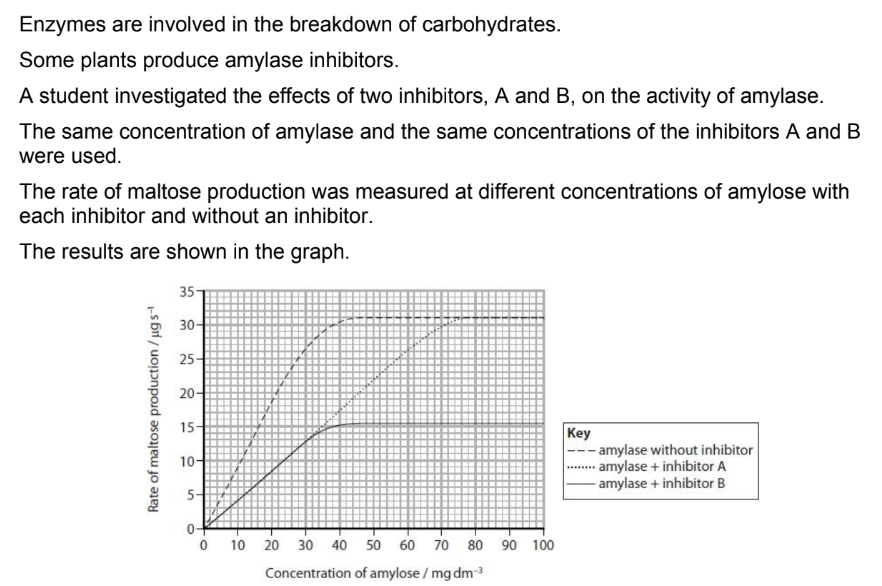
Explain which of the two inhibitors is non-competitive
inhibitor B because reaction does not reach the maximum rate without inhibitor
this is because it binds to the allosteric site
which changes the active site of the enzyme
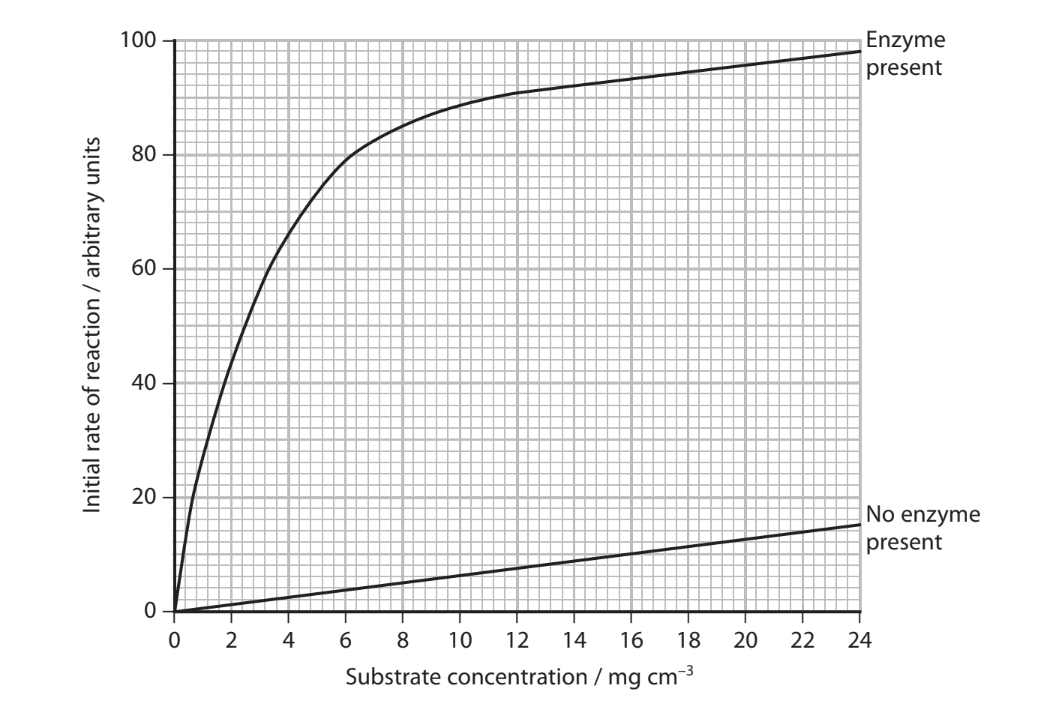
The action of lipase can be investigated using a triglyceride as the substrate.
Describe an experiment, using lipase and a triglyceride, that could be carried out
to collect data to plot a graph similar to the one shown in part (a).
use a range of different triglyceride concentrations (at least 6) e.g 0.2%, 0.4%, 0.6%, 0.8%, 1.0% and 1.2%
mix 10 cm3 of lipase solution with 15 cm3 of triglyceride solution and place the test tube in a water bath at 25o C - keeping the temperature constant.
measure the change in pH over regualr intervals, every 30 seconds using a stopwatch then plot a graph and calculate the gradient from a linear part of the graph to calculate the initial rate of reaction
repeat the investigation using the same concentration and volume of lipase solution and keep the temperature constant at 25o C using a water bath.
also repeat the investigation without the lipase enzyme as a control

enzyme increases the rate of reaction
the rate at which the reaction increases with the enzyme is not linear as the gradient is constantly changing
increase in (initial) rate of reaction is the same with or without enzyme present above the substrate concentration of 10
Explain why it is necessary to measure the initial rate of reaction when
investigating the effect of enzyme concentration on the rate of reaction.
at the start the substrate is not a limitting factor
as the reaction proceeds the concentration of substrate decreases
lower concentration of substrate limits rate of reaction

pH - control through a buffer
temperature - use a water bath