PN2001 Social Psychology
 Call Kai
 Learn
 Practice Test
 Spaced Repetition
 Match
 Flashcards
 Knowt Play
1/78

Earn XP
Description and Tags
flash cards from lectures
79 Terms
social psychology definition
the scientific study of how the thoughts, feelings, and behaviour of individuals are influenced by the actual, imagined, or implied presence of other human beings
levels of analysis
different types of concepts and mechanisms that we use to explain the same phenomenon. different levels of analysis offer different, potentially complementary explanations of the same behaviour.
individual, interpersonal, group, societal/culture
the four (five) levels of analysis
Ideological - cultural beliefs and norms within society
positional - status and power relations between groups
interpersonal - social interactions, presence of others
intrapersonal - cognition, emotion and motivation
neurobiological - brain processes and physiological responses
the social origins of the self
symbolic interactionism
sense of self develops through social interactions and the meanings we attach to them
the looking glass self
we see ourselves partly through how we imagine others see us. our self perceptions are shaped by how we think others see us
the generalised other
see ourselves through shared attitudes and expectations of wider community
‘the self’ meaning
a set of beliefs, evaluations, perceptions, and thoughts that people have about themselves
what is the self-concept
the overall set of beliefs and knowledge we have about ourselves
what is self-schemas
cognitive generalizations about the self, derived from past experiences, that organize and guide the processing of the self-related information contained in an individuals social experience
self-schematic meaning
being independent is an important part of who i am
self-aschematic
i dont particularly think of myself in terms of independence
function of self-schemas
cognitive structures that influence how information about the self is processed and retrieved from memory
self-schemas influence aspects of daily life
example = body image
self schemas can shape how people attend and process appearance related information
different forms of self knowledge
active (working) > stored
what is on our mind right now versus what we know about ourselves more generally
semantic > episodic
general knowledge about ourselves versus memories of specific experiences
actual self > possible selves
who we believe we are versus who we might become, hope to be or fear becoming
how do our self views differ
valence
importance
certainty and clarity
stability
organisation
contingency
social comparison theory
we evaluate our abilities and opinions partly by comparing ourselves with others
upward social comparison
compared to someone performing better
downwards social comparison
compared to someone doing worse
what is self esteem
self esteem - overall subjective evaluation of our own worth or value
internal influences
tendency to experience negative or psoitive emotions + our percieved strengths and weaknesses
external infleunces
how accepted valued and included we feel by other people
sociometer theory of self esteem
self esteem acts as a psychological guage of how accepted and valued we feel by others
characteristics we value in ourselves are often connected to what our social group values
changes in self-esteem can serve signal that our social relationships or groups standing may be under threat
narcissism
personality characteristic involving an inflated send of self importance, entitlement and difficulties relating to others
self esteem can be explicit (consciously held) and implicit (unconscious, automatic evaluation of the self)
classic view of narcissism - jordan et al 2003
narcissists have high levels of explicit self-esteem, but low levels of implicit self-esteem
requires constant external validation and show aggressive behaviour in the face of criticism
current understanding of narcissism
the explicit-implicit discrepancy is not consistently supported
grandiose narcissism - inflated sense of self worth and superiority, characterised by entitlement, antagonism ( hostility or defensiveness when their self image is threatened), and a strong desire for admiration and status - approach orientated
vulnerable narcissism - a fragile, insecure sense of self worth, characterised by entitlement, antagonism towards others and a heightened sensitivity to criticism, rejection and perceived slights - avoidance oriented
three fundamental self motives
self assessment - accuracy
self verification - consistency
self enhancement - positivity
these can reinforce or conflict eachother
forms of self enhancement
remembering success, forgetting failure
people who say nice things about us are perceived as more credible
self serving attribution bias
better than average effect
better than average effect
tendency to evaluate oneself more positively than the average person
judgement domains
personality traits
popularity and attractiveness of dating profile
fairness of behaviour
effect tends to be stronger for desirable traits particularly those perceived as controllable
individualistic culture and the self
individualistic cultures - emphasises autonomy, uniqueness, personal achievement and self expressions >
interdependent self - defined primarily by personal traits, abilities and preferences
collectivistic culture and the self
collectivistic culture - emphasise connectedness, social obligations, cooperation’s and harmony
self categorisation theory
personal identity - me - what makes me distinctive
social identity - us - what are we like
intragroup and intergroup
what is an attitude?
an evaluation of some object:
is it good or bad
do i like it or not
the nature of attitudes
attitudes can be mixed or ambivalent
views can be positive and negative at the same time
attitude complexity
the number of dimensions on which an attitude object is evaluated
how is attitude strength determines
attitude extremity - deviation from the neutral point
attitude accessibility - how easily an attitude comes to mind, how quickly it can be expressed
attitude intensity - strength of the emotional response evoked by an attitude object
attitude knowledge - how much you know about issue, amount of info about the object in memory
attitude elaboration - how deeply you have thought about the attitude object
explicit attitudes
conscious, based on deliberate appraisal of an object. can openly be communicated with others
implicit attitudes
evaluative associations that are actively relatively automatically and assessed using indirect measures such as reaction time tasks
self perception theory
we infer our attitudes from our behaviour (at least sometimes)
i eat a lot of cake so i must like cake example
over justification effect
incentives can undermine motivation because we wont attribute our behaviour to intrinsic interest
embodied cognition
the idea that our thoughts, feelings and attitudes are shaped not only by mental processes but also by our bodily states, sensations and movements
dispositional attribution
internal causes
situational attributions
external causes
the naïve scientist approach
ordinary people are rational, scientific thinkers who make casual attributions using similar processes as scientists (heider,1958)
kelleys (1967) covariation model
people typically attribute the cause of a behaviour to the factor that most clearly covaries with the behaviour (factor that tends to be present when the behaviour occurs, and absent when it does not occur)
three components of a typical social situation
a person behaving in a particular way
a stimulus towards which behaviour is directed
a particular occasion or circumstance
an observer infers a casual explanation based on three dimensions
consensus - do other people react the same way to the stimulus?
distinctiveness - does the person react this way towards other stimuli?
consistency - does the person behave in this way towards the stimulus on many other occasions?
correspondence bias (FAE)
our tendency to infer that someone’s behaviour corresponds to their underlying attitudes or dispositions, even when situational factors help explain that behaviour
FAE
Fundamental attribution error
when does FAE most likely occur
people make quick judgements
they are distracted
they are in a good mood
they don’t know much about the person
actor-observer bias
tendency for actors to attribute their own behaviour to the situation and for observers to explain behaviours in terms of dispositional factors
moderators - relationship to actor, actor distinctiveness, event valence
self serving attribution bias
taking credit for success and denying responsibility for failure
attribution biases in depression
exaggerated sense of personal responsibility for negative events, even uncontrollable ones (negative thinking)
attribute negative events to internal, stable and global causes = risk of developing depression
holistic thinking
orientation towards context as a whole, how things are related to eachother - is more prevalent in collective cultures
analytical thinking
detaching factors from the environment - is more prevalent in individualistic cultures
FAEs affect in cultures
FAE weaker in collectivist (than individualistic) cultures, where people are less likely to attribute behaviour to dispositions and more likely to explain behaviour using situational accounts
victim blaming and attributes
we view people as bad that are victims of
illness
poverty
rape
theft
our attributes impact wider societal consequences
just world theory
people have a need to perceive the world as just a place
children are socialised to follow rules and pursue goals
what is an attitude
A psychological tendency that is expressed by evaluating a particular entity with some degree of favour or disfavour
an evaluation of some object, is it good? or bad? do i like it or not?
the nature of attributes
attitudes can be mixed or ambivalent
your views of a particular attitude object can be both positive and negative at the same time
attitudes strength is determined by
attitude extremity - deviation from neutral point
attitude accessibility - how easy an attitude comes to mind, how quickly it can be expressed
attitude intensity - strength of the emotional response evoked by an attitude object
attitude knowledge - how much you know about the issue, amount of information about the object in memory
attitude elaboration - how deeply you have thought about the attitude object
explicit attitudes
conscious, based on deliberate appraisal of an object, can be openly communicated to others
implicit attitudes
evaluative associations that are activated relatively automatically and assessed using indirect measures, such as reaction time tasks
LaPierre hospitality study
Chinese couple was not turned away from 66 hotels etc and 184 restaurants that said they would not accept chinese people as guests . they were only refused once.
theory of planned behaviour

self perception theory
we infer our attitudes from our behaviour
self perception involves an attribution process
internal causes we may infer that it reflects our attitudes (interests/preferences)
external causes we are less likely to draw such influences (rewards/social pressure)
over justification effect
incentives can undermine motivation because we wont attribute our behaviour to intrinsic interest
misattribution of arousal
male participants were more attracted to a female experimenter when they had been put in an arousing situation of being asked to cross the shaky bridge
cognitive dissonance theory
our attitudes, beliefs and behaviours are represented as cognitions that can be consistent or inconsistent
inconsistency between important cognitions can produce cognitive dissonance, an unpleasant psychological state
this discomfort motivates us to reduce inconsistency, for example by changing our attitudes, behaviours or how we interpret the situation
cognitive dissonance in relation to attitude change
contributes to attitude change particularly when behaviour conflicts with import established attitudes
self perception in relation to attitude change
contributes to attitude change particularly when attitudes are weak or ambiguous
yale approach to communication and persuasion
the source - who
attractive, likeable, similar to self; perceived credibility, expertise, trustworthiness, fast speaker
the message - what
length, consistency, repetition; primacy/recency effects
the target or audience - to whom
gender, age, individual differences (need for cognition), mood
social norms
shared expectations about how people behave or should behave in a particular situation
descriptive norms
behaviour that is most common in a specific situation, information about what other people typically do
injunctive norms
which behaviour is most undesirable in a given situation, information about what others disapprove of
informational influence
wanting to be right (i conform beacuse i believed others are likely to be correct)
under certainty, in ambiguous situations
sherifs studies ising the autokinetic effect
normative influence
wanting to be liked, accepted, avoid disapprove; or social exclusion (i conform because i want acceptance or wish to avoid disapproval)
pluralistic ignorance
people privately reject a norm but mistakenly believe others support it
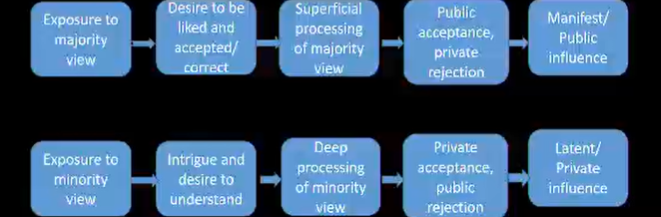
minority social influence
when a minority changes the attitudes of a majority
genetic model of minority influence
avoid these as attributes, the minor needs to adopt a particular behaviour style
5 aspects of how social norms change
consistency
investment
autonomy
rigidity
fairness
major influence
comparison process
submission to social pressure
temporary, public conformity
normative social influence
minor influence
validation process
trying to understand why the minority gas position it does
deeper level of cognitive processsing
infomrational social influencing
conversion theory