Chinese art history
 Call Kai
 Learn
Learn Practice Test
 Spaced Repetition
 Match
Match Flashcards
 Knowt Play
1/53

There's no tags or description
Looks like no tags are added yet.
Name | Mastery | Learn | Test | Matching | Spaced | Call with Kai | Chat |
|---|
No analytics yet
Send a link to your students to track their progress
54 Terms

bronze fangding featuring liewen design made at the end of the shang period

Fang: Square wine vessel , Warring States Period
Ding
a bronze ritual cauldron, often either globular (tripod) or squared, called a fangding, on four legs.
oracle bone
an animal bone, typically made from turtle in ancient China, used for divination.
Liewen
literally meaning “thunder pattern.”
piece-mold casting
A casting technique by which bronze is made by pouring metal into clay molds that are first formed around a clay model, cut away in equal sections, and then rearranged around the reduced clay model.
taotie
relates to a spirit, an ancestor, derived from the mask.

Jade burial suit bound with gold wire (Western Han Dynasty)
bi
a flat disk with hollowed at center, sometimes with a blank surface or with incised patterns and designs
Cong
pronounced “tsong:” A hollowed jade tube with a squared exterior
dao
means “the path,” the principal concept in Daoism as developed by Zhuangzi (350 – 275 BCE)
Fu Hao
wife of King Wuding in the late Shang whose burial artifacts exemplify the height of Shang period craftsmanship and objecthood
Jade flower
term in Daoist alchemy relating to longevity and eternal life, chief principles of jade as articulated in late Warring States & Han dynasty texts.
Hun and po
The souls that ascends and the soul that descends
Nephrite
a hard, fibrous silicate of varied colors
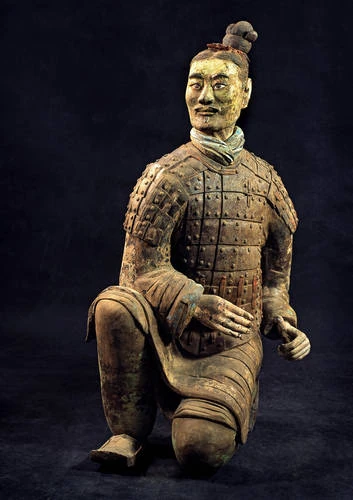
Kneeling Archer, terracotta (modular) Qin Dynasty

Acrobats, No. 5 (strong man) and No. 2 (upraised arm), terracotta, Pit K9901, Emperor of Qin’s Mausoleum, 3rd century BCE.
Terracotta
means “baked earth” and designates unglazed clay works fired between 900 -1050 C.
Lacquer
toxic sap that becomes reduced to shiny coating that is highly resistant to water, insects, and acid, protecting the works from rot and damage
Stele
stone tablet with inscription, often recording or commemorating a historical event, eulogizing a figure, etc.

A Woman, A Phoenix, and a Dragon, ink on silk, portrtait and mingjing (warring states)

Funerary Banner with the portrait of Lady Dai (Han dynasty)
Auspiciousness
good fortune; foretelling of a successful outcome or situation; positive presence
Correlation
(vs. narration): instead of a mono-directional story, the imagery is present according to conceptual relationships
Microcosm
A vast and multi-faceted space on a smaller scale and in a condensed version
mingjing
“name banner,” is made to indicate the Jiu (body in its permanent home) of the deceased, hung up beside the deceased’s coffin.
Mt. Kunlun
the realm of immortals in ancient Chinese cosmology
Polycentrism
No single center; instead, multiple systems co-existing in one space
Portrait
literally, reproducing a known person’s lifelikeness; conceptually, serving as a representation
Tu
means chart or diagram

Stone sarcophagus of Yuan Mi (d. 523), Luoyang area, Henan province,
Funerary sarcophagus featuring scenes of filial piety, Northern Wei period, ca. 525 CE,
Confucianism
Philosophical system attributed to a historical figured by the name of Master Kong serving as social code
Filial piety
behaving with the utmost respect according to familial rules and codes
Paragons
exemplars
Tuoba Wei
a powerful clan that ruled northern China from 386 – 584 CE, unifying the north in 439.

The Admonitions scroll, Tang dynasty, 3rd century Zhang Hua
Bangti
an identifying inscription or label, next to the images
Handscroll
a painting format that develops in China during the Six Dynasties period in which a horizontal painting unfolds in sections from right to left.
Six Laws
Xie He’s theories on painting, of which the first on spirit resonance (energy transmitted from the artist into the work) was perhaps the most enduring as a focal point.

Thousand-eyed, Thousand-armed Guanyin Bodhisattva, Tang Dynasty, Library Cave, Dunhuang
Bodhisattva
an enlightened being who decides to stay back in the worldly realm in order to help sentient beings reach enlightenment
Buddha
an enlightened being, also the historical Sakyamuni Buddha who lived in India in the 5th century BCE
Dharma
the Buddhist teachings
Guanyin
Literally means “perceiving sound” in Chinese, one of the most popular and important bodhisattvas, and is the bodhisattva of compassion
Mudra
hand gestures that signal various moments of the Buddha’s life, and effectuate certain processes in ritual
Sutra
a Buddhist doctrinal text

Mogao Cave 72, south wall, 9th – 10th century, Dunhuang, China
Chan
Buddhist meditation, which sometimes involves visualization (guan) practices
Ruixiang
a divine image that possesses magical power and can act on its own
Transformation tableau
two-dimensional compositions that encapsulate a sutra’s teachings.

Printed images of the Buddha, Tang dynasty
zhou
means spell or incantation (not unique to Buddhism), and is a catchall word including both mantras (esoteric Buddhism) and dharanis (exoteric Buddhism) utterances.
Frontispiece
illustration at the front of a manuscript