2. Cancer epigenomics
 Call Kai
 Learn
Learn Practice Test
 Spaced Repetition
 Match
Match Flashcards
 Knowt Play
1/25

There's no tags or description
Looks like no tags are added yet.
Name | Mastery | Learn | Test | Matching | Spaced | Call with Kai | Chat |
|---|
No analytics yet
Send a link to your students to track their progress
26 Terms
What are epigenetics?
Changes in the genome, often affecting gene expression, not due to changes in the DNA sequence.
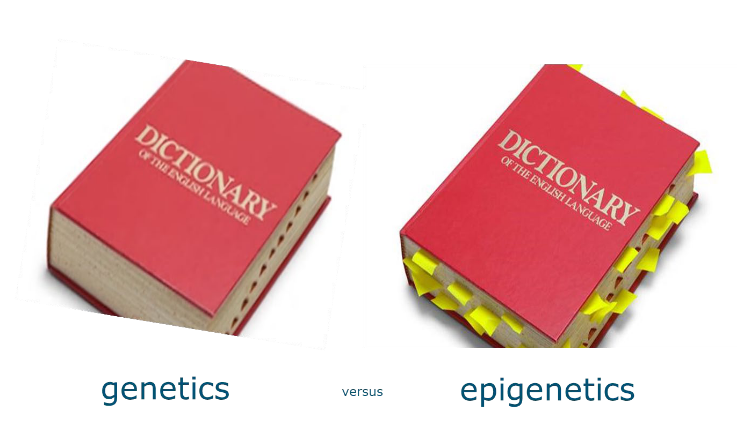
Genetics vs Epigenetics example
The dictionary itself is not changed, but your own interpretation can be added using the notes.
How can expression of genes be regulated?
DNA methylation
Histone modification
miRNA
Genetic structure in our bodies
Nucleus contains the DNA
DNA is very long strand of information that has to fit in a very small space.
Therefore the DNA is folded around certain proteins called histone proteins
Those proteins stick together making it a very tightly packed DNA
DNA methylation and cancer
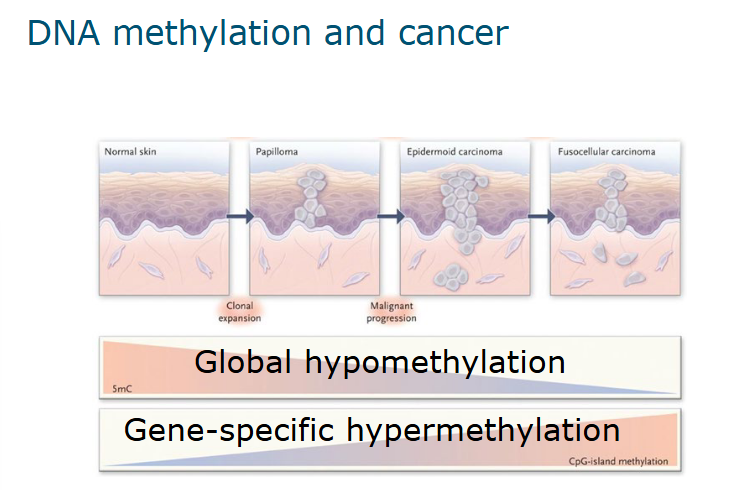
During cancer the DNA methylation is changed
Specifically, there is often hypermethylation, where certain genes are silenced such as tumor suppressor genes and DNA repair genes.
What is DNA methylation
Adding of a methyl group to Cytosine
Specifically the Cytosine that are next to a Guanine (CpG sites)
This is done by DNA methyltransferases (DNMTs)
High frequency of CpG sites (CpG islands)
Where do the methyl groups come from for DNA metylation
Through a process known as one carbon metabolism
Consists of two parts.
Firstly: the folate pathway, folate is a vitamin
Secondly: the methylation pathway.
Here methionine is converted to SAM which releases a methyl group that is picked up by an enzyme
Gene expression & DNA methylation
When a gene is expressed in it transcribed into RNA and then translated into a protein.
Gene transcription contains promoter regions and these often contain dense regions of CpG’s
Hypermethylation of CpG islands in promoter regions prevents binding of transcription factors = silencing of gene expression
DNA methylation can regulate gene expression.
Promoter regions and DNA methylation
Promoter regions are regions before a gene that highlight where transcription should start
These are often characterized by CpGs
Therefore, the promoter region can be methylated if you want a gene to be silenced and not transcribed. Because if the methyl groups are there, the other enzymes that are needed for transcription cannot bind anymore.
Repetitive elements
Sequences in the DNA that do not code for proteins
These repetitive elements are methylated because they should be silenced and not transcribed as they do not code for a protein
Methylation of these regions is very important for stability of DNA
When there is not enough methyl groups, it is known as hypomethylation
Global DNA methylation
DNA methylation can occur in the genes (gene-specific) or in the rest of the genome (global)
A lack of methylation in global regions (e.g. repetitive elements) can result in genomic instability
DNA methylation can regulate gene expression.
Meaning of low vs high methylation
‘Low methylation’ of promoter = expression
‘High methylation’ of promoter = hypermethylation = silencing
Silencing of tumor suppressor genes may be a ‘hit’ for cancer development
Which genes can cause cancer when silenced?
Tumor suppressor genes
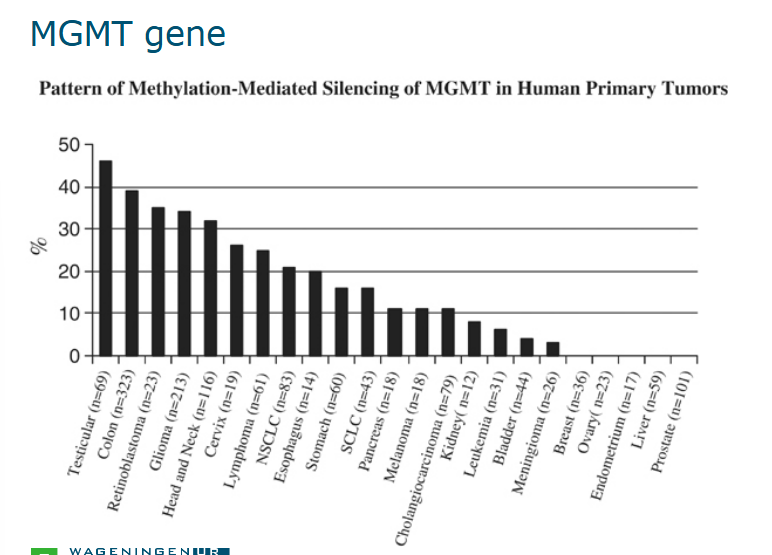
DNA repair genes (e.g. MGMT gene)
MGMT gene
Hypermethylation of MGMT promoter = silencing = mutation = cancer (epidriver)
DNA methylation and cancer
Differs between global and gene-specific
How to measure DNA methylation
Hard to do because there are many different cells that may be affected by DNA methylation differently. (e.g. breast cancer, there are different breast cells)

Genome-wide approaches of measuring DNA methylation
Can be done using array-based technology Illumina
Infinium HumanMethylation450 BeadChip
DNA methylation
500 ng DNA
12 samples
Gene-specific
>450,000 CpG sites
~99% of RefSeq genes
What is chromatin?
A complex of DNA and protein
DNA wrapped around histone proteins
4 core histones (H2A, H2B, H3, H4)
1 linker histone (H1)
Histone modifications
Modification on the tails of the histones (tails consist of amino acids) and affect chromatin structure (open/condensed)
These modifications can be because of the addition of one of these groups:
Groups: methyl, acetyl, phosphate, ubiquitin
Histone modifications may influence gene expression, DNA repair, cell cycle regulation, and genomic stability
Aberrant histone modification patterns have been associated with many cancers
How to identify histone modification?
Coding refers to residues and sites: e.g. lysine (K)
Contains numbers to know where the groups are added
Why are histone modifications important?
Determines if DNA is accessible (open or closed)
Closed DNA is not accessible, and transcription cannot occur
Open DNA is accessible, and transcription factors bind and induce gene expression.

Predicting the effect of histone modification
Usually cannot be predicted
However a few combinations and its effects are known:
Acetylation of lysine → transcriptional activation
Methylation of mono-, di- or trimethylation → repression and activation
How to read code: H3K27me3
On histone number three
Position 27 of the tail
me 3 = three methyl groups there
What is miRNA?
Non-coding RNA
Small non-coding RNA fragments
Regulatory function (regulation of gene expression)
Aberrant expression in tumors
miRNA and cancer
Post-transcriptional regulation of gene expression (stops messenger RNA from making proteins)
Interaction with target mRNA
Function:
Translational repression (protein)
Cleavage of mRNA
Oncomirs function as oncogenes or tsp-genes
Folate vs folic acid
Folate is natural form of vitamin B found in leafy greans or liver
Folic acid is synthetic vitamin B, which is more stable.