L34 - Global Patterns in Ecology
 Call Kai
 Learn
 Practice Test
 Spaced Repetition
 Match
 Flashcards
 Knowt Play
1/22

There's no tags or description
Looks like no tags are added yet.
23 Terms
What is ecology?
Ecology is the study of interactions between organisms and their environment.
What are physical factors that can influence ecology?
Physical factors that can influence ecology are;
Temperature
Water
Sunlight
Wind
Soil chemistry
Disturbance
Etc.
What are biotic factors that can influence ecology?
Biotic factors that can influence ecology are relationships between;
Predator/prey interactions
Parasitism
Symbionts
Competitors - Most organisms greatest competitor is individuals of their own species.
Etc.
What is the biosphere?
The biosphere is the parts of the Earth inhabited by organisms.
What is a biome?
A biome is a climatic region, e.g tundra, deep sea, savannah, etc.
What is an ecosystem?
An ecosystem is the functional unit of ecology: the organisms in a habitat type that interact to create its structure.
What is a community?
A community is a subset of the ecosystem that is found in one location.
What are the levels of ecological organisation?
The levels of ecological organisation are;
Biosphere
Biome
Ecosystem
Community
Population
Individual
What is a population?
A population is the members of one species that interact together, e.g. lakes have distinct fish populations.
Is biodiversity evenly distributed across the globe?
No, biodiversity is not evenly distributed across the globe.
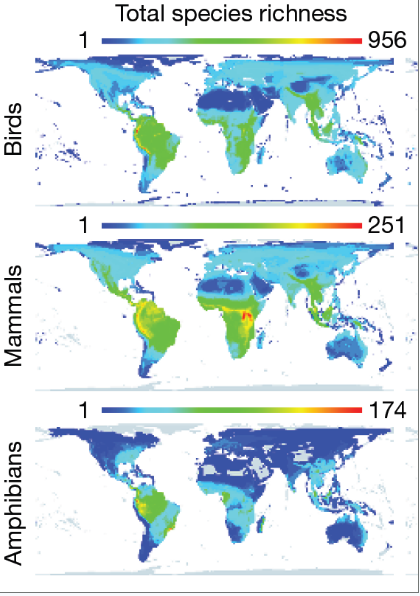
What do different taxonomic groups often show in terms of their distribution?
Different taxonomic groups often show parallel patterns of biodiversity. Therefore, we can use taxonomic groups that are easy to survey, such as birds, to give us an idea of the biodiversity of other taxonomic groups in a region.
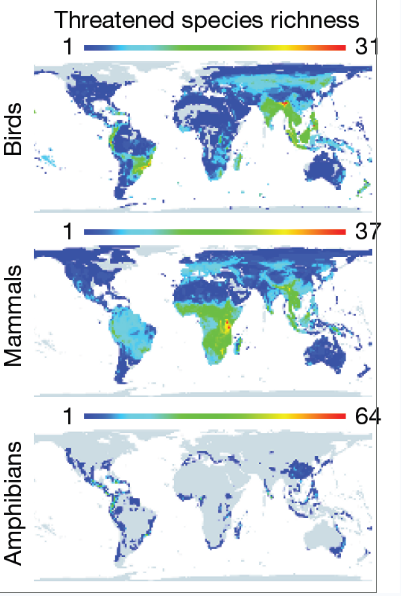
What do the threatened species of different taxonomic groups often show in terms of their distribution?
Threatened species of different taxonomic groups do not show parallel patterns of biodiversity.
What is the general trend of distribution of biodiversity across the globe?
The general trend of distribution of biodiversity across the globe is that there are more species near the equator than at the poles. This is found in animals and plants, marine and terrestrial.

What is the reason for the general trend of high biodiversity at the equator, and low biodiversity at the poles?
There are over 25 hypotheses for this trend, but none account for all of the observed patterns, suggesting that there may be different explanations for different taxa. The underlying factor of most of these hypotheses is likely to be greater climatic stability and productivity at the equator, leading to greater speciation/smaller niches,
23:35 make glashcards