cell structure
 Call Kai
 Learn
Learn Practice Test
 Spaced Repetition
 Match
Match Flashcards
 Knowt Play
1/8

There's no tags or description
Looks like no tags are added yet.
Name | Mastery | Learn | Test | Matching | Spaced | Call with Kai | Chat |
|---|
No analytics yet
Send a link to your students to track their progress
9 Terms

plasma membrane
All cells must have an outer border to maintain an internal chemistry that is different to the exterior (homeostasis)

genetic material
All cells must contain coded instructions (DNA) that function to control internal activities within a cell (metabolism)

ribosomes
All cells must contain ribosomes in order to translate the cell’s coded instructions into functional elements (proteins)

cytosol
All cells must contain an internal fluid that functions as a reaction medium for all necessary metabolic processes
what are atypical structures
Certain types of eukaryotic cells and tissues do not conform to the standard organisation of a typical cell
These cells have developed unique characteristics in order to better to support their specific cellular activities
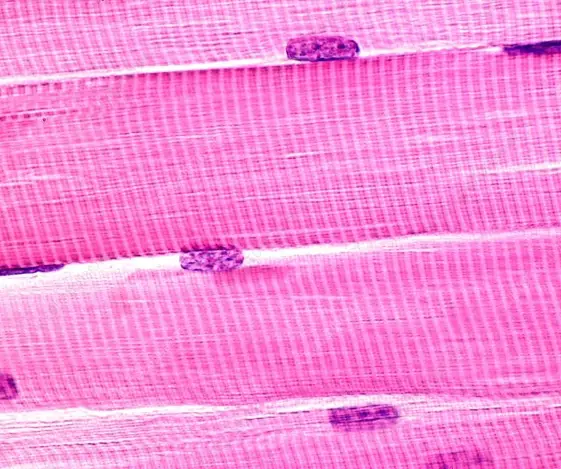
striated muscle fibres
Individual muscle cells fuse together to form long striated muscle fibres
These fibres are surrounded by a continuous plasma membrane and possess multiple nuclei
Striated muscle fibres challenge the idea that all living things are comprised of discrete cell units

aseptate fungal hyphae
Fungi may have filamentous structures called hyphae, which are used for nutrient absorption and growth
Hyphal cells are typically separated by internal walls (septa), but some hyphae are not partitioned and have a continuous cytoplasm (with multiple nuclei)
Aseptate fungal hyphae challenge the idea that living structures are composed of autonomous cells

sieve tube elements
Sieve elements that line the phloem in plants are interconnected by plasmodesmata into supracellular assemblies that transverse the length of a plant
These sieve elements also lack nuclei and have few organelles, relying on local companion cells for survival
Phloem sieve tube elements challenge the idea that multicellular structures are composed of anatomically independent cells

red blood cells
Red blood cells have no nucleus or mitochondria when they are mature (the organelles are ejected to allow more haemoglobin to be stored)
Without any genetic material, red blood cells cannot independently replicate and new cells must be continually produced within the bone marrow
Red blood cells challenge the traditional definition of a eukaryotic cell as they lack critical structures needed for autonomous survival