Biochem - Section 2: Enzyme Kinetics and Inhibition
 Call Kai
 Learn
 Practice Test
 Spaced Repetition
 Match
 Flashcards
 Knowt Play
1/54

There's no tags or description
Looks like no tags are added yet.
55 Terms
enzymes
molecules that act as a catalyst in a reaction
not all proteins are enzymes and not all enzymes are proteins
Catalyst
act in a reaction to decrease the amount of activation energy need to reach the transition state of a reaction
changes the rate of the reaction but not the change in free energy
What do enzymes do to ΔG‡
they decrease it
What do enzymes do to ΔG
nothing they don’t change this
what do enzymes do to Keq
ezymes do not have an effect on the equilibrium constant of the reaction
How do enzymes quicken the rate of the reaction
they bind to the transition states of the reaction better than substrates
enzyme bind to ES than then tighter binding to the transition state stabilizes the interaction and lower the activation energy needed

read this reaction coordinate diagram
ΔG‡ = activation energy
ΔG = change in gibbs free energy
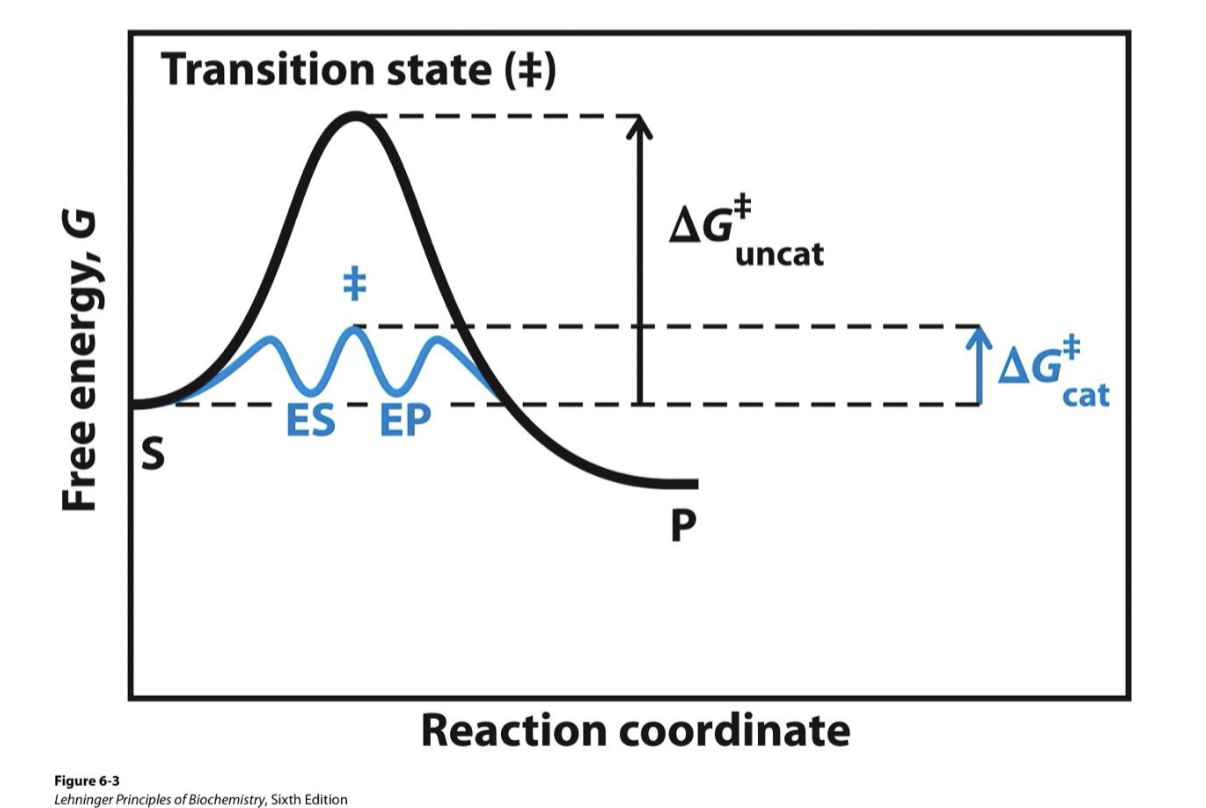
what factor do the change of free energy of a reaction rely on
standard change in free energy
concentrations of reactants and products
note tat this is additive
nucleophiles and electrophiles
nuc: electron rich moelcule that donates pair of e- to form a bond
el: electron poor molecules that accept a pair of electron to form a bond
acid base catalytic mechanism
giving and taking protons
covalent catalysis
involves a change of reaction paths
metal ion catalysis
uses redox factors or pKa shifters
electroststic catalysis
preferential interaction with TS
oxidoreductases
class of enzyme used in oxidation-reduction reactions
transferase
class of enzyme used for the transfer reaction of functional groups
hydrolase
class of enzyme used in reactions where H2O is used to break a bond
lyase
class of enzyme used in reactions where functional groups are added or removed
isomerase
class of enzyme used in reactions where compound is converted to its isomer
ligase
class of enzyme used when a new bond is formed that requires energy
homolytic cleavage
rare cleavage of a bond where the electron pair splits - one goes to the 1st product one goes with 2nd product
heterolytic cleavage
more common cleavage where both electron go to the same product
leads to unstable products
pre steady state
phase of enzyme reaction where the [ES] is building up but is not steady -see green area

Steady state
[ES] is constant, and P forms at a steady rate - see orange area
this is the phase modeled by the Michaelis-Menten kinetics models the steady state

Approach to equilibrium
S is depleted and the rate slows
initial velocity (V0)
the slope of the tangent to the progress curve at t=0
this is measured in the steady state of the reaction - when [S] » [E]
each starting [S] give one Vo;
Does V0 increase linearly with [S]
No it does not
there are only so many enzyme active sites
the enzyme eventually saturates which means that all sites are busy so more substrate doesn’t raise V0

Km
Michaelis constant - an approximate measure of substrate’s affinity for an enzyme
units - mM, micromole
lower Km -half of Vmax is reached at lower [S]
higher Km - more [S} is needed to reach half of Vmax
kcat
turnover number - the number of substrate molecules that an enzyme molecule can convert per second
kcat = Vmax/[E]
units - s-1
Vmax changes with [E], kcat doesnt
assumptions of MM kinetics - 5
initial velocity is measured early so [P] is low and E + P → ES is ignored
[S] » [E] ([S] = [Stotal]
in the steady state, [ES] is constant (the rate of formation equals the rate of breakdown)
theres a constant amount of enzyme present
the scheme is simple - one substrate, one product, independent active sites
MM scheme
E + S → ES → E + P (there a k1, k-1, and k2 all are rate constants)
rate of product formation depends on [ES]: V0= k2[ES]
higher [S] = more ES and a faster reaction
Vmax
the rate of reaction when [S] increases to the point where all active sites are occupied (saturation)
Vmax = kcat[Etotal]
units - micromoles/min
how are Km and Vmax related
Km is ½ of Vmax
kcat/Km
measures how efficiently an enzyme uses S at low [S] (catalytic efficiency)
units - M-1s-1
limit of the result is how fast S diffuses to the enzyme
perfect enzymes - 107 - 109 M-1s-1
when does Km = Kd (dissocication)
only when k2 « k-1
what kinds of kinetic mechanisms can multi-substrate reactions have
sequential mechanisms
ping pong mechanisms
sequential mechanism
binding creates a tertiary complex where all substrate must bind to the enzyme before product is released
can be random or ordered
ping pong mechanism
substrate bind and release before the next substrate comes in
no tertiary complex is involved
Lineweaver-Burk plot
plots 1/[S] vs 1/Vo
slope - Km/Vmax
y interept - 1/Vmax
x-intercept = -1/Km

Why are lineweaver plots less accurate
the plot cluster points and distorts the error bars so that small errors at low [S] become large errors in 1/V0
a V0 vs [S] plot has error bars of equal sizes for each [S]
irreversible inhibitors
react with the enzyme
one molecule can permanently shut off one enzyme molecule
powerful toxins but may be used in drugs
reversible inhibitors
bind to and can dissociate from the enzyme
can be structural analogs of substrates or products
often used as drugs to slow a specific enzymes
can bind to free E to prvent binding to S or bind to ES and prevent the reaction
Penicillin
acts as a irreversible inhibitor
ressembles the substrate and binds to the active site of the enzyme
it forms a covalent bond with the enzyme and makes it so the enzyme cannot build the bacteria cell wall
competitive inhibition
type of reversible inhibition where the inhibitor directly competes with the substrate making it so it cant bind
does not affect catalysis directly or react to form P
Vmax stays the same, but the apparent Km increases
competitive inhibition lineweaver plot
slope increases with increasing inhibitor concentration
lines meet on the y axis
y intercept = same , X int = moves toward 0

uncompetitive inhibitors
binds only the ES complex at an allosteric site and prevents catalysis, no effect on substrate binding
Vmax and Km both decrease
uncompetitive inhibitor lineweaver
slope remains the same - cause Km/Vmax stays the same
y intercept increases making Vmax smaller
parrellel lines

mixed inhibition
binds to E or ES at a different site than active site so substrate binding and catalysis are inhibited
affinity for E and S differs
Vmax decreases, apparent Km can increase or decrease
mixed inhibition lineweaver-Burk
slope and the y intercept both increase
x int moves either way
lines meet left of the y axis

Noncompetitive inhibition
special case of mixed inhibition where it binds to E and ES with the same affinity
inhibitor binds to a different site than the active site
it blocks catalysis and leave substrate binding intact
Vmax decreases, Km stays the same
Noncompetitive inhibition lineweaver burk
slope and y intercept both increase
lines meet on x axis
methotrexate
competitive inhibitor tat resembles the folate substrate of DHFR
binds to active site where folate is suppose to bind
increased substrate concentration competes it away - v max same Km inc
needed for nucleotide synthesis
allosteric enzymes
binding at one site changes the activity at another site
on a V0 vs S plot, the curve is sigmoidal instead of hyperbolic
have T state and R state
can be homo or heterotropic
T states and R states
T-state: low affinity for substrate
R-state: high affinity for substrate
homotropic vs heterotropic effectors
homotropic - the substrate binds
heterotropic, other molecule binds
Hill coefficient
V0 = Vmax[S]n / (K0.5n + [S]n)
n = 1 hyperbolic curve, no cooperativity
n > 1 positive coop, sigmoidal
N<1 negative coop