UPEI 2040 ZOOLOGY LAB EXAM
 Call Kai
 Learn
 Practice Test
 Spaced Repetition
 Match
 Flashcards
 Knowt Play
1/53

There's no tags or description
Looks like no tags are added yet.
54 Terms
What does early development depend on
a) pattern of cleavage
b) type of coelom formation
c) blastopore orientation
What is pattern of cleavage?
the way mitosis proceeds from an egg to a blastrula.
Whats radial cleavage?
Uniform division ending in symmetric blastomeres. (1→2→4→16)
What’s spiral cleavage?
Non-uniform division ending in asymmetric blastomeres. (1→2→4→11)
What are the two different types of coelom formation?
Entero-coelous Schizo-coelous
What is the Entero-coelous type of coelom formation?
Formation of mesodermal pouches.
What is the Schizo-Coelous type of coelom formation?
Formation of mesodermal splits.
What are the two types of blastopore orientation
Deuterostome and Protostome
What is a deuterostome?
where the blastopore becomes the anus, and mouth forms later.
What is a protostome?
Where the blastopore first becomes the mouth, the anus forms later.
What is the Phylum Porifera?
Sponges.
Three body types of Porifera we looked at in lab?
Ascon, Sycon, and Leucon.
What are the unique structures of the Ascon body type?
Thin walls with large atrium and osculum, simplest body type. Contains choanocytes for water flow and filter feeding, with a vase body shape.
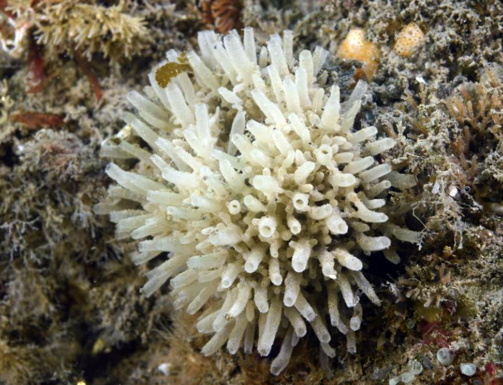
What type of sponge body type is this?
Ascon
what is the unique structures of the porifera body type Sycon?
Have finger like projections near the osculum with dermal pores that increase the surface area.

What type of songe body type is this?
Sycon
What are the unique body structures of the porifera body type Leucon?
Has a rough appearance with many ostia, with the many branching canals that feel like fragile crystal fragments.

What type of sponge body type is this?
Leucon
What are the four classes of Porifera?
Calcarea, Demonspongiae, Hexactinellida, and Homoscleromorpha.
What is Class calcarea (porifera)?
3-ray spicules skeleton, shallow water species.
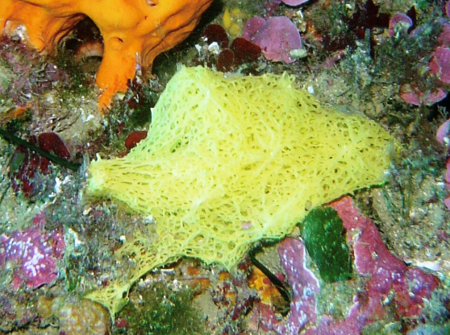
What porifera class is this?
Calcarea (looks like cheese)
What is class demonspongiae (porifera)?
they have soft various spicules, found in deep or shallow water and include most sponge species.

What porifera class id this?
Demonspongiae.
What is the class hexactinellida (porfiera)
a glassy 6-ray spicule skeleton structure, found in deep sea.

What porifera class in this?
Hexactinellida
What is the class homoscleromorpha (porifera)?
Reduced skeleton with little to no spicules.

What porifera class is this?
homoscleromorpha (looks like noodles)
What type(s) of reproduction do porifera’s have?
Both sexual and asexual
How does Porifera sexual reproduction occur?
Sponges are hermaphrodites and can produce both eggs and sperm, releasing sperm (modified choanocytes) into the water to fertilize eggs (modified amoebocytes) of other sponges.
How does porifera asexual reproduction occur?
through budding or fragmentation and the regeneration of gemmules (the parts of sponges that can grow into new individuals)


Label this Sycon sponge
A) mesohyl
B) radial canal
C) incurrent canal
D) atrium/spongocoel
E) choanocytes
F) mesohyl
G) pinacocytes
H) radial canal
What is the phylum Cnidaria?
Jellyfish & Polyps.
What are the three classes of Cnidarians did we talk about in lab?
Hydrozoa, Scyphozoa, Anthozoa.
What type(s) of body structure does class Hydrozoa have?
Has both polyp and medusa.
What are the two structures of Cnidaria?
Medusa and Polyp.

What is a unique structure to cnidarians?
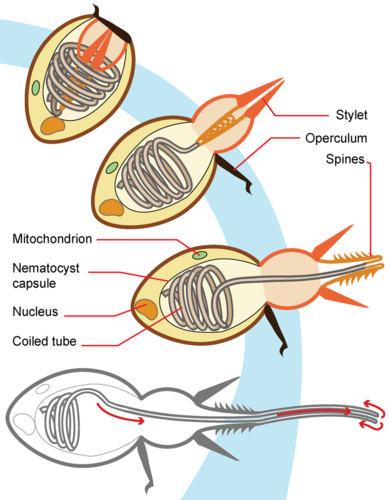
They posses specialized cells called cnidocytes that is a harpoon(nematocysts) like structure used for hunting and defense.

What is this? how does it reproduce?
Budding Hydra. only reproduces asexually, note the skinny polyp form and no medusa.
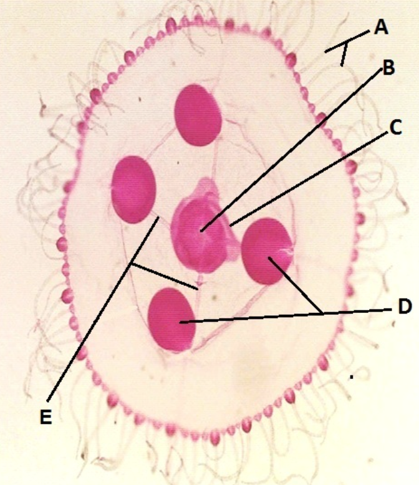
What is this? What makes it memorial?
Obelia Medusa. Note the tentacles along the edge of the umbrella, and the large gastrovascular cavity.

Label the obelia medusa.
A) tentacles
B) mouth
C) manubrium
D) gonads
E) radial canal
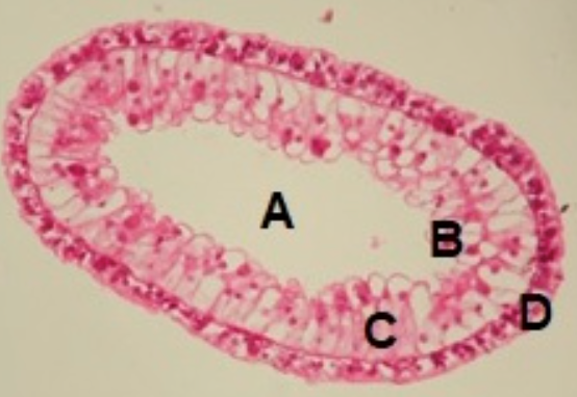
Label Hydra c.s.
A) gastrovascular cavity
B) gastrodermis
C) mesohyl/mesoglea
D) epidermis

What is this? What is unique about it?
Obelia colony. The cylindrical gonozoid, tentacled gastroid, epidermis (hydracaulus), and gastrovascular cavity.
What type(s) of body structure does the class Scyphozoa have?
Medusa dominant.

What is this? What is unique?
Aurelia Medusa. ‘C’ shaped gonads, small tentacles, large oral arms, central mouth, and indented rhopalium around the edge of the umbrella.
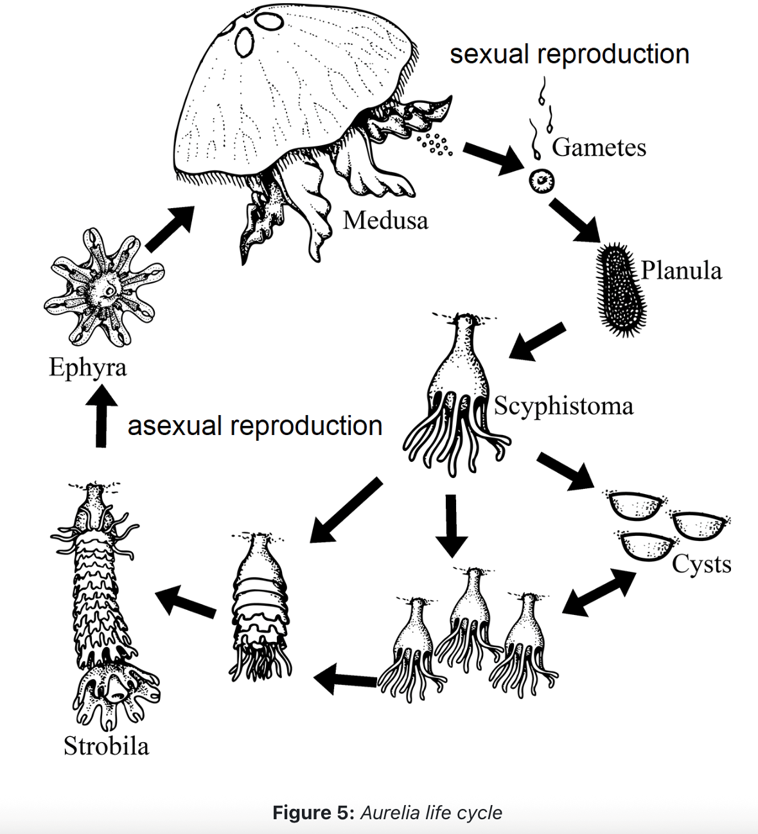
Life Cycle of class Scyphozoa.

What is this? (cnidarian)
Planula: free swimming (apart of scyohozoa life cycle)

What is this? (cnidarian)
Scyphistoma: small polyp (scyohozoa life cycle)

What is this? (cnidarian)
Strobila: stack of polyps. (scyphozoa life cycle)

What is this? (cnidarian)
Ephyra: pre-medusa. (scyphozoa life cycle)
What is in the class Anthozoa, and what body structures do they have?
Sea anemones and corals. Polyp dominant.
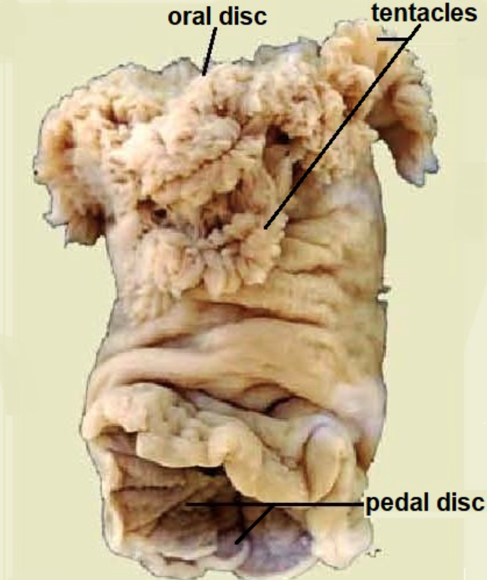
What is this? Whats unique about it?
Metridium. The tough body (thick epidermas), central mouth on the oral disc, and tubular pharynx that leads into the gastrovascular cavity.

What is this? What is unique about it?
Metridium c.s. The endoderm that lines the pharynx, and the mesohyl below the external epidermis.

What is this? What is unique about it?
Dried coral skeleton. The hard CaCO3 skeleton with cups where polyps live in colonies.
What is the phylum Platylhelminthes?
Flat worms