7. Effects of pre- and post- mortem handling on carcass and meat quality
 Call Kai
 Learn
Learn Practice Test
 Spaced Repetition
 Match
Match Flashcards
 Knowt Play
1/68

There's no tags or description
Looks like no tags are added yet.
Name | Mastery | Learn | Test | Matching | Spaced | Call with Kai | Chat |
|---|
No analytics yet
Send a link to your students to track their progress
69 Terms
Pre-mortem transportation of animals
On farm individually selected, drafted and sometimes weighed
Groups of marketable animals made up from different rearing pens
Transport via road
▪ Specially designed vehicles
▪ Ventilation requirements important – at high ambient temperatures*
▪ Very low ambient temperatures may also be a problem
* chickens- no sweat glands
Animal handling
Animal loading and unloading can be difficult and stressful
Some vehicles require steep loading ramps is difficult for animals to negotiate
Pigs more easily loaded and unloaded using vehicle tailboard hoists or tail lifts
Animals may be reluctant to move out of pens or through races
Take advantage of their natural behavioural characteristics - design and operation of handling facilities
Picking up of birds
Poultry harvesting: catching birds and placing in transport crates
Broiler chickens mostly raised on litter i.e., wool shavings in sheds housing with thousands of birds
Hens often housed in battery cages and removal at end of laying life more difficult than catching broilers
Birds picked up:
Manually by teams of catchers
Mechanical ‘harvesters’ - rotating rubber fingers collect and encourage birds on to moving conveyors
Problems with closely stacked crates
Restricted airflow and ventilation may be poor
Birds may suffer hypothermia
Birds on outside may get very cold
In cold weather, side curtains should be used to protect birds
High probability thermal stress suffered by at least some birds in transit
Live auction and computer auctions and animal handling
Animals may be sent directly from farm or production unit to slaughter plant
May be sold via collecting stations or auction markets
Live auction (more for beef animals today)
Increases time between leaving farm and slaughter
Increases chance of different animal group being mixed
Computer auctions beneficial - duration of handling reduced
Distance between farm and slaughtering facilities
Normally slaughtering facilities nowadays more centralized in fewer plants - marketing times and animal travel distances likely to increase
Lairage/stockyard
After arrival of animals at slaughtering facility, held for lairage or stockyard depending on animal condition and travel distance
Need to be supplied with water and (if appropriate) bedding and food
Lairage conditions should be ocnductive to animal resting - recover form rigors of transport
Animals can spend between 1 and 24 hours in lairage
Some countries: legal minimum and maximum times prescribed
Stresses associated with marketing
Physical stress: temperatures, noise, changes in acceleration
Physiological stress: Breakdown of social group; mixing with unfamiliar animals; unfamiliar or noxious smells; new environments
Marketing
Involves: removed from home environment; loaded and unloaded on to vehicles; long journeys; held in
unfamiliar surroundings with different animal
Why are animals not fed before transport?
To prevent faeces
However may cause hunger, thirst and fatigue during transport
Effects of transport on meat quality
Carcass quality equates to carcass yield and easy to relate to economic loss
Total loss is animal dies during transport
Losses of variable sizes if carcass damaged through bruising, haemorrhage, fighting or other trauma
Mortality of animals during transport
Death of animal is total loss of value
Mainly affects pigs and broiler chickens; ruminants more resilient
Fines exist by government if animal dies.
In eu occurs ±0.1% to >1%
Two major factors influencing mortality of animals during transport
Environmental temperature
In northern Europe where average daily temperatures are below 10C incidences are very low.
In places where the temperature is above 18 C, there is a rapid increase in mortality - also depends on season
Genotype
Stress-susceptible pig breeds more prone to dying in transport
Explain variation between countries - more pigs dying in places where genes from stress-susceptible breeds are widely disseminated
Where frequency Halothane gene is low - mortality is still demonstrated
Mortality of birds
In UK 2 million birds are lost per year durng transport
Longer transport = higher mortality
Adequate ventilation during transport is necessary
Therefore reducing bird stocking rates in transport containers can reduce mortality
Careful bird catching can influence mortality by affecting trauma inflicted.
Bruising during marketing
Can occur during:
Handling on farm
Transport and unloading
Time immediately after stunning, but before exsanguination
Is an aesthetic problem rather than a hygiene problem.
Haemorrhages during marketing
Blood from damaged blood vessels accumulate in surrounding tissue:
Bruised meat looks unsightly and usually trimmed
Reduces yield and frequently leads to downgrading
Cost of downgrading may be greater than value of trimmed meat
Why is carcass damage a problem?
Bruised tissue likely higher intitial microbiological load than normal tissue
Aesthetically undesirable
Can be caused by misuse of slap markers or due to slipping
Cause of bruising in cattle
Due to (fighting) behavior, especialy in males/young bulls
Often caused by trying to move animals too quickly, particularly over uneven or slippery floors
Too high/too low stocking density during transport can cause bruising
Extreme under stocking - animals thrown about when vehicle is moving
Overstocking usually greater danger
Insufficient space to position legs for maintaining balance with changes in velocity
Horned cattle can cause damage to other stock in close confinement
Long periods without food
Chronic stress
Live auctioning due to more journeys + handling in market
How is carcass damage assessed?
Scoring system
However, attempts to estimate age of bruises has not been very successful
Characteristic color changes caused by breakdown of haemoglobin in blood.
Therefore to test the age of a bruise you can test bilirubin content
Skin blemish in pigs
Superficial skin damage caused by fighting in pigs, particularly between unfamiliar animals
Pigs, when togheter develop stable social hierarchies
Pigs from different rearing pens mixed to make up batches with similar live weights, also mixed in lairage
This disrupts hierachies = fighting
Fights can be severe and cause lacerations on skins
Broken bones and bruising in poultry
Chance increased due to restricted movement
Care during handling
Broken bones may cause bone splinters in meat - dangerous to consume if not detected after deboning
Today - use X-ray technology
Bruises may be caused by stunning at slaughter
Most occurs on breast → legs → wings → back → thighs
Factors influencing level of bruising in birds
Strain and age of birds; season; degree of muscling; care during handling
e.g. modern strains of turkeys is bigger but younger at slaughter - very prone to carcass damage
How does a reduction of live weight and carcass yield by inanition and transport occur?
Animals are deprived of food for some time before slaughter
Live weight loss due to loss of gut fill and excretory losses
Loss rate ± 0.2% per hour
Carcass weight loss due to mobilization of tissues to provide energy for maintaining vital functions of body + dehydration
Overall ruminants less sensitive due to proportianlly larger gut
Implications of food and water deprivation and other stresses
Disposal of large quantities gut contents at abattor is costly
Sheep and cattle → long periods without water is skin removal more difficult
Red meat species → some evidence that long food deprivation can lead to a build-up of pathogenic bacteria in gut
Pigs fed too soon before transport show slightly increased mortality rate (shoudl not have access to food within 4h of loading)
Food deprivation periods in ruminants - stomach content more watery
Poultry - contamination with Salmonella and Campylobacter
Longer feed withdrawal cause increased prevalence Salmonella in laying hen crops and higher prevalence birds testing positive for Campylobacter jejuni in cloacal swabs
However animals may poop when nervous and spread disease
What causes PSE?
PSE = Pale, Soft and Exudative meat
Acute stress, mainly affects pigs
Denk er zo overna: als je stres hebt gaat als het bloed uit je lijf.
Acute stress accelerates the post-mortem rate of muscle acidification while the carcass temperature remains high
Muscle reaches a low pH while internal carcass temperature is still warm
This causes protein denaturation
Denatured proteins lose their water binding ability, and the myofibrillar lattice shrinks, forcing fluid into the extracellular space. When the meat is cut, this fluid exudes as sever drip loss
Denatured protein = scattered light = pale look.
What causes DFD?
DFD = dark, firm and dry meat
Chronic stress, occurs in all species
Caused by chronic stress, starvation, fighting or prolonged exhaustion prior to slaughter
This causes muscle glycogen reserves to be depleted before death
As a result there is no lactic acid produced and ultimate pH is really high (causing spoilage)
Therefore proteins do not denature and water remains tightly bound within the myofibrils
pH values PSE and DFD meat
pHu is into eternity. (ultimate pH)
No variation between muscles

Why does DFD have high spoilage potential?
Two reasons:
DFD meat caused by glycogen depletion pre-mortem (low levels CHO in muscles)
Prevents growth LA bacteria → encourages growth of bacteria that metabolize amino acids and proteins
Produce unpleasant smelling waste products
High pH of meat promotes bacterial growht
Spoilage risk serious problem in processed raw products
Problem of high pH when vacuum packing
High pH may occur in DFD meat. High pH meat can be a problem when vacuum packed:
Green coloration
Formation of sulfmyoglobin
Haem pirgments myoglboin reacts with sulfide
Producing bacteria unde anaerobic conditions
Why can PSE meat hold less water?
low pH and high temp → denaturation of some muscle proteins
Shrinkage of myofibrillar lattice expels resultat fluid into extracellular space → increase in volume
Color of PSE meat
Light scattering from surface caused by differences in refractive indices of myofibrils and sarcoplasm
Larger the difference → higher scattering → paler meat appearance
Causes of color of DFD
Myofilament shrinks little to none
Therefore difference in refractive indices of myofibril and sarcoplasm reduced
Muscle present closed, translucent structure that absorbs rather than reflects light → meat appears dark
Closed structure reduces diffusion of oxygen into muscle from surface
Any oxygen that does reach interior used by high cytochrome activity encouraged by high pH - results in very thin surface layer bright red MbO allowing purple color redued Mb to show through.
PSE vs DFD

Two-toning
Quality defect where a single cut or adjacent muscles display a noticeable, uneven contrast in surface color
Chronic pre-slaughter stress is DFD and acute pre-slughter stress is PSE is oversimplified
To some degree different pre-slaughter handling factors interact
Pig exposed chronic stress pre-slaughter is high pHu even if breed prone to PSE
Different muscle types are more susceptible to PSE/DFD
‘White’ muscle is less susceptible to glycogen than ‘red’
Ocassionally single carcass may show both PSE and DFD conditions in different muscle is two-toning
Two-toning due to temperature
Heat ring is sued to describe the occurrence of both dark and pale colored areas in the same muscle - rare condition and physiological and biochemical basis is unclear.
Can occur in beef if pH of same part of muscle drops more quickly than normal when muscle temperature is still high.
Outmost part cools quickly → appears darker
Innermost part cools slowly → risk denaturation and meat appears paler
Pale beef sometimes occur in deep muscle of leg because cool relatively slow.
What is blood-splash?
Not a hygiene concern but detracts from meat appearance and is economic problem
Discrete spots of haemorrhage ranging from pin-head size to ± 1cm in dm
Frequently seen on inside of thoracic cavity → may occur in any muscle
Occurs most commonly in lambs and less commonly in older sheep
How does blood-splash occur?
Animals slaughtered without prior stunning show little/no blood splash
All stunning methods increase blood splash to varying degrees
Rise in blood pressure increases chances of capillaries rupturing
Carcass chilling
After slaughter, carcass starts to cool down. The rate at which this occurs depends on:
Size of carcass → larger carcasses cool slower
Subcutaneous fat cover → insulating as thermal conductivity low compared to muscle and bone
Air circulation
Modern proactice to speed up process of chilling using frige air.
Reduces microbe growth
Also may prevent weight loss compared to normal chilling
Balance between cooling and rigor mortis onset
If rigor mortis develops too rapidly while carcass temperatures are still high then it may lead to PSE and heat shortening
If rigor mortis develops too slowly while the carcass is chilled rapidly than cold shortening happens.
pH fall and temperature
Tightly linked process, occurs post-mortem
Rate of pH fall is at minimum at 10C between an in vivo pH of 7 and 6.1. The rate is approximately linear with time.
As muscle temperatures rise from 10C towards 37C, the rate of pH fall increases due to the activation of Ca2+ independent ATPase
As temperature drops form 10C towards 0C the rate of pH fall increases again due to Ca2+ dependent ATPase activation
What is preferred temperature before further handling?
7C or lower. If this doesnt happen than aging may accelerate.
Effect of cooling rate on muscle metabolism
Cooling rate has other implications besides effects on microbiology, weight loss and WHC.
Enzyme activity still occurs after an animal has been slaughtered and enzyme activity is temperature dependent and affected by cooling rates
Rates of pH fall through lactic acid production
Disappearance of CP and ATP
Speed of rigor mortis onset
ATP depletion post-mortem
Initial delay phase
ATP used for normal energy consuming processes in muscle is wholly/partly replenished by resynthesis from CP and through glycolysis
Length of delay phase temperature dependent: max. at 10-15C
Second phase where ATP falls
Re-synthesis cannot maintain ATP concentration and falls in linearly
At lower and higher temperature → delay phase is shorter
Rate of second phase is temperature independent
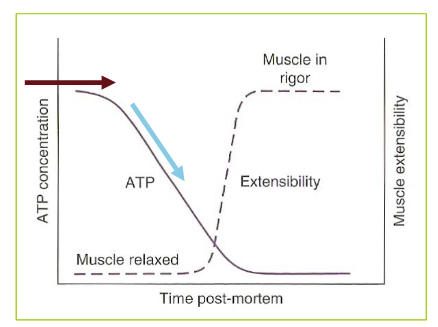
Three practical implications of different rates of carcass cooling
Cold shortening
Thaw rigor
Heat shortening
Cold shortening
Cold shortening is a major meat defect that occurs when pre-rigor muscle is cooled below ~10°C before rigor mortis has set in (specifically before muscle pH drops to ~6.1)
Gives very tough meat, even after cooking
Mechanisms cold shortening
Failure of the Calcium Pump: At temperatures below ~10°C, the sarcoplasmic reticulum (SR) and mitochondria lose their ability to sequester calcium ions.
Actomyosin Activation: A massive release of un-sequestered Ca²⁺ enters the sarcoplasm. Because ATP is still present in pre-rigor muscle, this calcium activates actomyosin ATPase, triggering active muscle contraction
Species & muscle fiber susceptibility of cold shortening
Lamb: Most prone to cold shortening because carcasses are small enough to cool rapidly before rigor mortis develops.
Beef: Prone to cold shortening (especially smaller or leaner carcasses), whereas heavier carcasses with thicker insulating fat cover cool more slowly.
Pork & Poultry (Chicken): Generally less susceptible because they enter rigor mortis very rapidly, though intense modern chilling systems can still shorten superficial muscles.
Red vs. White Muscle Fibers: Red (oxidative) muscle fibers are more prone to cold shortening than white (glycolytic) fibers because red fibers have a less-developed SR and contain more mitochondria, which also release un-sequestered calcium at low temperatures.
Effect of cold shortening on the meat
Sarcomere Shortening: The resulting muscle contraction occurs without relaxation, leading to shortened sarcomeres with excessive overlap of thin (actin) and thick (myosin) filaments[5].
Uneven Contraction & Persistent Toughness: In practice, cold-shortened muscle undergoes localized, uneven areas of contracture, producing meat with variable texture that is persistently tough after cooking[5][6].
Inhibited Aging: Meat with severely shortened sarcomeres undergoes little to no post-mortem tenderization (conditioning/aging)[2][6].
How can cold shortening be resolved?
effect of CS can be improved by long conditioning times
does cold shortening occur during rapid chilling?
Would be expected
But can lead to tender meat in some circumstanes rather than toughening
Potential reasoning:
hard crust forme by frozen surface → prevent shortening of underlying muscle by physical restraint
differential freezing might cause fractures/breaks in meat structure → tenderising
massive release of Ca caused by low temperature → promote proteolysis by stimulating calpain systems
Explain thaw rigor
Rate of carcass cooling is sufficiently high, meat freezes before rigor onset then on thawing muscle shortens severely. Meat becomes tough after cooking.
Mechanism of thaw rigor
Muscles freeze while ATP and glycogen reserves remain high
Upon thawing, the sarcoplasmic reticulum (SR) releases a sudden, massive flood of calcium ions (Ca2+) into the sarcoplasm - an effect that is even more acute in muscle frozen very rapidly
The unsequestered calcium activates contractile actomyosin ATPase (unlike the non-contractile ATPase involved in normal rigor), causing ATPase activity to surge up to 10 times higher than normal[3]. This drives extremely fast glycolysis and hyper-accelerated ATP depletion, triggering intense, violent muscle contraction
Thaw rigor impact on meat quality
Thawing muscle shortens muscle, losing 50% or more of its orginal resting length
Meat quality causes massive drip loss: the violent contracture squeezes water out of the myofibrillar matrix, causing severe exudate loss of up to 30% of total muscle weight
The extreme sarcomere shortening produces meat that is exceptionally tough after cooking.
Mitigation and prevention of thaw rigor
Keeping muscle attached to the carcass skeleton under tension physically restricts fibers from contracting upon thawing
Slow thawing: allows remaining ice structure to physically block contracture while ATP gradually depletes
Extended frozen storage: storing pre-rigor frozen meat below freezing for an extended period gradually reduces ATP concentrations and actomyosin ATPase activity over time, dampening the thaw rigor reaction when the meat is eventually thawed.
Why would electrical stimulation be used?
Electrical Stimulation of carcasses at various times after slaughter speed up normal post-mortem processes by causing intense muscle contractions.
Use up glycogen and CP, promote rapid pH fall and earlier rigor mortis development
How does electrical stimulation give tenderization?
Intense contraction physically disrupts and weakens muscle structure
Ca released during contraction might stimulate calpains at time when muscle temperature and pH are high = greater proteolytic breakdown
Lysosymes might be disrupted, allowing release of cathepsin
Potential concern of electrical stimulation
May increase rate of pH fall in some deep muscles (beef), low pH reached when temperature still high producing equivalent of PSE muscles unless cooling accelerated by hot deboning
Electrical stimulation and flavor
May improve flavor by affecting concentrations of flavor precursors and enhancers in muscles
Difference in electrical stimulation at low and at high voltage.

Would you recommend to use electrical stimulation on pigs, why or why not?
Not because:
High risk of PSE as it accelerates post-mortem muscle acidification while carcass temperatures remain high
Pigs have a rapid rate of rigor onset = lower chance of cold shortening = ES not necessary
What is heat shortening?
A meat quality defect that occurs when muscle enters rigor mortis while the carcass temperature is still high and muscle pH drops rapidly
Mechanism behind heat shortening
Uninhibited Muscle Contraction:
When muscle metabolism is accelerated at elevated temperatures, muscles contract and shorten pre-rigor without relaxing.
This shortening leads to shorter sarcomere lengths, increasing physical toughness.
Denaturation of Calpain Enzymes:
Under normal conditions, elevated temperature speeds up enzymatic activity; however, the combination of low pH and high temperature causes partial denaturation of proteolytic calpain enzymes.
Common causes of heat shortening
Overstimulation from Electrical Stimulation (ES): Heavy or excessive use of electrical stimulation forces ultra-fast muscle glycolysis, driving muscle pH down to low levels while the carcass core temperature remains hot.
Hot Boning / Processing: Deboning or manipulating pre-rigor muscle while still warm can stimulate rapid contraction and trigger heat shortening.
How to prevent heat shortening?
Prevention Rule: Muscle pH must remain above 6.0 as long as muscle temperature is at or above 35°C.
How to prevent cold shortening?
pH must be less than six if the muscle temperature is lower than 12C
Hot boning/processing
Conventional systems chill whole carcass to 7C or less before subsequent cutting into smaller parts and further processing which is kind of an energy waste and carcass cools unevenly.
Therefore solution: processing carcass while it is still hot before chilling
Involves removal muscles from skeleton is hot boning/deboning/cutting
Saves refrigeration space and energy
Require less labor and reduce time needed to produce marketable meat.
Advantages/disadvantages of hot boning

Name 2 carcass suspension methods and describe how it affects meat texture
Achilles tendon suspenion (conventionaal)
Carcass is suspended from an overhead rail by passing hooks behind the Achilles tendons of the hind legs
This pulls on specific muscle groups, stretching htem as they go into rigor mortis. This increases sarcomere length which plays a fundamental role in producing more tender meat after cooking.
Pelvic suspension
Carcass is suspended by the pelvic bone rather than the hind feet
Makes meat more tender after cooking
Disadvantages/advantages of suspension mtehods
