2. Foundations of Psychology Theory
 Call Kai
 Learn
 Practice Test
 Spaced Repetition
 Match
 Flashcards
 Knowt Play
1/9

There's no tags or description
Looks like no tags are added yet.
10 Terms
Psychoanalysis emerged inside history
Connections, Conflict, Meaning, Culture…
Freud trained in neuroanatomy and neurology
Natural science encouraged lawful accounts of mental life
Bourgeois self-control coexisted with sexual regulation & class inequality
Antisemitism shaped Freud’s position as participant and outsider
Patients’ narrative and refusals influenced the developing method
Symptoms challenged purely organic explanation
Freud’s Iceberg Theory
Ego and Superego is part of your conscious & unconscious mind, but ID is exclusively only part of our unconscious mind.
Eros & kanatos:
Eros is the life: hunger, thirst, physically attention, sexual needs
Kanatos is the death drive: the urge towards aggression, destruction, anger
The superego is the judge basically: it’s not a base addition to a baby when born, and it usually appears around age 4-5.
The ID is the opposite of superego: the basic needs, urges, and so on that your brain tells you to do. It wants to have fun, it wants to do things that it feels the need to immediately.
The ego is the decider: how you will decide something, between superego and ID. It”s the part of you that thinks that plans, thoughts, etc. between the ID and superego needs to be decided which path you’ll take.
Two meanings of unconscious:
Descriptive
Outside current awareness and often readily retrievable
Dynamic
Kept from awareness by defence and returning indirectly

Dreams are constructed compromises
Manifest content is the dream as remembered
Latent dream-thoughts include wishes, fears and recent residues
Dream works transforms those thoughts into a tolerable form
Interpretation reconstructs possible pathways rather than decoding a cipher
Dreams usually turn an experience, a fear, a need, etc. into symbolic imagery, bringing unconscious memories back in those ways — Wish fulfillments.
Defending Against Anxiety
When instinctual demands or excessive guilt threaten conscious stability, the Ego- develops automitc, unconscious defense mechanisms:
Regression: Unconsciously pushing unwanted or painful thoughts and memories out of conscious awareness.
Denial: Refusing to acknowledge a clear reality or fact because it is too threatening to face.
Projection: Attributing your own unacceptable thougts, feelings, or motives onto another person.
Displacement: Redirecting a negative emotion from its original, dangerous source to a safer, substitue target.
Rationalization: Inventing seemingly logical or acceptable excuses to justify unacceptable behaviors or feelings.
Sublimation: Channeling unacceptable impulses or emotions into socially acceptable and productive activities.
Intellectualization: Focusing entirely on the abstract, logical facts of a stressful situation to avoid experiencing the painful emotions associated with it.
It’s important during therapy session to have a comfortable environment for the patient, so they can be more open when talking about topics.
The analyst tries to analyse where feelings come from when the patient talks about something (Transference — Countertransference)
A divided subject replaces the unified conscious actor
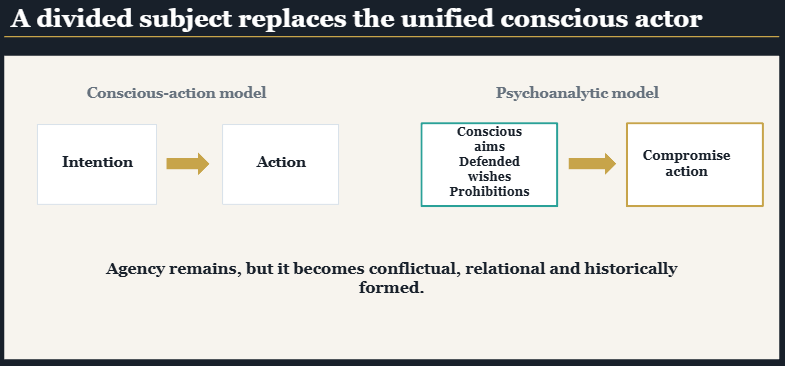
The topographical model

Repression changes the route of expression

The clinical relationship: Old expectations organize a new relationship
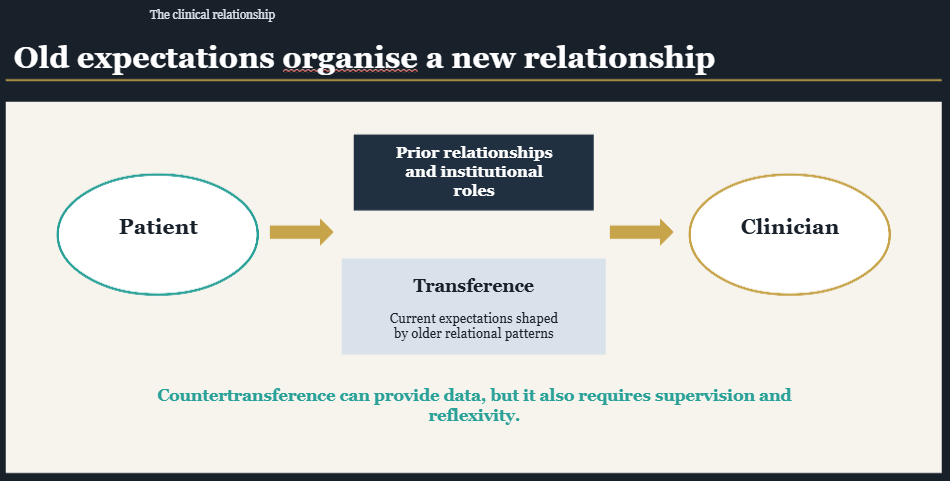
Psychology’s Transference, Countertransference

What kind of evidence can support psychoanalytic claims?
Karl Popper: Interpretations risk insulation from falsification.
Adolf Grünbaum: Some casual claims are testable, but clinical evidence may not establish them.
Paul Ricoeur: A hermeneutics of suspicion investigates meanings beyond conscious intention.