Forest Dynamics
 Call Kai
 Learn
 Practice Test
 Spaced Repetition
 Match
 Flashcards
 Knowt Play
1/39

Earn XP
Description and Tags
ENVS 31: Forest Ecology (Dartmouth)
40 Terms
The death of Hemlock’s in Harvard’s forests due to the invasive wooly adelgid insect shows what concept of forest dynamics?
The remains of foundation species influence ecosystems long after death.
Simply put, what role does growing space play in tree growth?
Trees fill spatial niches where competition is low enough for them to receive adequate light, water, and nutrients for survival.
The process of trees filling spatial niches is reflected in their _____ ________.
Growth Geometry.

How might varying levels of growing space in a stand/forest influence tree geometry?
Large gaps: There is low competition for light, wider tree growth is favored b/c expanding canopies maximizes light input.
Small gaps: There is high competition for light, vertical growth is favored to compete for light.
How might water competition/low water conditions influence tree geometry?
Low water conditions may favor shorter trees, as it takes more pressure to move water through the stem of a taller tree. (from roots to stem to leaves for transpiration).
How might nutrient competition/limited nutrient conditions influence tree geometry?
Low nutrients may favor trees that develop mycorrhizal associations to expand the surface area of their roots and receive more nutrients from the soil.
How does evolution influence tree morphology?
Tree morphology adapts to full available niches in the forest.
What are the 5 layers of the canopy?
Forest floor, shrub layer, understory, canopy, and overstory.

Canopy cover was measured with layers in the LiDAR study, what is a more feasible method?
Leaf-area Index
What did the study on Scots Pine and European Beech in monocultures vs. mixed stands reveal about growing space?
Growing Space may be more effectively utilized by mixed stands with more heterogeneity in structure, and have denser canopies due to crown extension, multilayering, and higher stock densities (more trees can fit).

What concept is shown by the Scots Pine and European Beech study? What does this show about growing complementary tree species vs. growing monocultures.
Niche Partioning: Complementary species fill the “gaps” in the niche that are left by one another, allowing more trees to fit in the same amount of space.
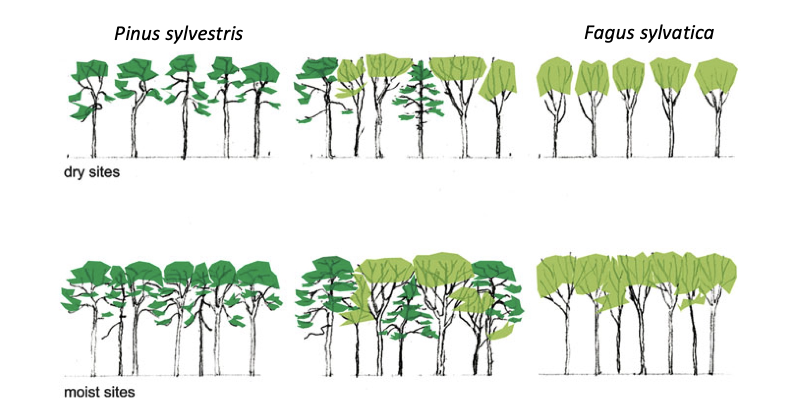
How did moisture influence the structural heterogeneity of the stands in the Scots Pine/European Beech study?
More moisture increased the superior heterogeneity of mixed stands over monocultures.
What is the Crown Shyness Effect?
When the uppermost branches of tree canopies avoid touching.

What effect does crown shyness have on the trees? Describe how it might affect trees at lower heights in particular.
Influences the shape of the crowns. Trees below the overstay may transition to a bouquet-shaped canopy in order to compete for enough light to survive.

Where is crown shyness most commonly seen?
In monocultures
Why might trees exhibit crown shyness?
To maximize growing space optimally and minimize competition with neighboring trees.
What is Growing Space Efficiency (GSE)?
Stem volume growth per unit of crown projection area. Conceptual link between physiological aspects of tree growth and tangible measures of wood production.

To maximize growing space efficiency in a group of trees, one may have to…
cut down neighboring trees to increase growing space and exposed crown area of the surrounding trees.
What is live crown height?
The area of the tree that has living leaves.
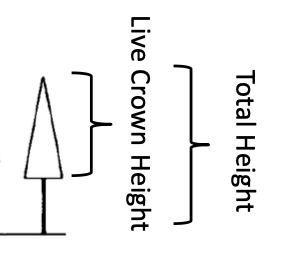
How does crown ratio differ between shade tolerant and shade-intolerant tree species?
Shade intolerant species have lower crown ratios, as they have less living leaves on the lower parts of the stem that receive less light. Shade tolerant trees have larger crown ratios because leaves are more evenly dispersed across the stem.
What is Crown Ratio?
Ratio of live crown height to total height.

Why is a wide canopy favored in shade tolerant species?
It is better for capturing every bit of light that slips through the overstory into the shaded understory. These trees have lower light requirements and can afford to keep these leaves, whereas the cost to maintain them would outweigh their benefits in a light intolerant tree that has access to direct sunlight.

How might initial spacing of trees influence how trees choose to allocate resources?
More space may favor width over height due to low competition for light.

What is vertical load on a tree?
The weight of the above-ground mass.
What is horizontal load on a tree?
The pressure of fluid (air) pushing against the tree.
How is the influence of horizontal load on tree shape shown in the evolutionary traits of conifers vs. hardwoods?
Conifers: Generally taller and minimize the wind resistance in the canopy at higher altitudes with needles and decurrent structure.
Hardwoods: Generally shorter, and can instead afford to have broad leaves with more surface area to absorb light and a excurrent structure since they face less horizontal load.
These differences reflect how they occupy their niches differently.

Tree shape (form) develops as a response to….?
Mechanical Loading

How does light influence cause differences in tree morphology/Crown base height between border trees and interior trees?
Border trees likely have lower crown base height and greater live crown ratio than interior trees due to being on the edge of the stand. Light is directional, and trees receive it directionally, which may cause border trees to have leaves that start lower on the side facing the edge and higher on the side facing the interior.

How can growing space history be seen in tree rings?
Years following disturbances that create grader growing space have tree rings that are wider as a result of more rapid growth.

What is Mean Annual Increment (MAI)?
The average annual growth increment over the total age of the tree or stand (i.e. “how its grown long-term”).
What is Periodic Annual Increment (PAI)?
The average growth increment over a period of years, typically the 5 most recent years (i.e. “how its grown recently”)
What is Current Annual Increment (CAI)?
The growth for the most recent year of growth (i.e. “how it’s growing now”).
What is yield?
The quantity of harvestable material or attributes produces on a defined area of land.
When is the best time for a silviculturist to harvest their trees?
The Biological Rotation Age: Where the MAI overlaps with the PAI. At this point, the trees haven’t yet hit their peak growth, but after this their growth rate significantly slows. Therefore it is favorable to cut now and reset to a crop of rapidly-growing trees.

The biological rotation age is the point where cutting the trees…..
maximizes long-term yield.

How does tree density of evenly-aged stands change over time?
Decreases continuously due to mortality as the stand ages.

How does average tree diameter of evenly-aged stands change over time?
Increases throughout the life of the stand as trees grow, assisted by the fact that smaller trees suffer a disproportionally higher mortality rate.

How does tree height of evenly-aged stands change over time?
Height of dominant and codominant trees increases and eventually levels off

How does basal area of evenly-aged stands change over time?
Increases. In some species it rises to a plateau and stays there (growth balanced by mortality.

Site Index Curves
Species-specific curves that take the relative volume, height, and diameter into account to best guess how a forest is going to grow or age.
