Gene Expression
0.0(0)
Studied by 0 people Call Kai
 Learn
 Practice Test
 Spaced Repetition
 Match
 Flashcards
 Knowt Play
Card Sorting
1/44

There's no tags or description
Looks like no tags are added yet.
45 Terms
1
New cards
Gene expression
The process by which a gene's information is used to make a product (usually a protein): transcription, then translation
2
New cards
Transcription
Synthesis of RNA complementary to a DNA template
3
New cards
Translation
Synthesis of a polypeptide whose amino acid sequence is specified by the nucleotide sequence of mRNA
4
New cards
Original one gene, one polypeptide hypothesis
Each gene codes for one polypeptide (Beadle and Tatum; Nobel Prize 1958)
5
New cards
Why is one gene, one polypeptide an oversimplification?
Alternative splicing lets one gene make multiple polypeptides, and some genes (tRNA, rRNA) make functional RNAs that are never translated
6
New cards
The genetic code: the problem it solves
DNA has only 4 nucleotide bases but proteins use 20 amino acids
7
New cards
The genetic code: the solution
A non-overlapping triplet code: each codon of 3 nucleotides specifies an amino acid or a stop signal
8
New cards
Gene to protein flow
Gene -> DNA template strand -> mRNA (codons) -> polypeptide
9
New cards
RNA polymerase
The enzyme that catalyzes synthesis of RNA complementary to the DNA template strand
10
New cards
Template strand
The one DNA strand of a gene that is transcribed; it provides the template for the nucleotide sequence of the RNA
11
New cards
Is the same strand always the template for a gene?
Yes, the same strand is used every time for a given gene. Farther down the DNA, the opposite strand may be the template for a different gene.
12
New cards
How does RNA polymerase know which strand to use?
Enzyme orientation and a particular DNA sequence (the promoter) for each gene
13
New cards
RNA polymerase direction
Reads the template 3' -> 5', builds RNA 5' -> 3' (nucleotides are added only to the 3' -OH end)
14
New cards
Three stages of transcription
Initiation, elongation, termination
15
New cards
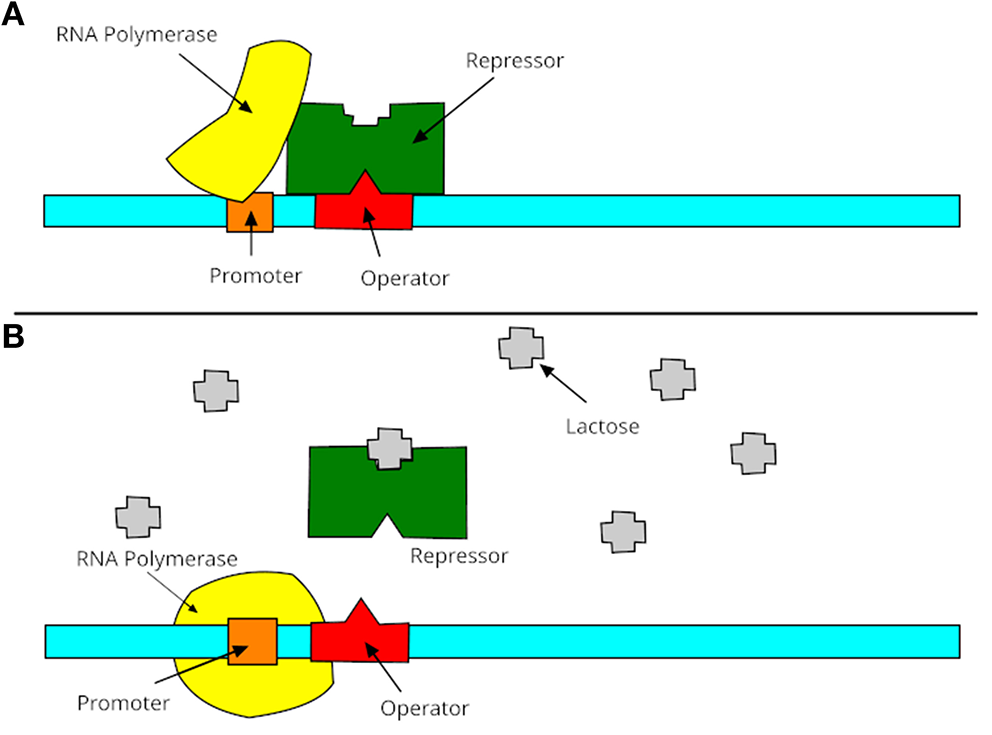
Promoter
A DNA sequence at the start of the transcription unit where RNA polymerase binds
16
New cards
Prokaryotic initiation
RNA pol binds the promoter directly. It separates the DNA strands itself (no helicase) and needs no primer.
17
New cards
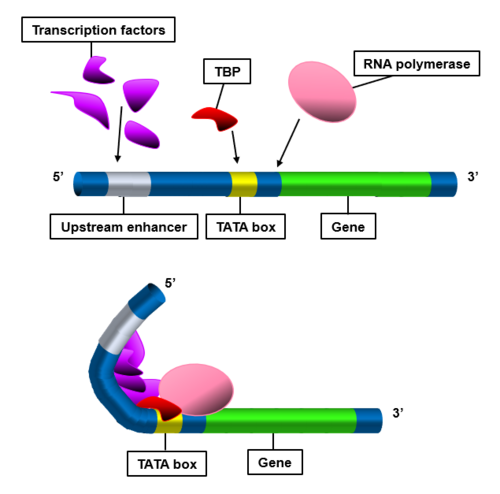
Eukaryotic initiation: why can't RNA pol II bind on its own?
It needs transcription factors (proteins) to bind the promoter region first
18
New cards
TATA box
A T/A-rich DNA sequence in the promoter region that transcription factors recognize and bind

19
New cards
Transcription initiation complex
The whole assembly: transcription factors bound to the promoter/TATA box plus RNA pol II

20
New cards
Eukaryotic elongation: what does RNA pol II do?
Unwinds ~10-15 base pairs at a time (the transcription bubble), builds RNA 5' -> 3', and the DNA behind it reanneals
21
New cards
Transcription bubble
The short stretch of unwound DNA where RNA pol is actively transcribing
22
New cards
Elongation rate (eukaryotes)
About 40 nucleotides per second
23
New cards
Product of eukaryotic transcription
Pre-mRNA, which must be processed before it can be translated
24
New cards
Prokaryotic termination
RNA pol transcribes a terminator sequence, which makes it detach. The mRNA needs no further modification.
25
New cards
Why doesn't prokaryotic mRNA need processing?
There is no nucleus, so it doesn't need protection on a journey out of one
26
New cards
Eukaryotic termination signal
The polyadenylation signal sequence AAUAAA in the pre-mRNA
27
New cards
What happens after AAUAAA is transcribed?
Nuclear proteins bind it, cut the RNA, and add the poly-A tail
28
New cards
Prokaryote vs. eukaryote: initiation
Prokaryote: RNA pol binds promoter directly.
Eukaryote: transcription factors + TATA box, then RNA pol II.
29
New cards
Prokaryote vs. eukaryote: termination
Prokaryote: terminator sequence.
Eukaryote: AAUAAA signal, then processing.
30
New cards
Prokaryote vs. eukaryote: after transcription
Prokaryote: ready to translate.
Eukaryote: pre-mRNA must be processed.
31
New cards
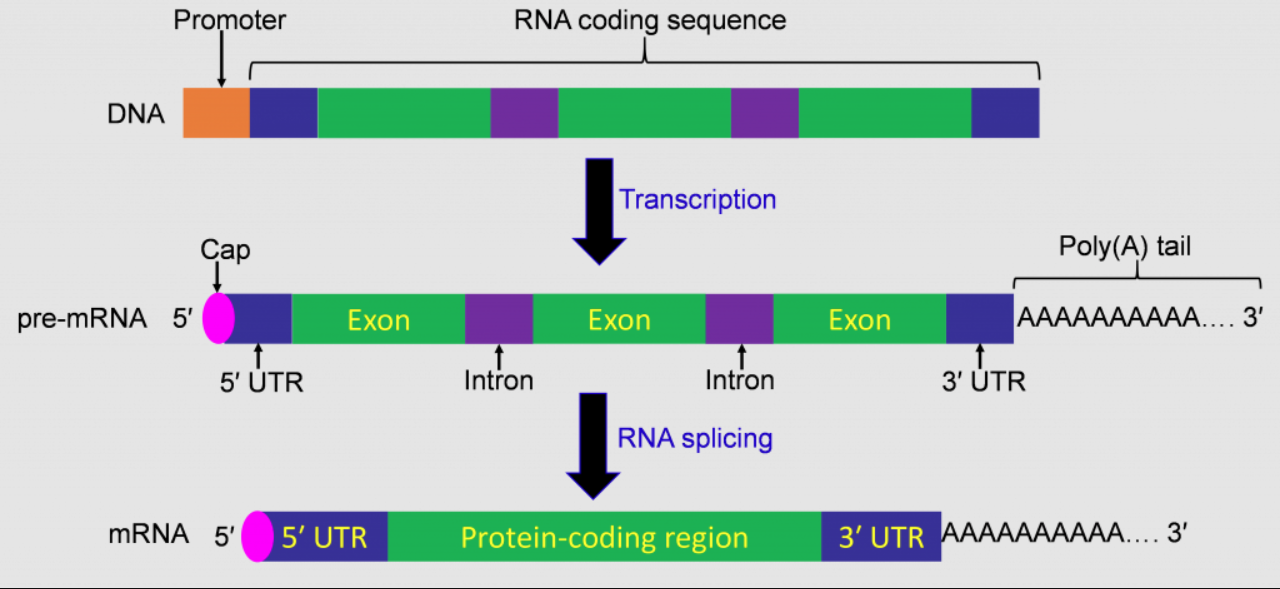
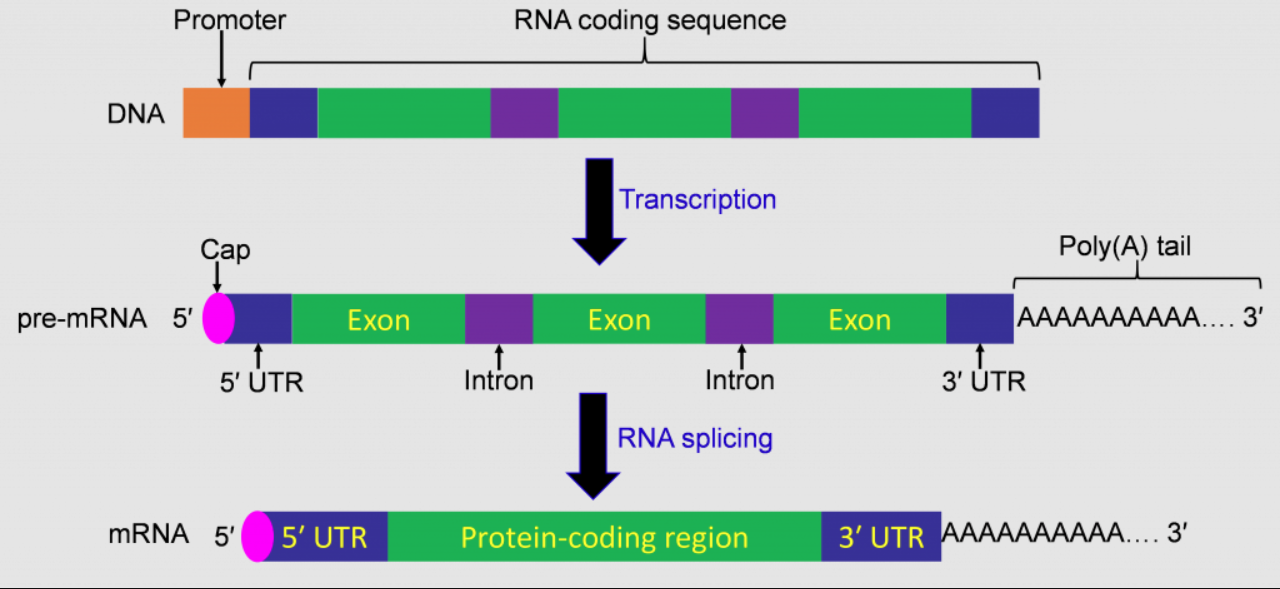
Three parts of pre-mRNA processing
5' cap, 3' poly-A tail, and RNA splicing
32
New cards
UTR
Untranslated region. The 5' UTR and 3' UTR are not translated into peptides.

33
New cards
5' cap: what is it and when is it added?
A modified guanine added to the 5' end after the first 20-40 nucleotides are transcribed (the 5' end is completed first)

34
New cards
3' poly-A tail
An enzyme adds 50-250 adenines (AAAA...) to the 3' end after termination
35
New cards
Function of the 5' cap and poly-A tail
Help protect the mRNA on its journey to the cytoplasm
36
New cards
The splicing puzzle
A transcription unit averages ~27,000 nucleotide pairs, but the average protein is ~400 amino acids (400 x 3 = 1,200 coding nucleotides). Splicing removes the extra.
37
New cards
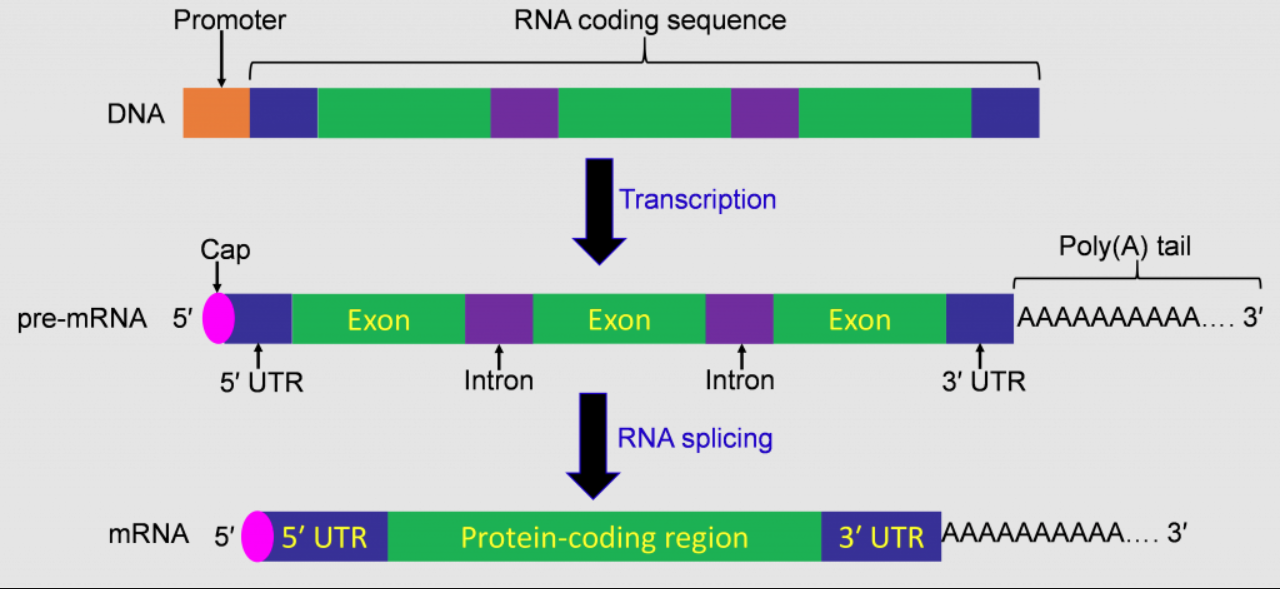
Introns
Intervening sequences: non-coding regions that are cut out of the pre-mRNA
38
New cards
Exons
The expressed regions that are spliced together to form the mature mRNA
39
New cards
Does RNA pol II transcribe introns?
Yes. It transcribes both introns and exons; the introns are removed afterward.
40
New cards
RNA splicing
Introns are cut out of the pre-mRNA and the exons are joined together, producing an abridged mRNA

41
New cards
Spliceosome
The complex that carries out splicing, made of snRNAs and snRNPs

42
New cards
snRNP
Small nuclear ribonucleoprotein: a snRNA bound to proteins
43
New cards
How does RNA pol II help splicing?
It has a region that recruits splicing factors to form the spliceosome
44
New cards
Alternative splicing
Different segments are treated as exons in different cases, so one gene can encode more than one polypeptide
45
New cards
Why is alternative splicing important?
The same gene and the same transcript can be spliced in different ways, producing different proteins