L9-kidneys and diuretics 2
 Call Kai
 Learn
Learn Practice Test
 Spaced Repetition
 Match
Match Flashcards
 Knowt Play
1/25

There's no tags or description
Looks like no tags are added yet.
Name | Mastery | Learn | Test | Matching | Spaced | Call with Kai | Chat |
|---|
No analytics yet
Send a link to your students to track their progress
26 Terms
wheres do loop diuretics have an effect on in the nephron
the ascending loop of Henle
describe how sodium rebasoption occurs in ascending the loop of henle

what are the two main expamples of loop diuretics
furosemide and bumetanide
explain how loop diuretics work e.g. furosemide ad bumetanide
they work in the ascending loop of henle by inhibiting the NKCC co transporter
this causes decreased reabsoption of sodium and chloride ions
and causes increased potassium excretion
this causes less water reabsorption too, more water remains inside the nephron tubules

explain the therapeutic use of loop diuretics e.g. furosemdie and bumetanide
they are the most powerful class of diuretics as this is where theres the most sodium reabsoption usually so it has more of an effect

where on the nephron do thiazide and thiazide like diuretics work on
the work on the distal convoluted tubule
explain the salt reabsoption in the distal conveluted tubule

explain the action of thiazide and thiazide like diuretics
they inhibit the sodium/chloride co-transporter decreasing the reabsorption of sodium and chloride ions into the blood so more water remains inside the nephron
but calcium ion has increased reabsorption

what are the two main examples of thiazide diuretics
hydrochlorothiazide and Bendroflumethiazide
what are the three main examples of thiazide like diuretics
chlortalidone
inapamide
metolazone
compare thiazide and thiazide like diuretics with loop diuretics
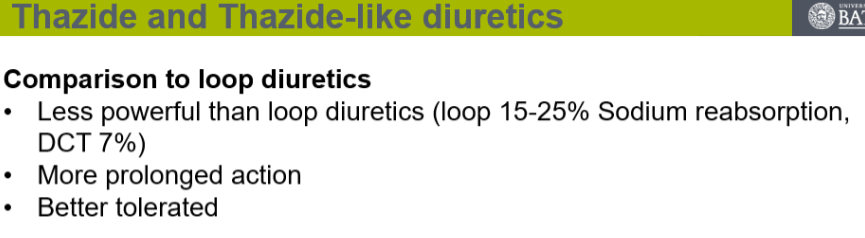
what are the theraputic uses of thiazide and thiazide like diuretics

what are the adverse effects of taking loop and thiazide/like diuretics
and hypokalaemia

explain why getting hypokalemia is an adverse effect of using loop and thiazide diuretics
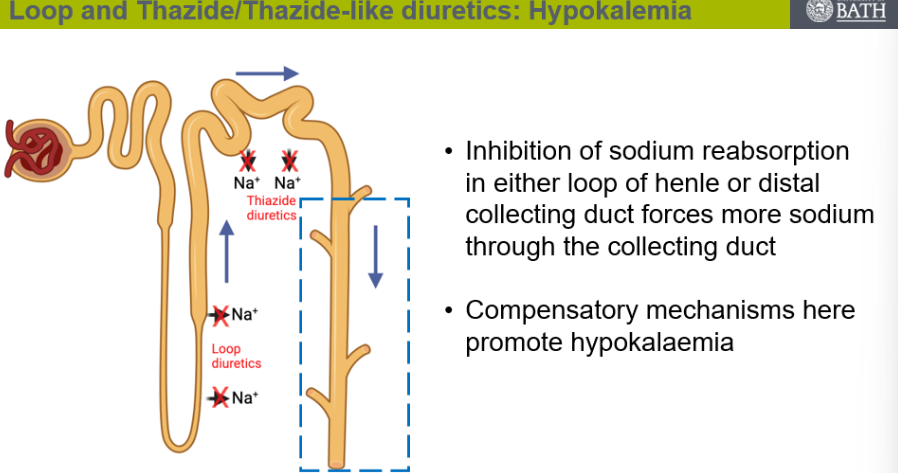
explain how salt is reabsorbed in the collecting duct

explain the compensatory activation of RAAS

what is the role of aldosterone

where do potassium sparing diuretics act on in the nephron
the collecting duct
what are the two classes of potassiumsparing diuretics

what is the therapeutic use of potassium sparing diuretics
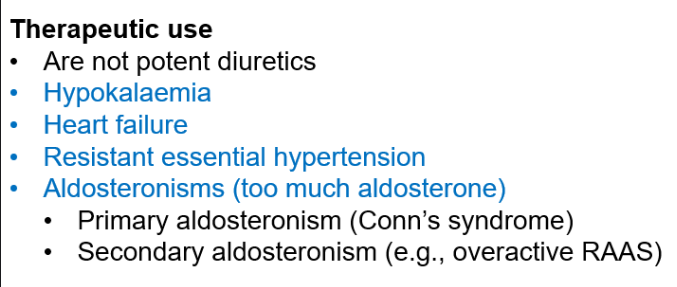
whats the adverse effects of using potassium sparing diuretics
hyperkalaemia
explain the use of vasopressin/ADH in increasing water reabsoption and blood pressure
the hypothalamus detects dehydration from high salt concentration in the blood,reduced plasma volume,effect of sympathetic stimulation or angiotesnsin 2
it sends signals to the posterior pituatory gland which secretets vassopressin which acts around the body to increase blood pressure and increase water absoption in two ways
firstly by acting on the v1 receptor (Gq) which causes blood vessel constriction increasing systemic vascular resistance to increase blood pressure
or by acting on the v2 receptor (Gs) which promotes fluid reabsoption in the kidney to increase the plasam volume and then the blood pressure
explain the action of vassopressin on the collecting duct

what is diabetes insipidus + the two types

what are the treatments for the both types of diabetes insipidus DI
