Antibiotic II 04 (1/2)

0.0(0)
Studied by 0 people
call kaiCall Kai
learnLearn
examPractice Test
spaced repetitionSpaced Repetition
heart puzzleMatch
flashcardsFlashcards
GameKnowt Play
Card Sorting

1/29

encourage image

There's no tags or description

Looks like no tags are added yet.

30 Terms

1
New cards

Selectivity

  • Human cells lack cell walls and don't possess transpeptidase

    • D-Ala-D-Ala linkage is unique to bacteria. All other a-acids have L configuration

  • Very clean D: non toxic, safe, few side effects

    • Major side effect: allergic rxn


<ul><li><p>Human cells lack cell walls and don't possess transpeptidase</p><ul><li><p>D-Ala-D-Ala linkage is unique to bacteria. All other a-acids have L configuration</p></li></ul></li><li><p>Very clean D: non toxic, safe, few side effects</p><ul><li><p>Major side effect: allergic rxn</p></li></ul></li></ul><p></p>
2
New cards

Source of allergy

  • Penicillin is a good El that can acylate host proteins = abnormal → "tagged" and recognized as foreign = allergic response

  • Strongest allergic response occurs upon re-exposure to D

  • Open ring penicillin is recognized as foreign substance


<ul><li><p>Penicillin is a good El that can acylate host proteins = abnormal → "tagged" and recognized as foreign = allergic response</p></li><li><p>Strongest allergic response occurs upon re-exposure to D</p></li><li><p>Open ring penicillin is recognized as foreign substance</p></li></ul><p></p>
3
New cards

Penicillin mechanism and structure

  • Side chain helps occupy substrate-binding region

  • Negative charge on right end

  • Similar 3D shape to D-Ala-D-Ala


<ul><li><p>Side chain helps occupy substrate-binding region</p></li><li><p>Negative charge on right end </p></li><li><p>Similar 3D shape to D-Ala-D-Ala </p></li></ul><p></p>
4
New cards

β-Lactam carbonyl

- Hydrolyzing an amide is very difficult, whereas...

- β-lactam has an amide in a ring, which makes hydrolysis easier since the LP aren't delocalized and ring strain

<p>- Hydrolyzing an amide is very difficult, whereas...</p><p>- β-lactam has an amide in a ring, which makes hydrolysis easier since the LP aren't delocalized and ring strain</p>
5
New cards

Penicillin G

- Isolated from mold

- Natural form of penicillin

- 4 major limitations as a D: acid sensitivity, resistance, spectrum of action & bioavailability

<p>- Isolated from mold </p><p>- Natural form of penicillin </p><p>- 4 major limitations as a D: acid sensitivity, resistance, spectrum of action & bioavailability</p>
6
New cards

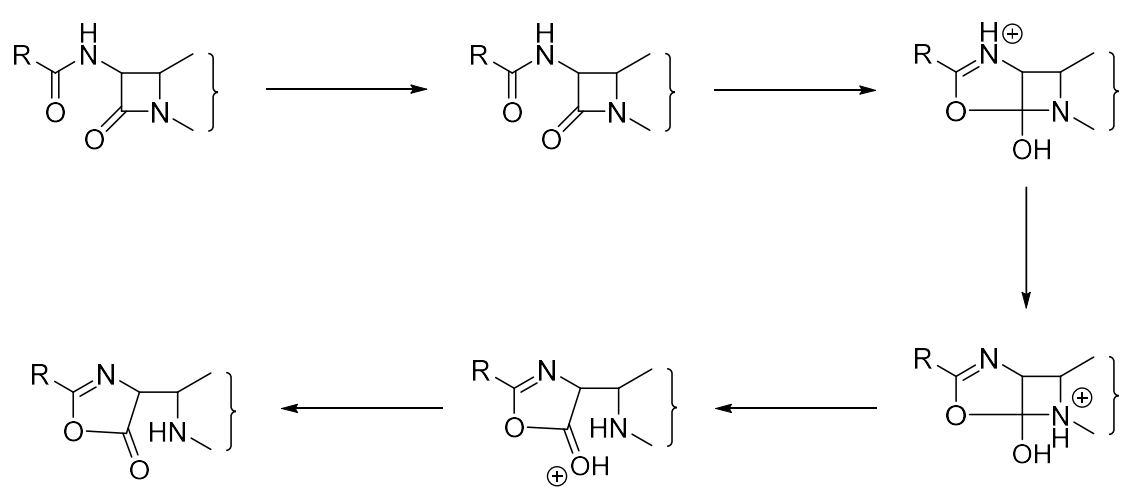
1. Acid sensitivity

- Stomach's acidic enviro deactivates penicillin G

- Must be administered by i.v. injection
<p>- Stomach's acidic enviro deactivates penicillin G</p><p>- Must be administered by i.v. injection</p>
7
New cards

Heteroatoms (engineering for acid sensitivity)

- Add an EN atom (X), which is an EWG to ↓ nuclephilicity and prevent acid-catalyzed degradation

- Allows penicillin to be taken orally instead of iv, since it won't be degraded

<p>- Add an EN atom (X), which is an EWG to ↓ nuclephilicity and prevent acid-catalyzed degradation</p><p>- Allows penicillin to be taken orally instead of iv, since it won't be degraded</p>
8
New cards

Charge (engineering for acid sensitivity)

  • Add NH2 which becomes NH3+ under physiological pH

    • Creates an electron-withdrawing effect & ↓ nucleophilicity of carbonyl O

    • Prevents acid-catalyzed degradation = allowing oral intake

  • Resulting molecule is ampicillin


<ul><li><p>Add NH2 which becomes NH3+ under physiological pH </p><ul><li><p> Creates an electron-withdrawing effect &amp; ↓ nucleophilicity of carbonyl O </p></li><li><p>Prevents acid-catalyzed degradation = allowing oral intake  </p></li></ul></li><li><p>Resulting molecule is ampicillin</p></li></ul><p></p>
9
New cards

Penicillin semi-synthesis

  • Penicillin "core" is complex & difficult to synth chemically

  • Obtain core from biolo sources & modify it synthetically to create new derivatives


<ul><li><p>Penicillin "core" is complex &amp; difficult to synth chemically</p></li><li><p>Obtain core from biolo sources &amp; modify it synthetically to create new derivatives</p></li></ul><p></p>
10
New cards

Biochemical preparation of 6-APA

1. Grow penicillium mold to prod penicillin G

2. Extract it from mold

3. Treat w amidase enzyme from E. coli to remove side chain

↳ Prods 6-APA: core used for semi-synthetic penicillin

<p>1. Grow penicillium mold to prod penicillin G</p><p>2. Extract it from mold </p><p>3. Treat w amidase enzyme from E. coli to remove side chain </p><p>↳ Prods 6-APA: core used for semi-synthetic penicillin</p>
11
New cards

Creation of artificial drug

1. Convert penicillin G into 6-APA using amidase

2. Attach a new acyl group to NH2 of 6-APA to create a semi-synthetic derivative (artificial penicillin) via a coupling rxn

<p>1. Convert penicillin G into 6-APA using amidase</p><p>2. Attach a new acyl group to NH2 of 6-APA to create a semi-synthetic derivative (artificial penicillin) via a coupling rxn</p>
12
New cards

2. Resistance

- Many bacteria have developed resistance to penicillin and evolve ways to get rid of the D

- Mechanisms include: mutations in transpeptidase, active transport out the cell & enzymatic destruction of D

13
New cards

β-Lactamase (aka penicillinase)

- Enzyme hydrolyzes the β-lactam ring, deactivating the D

- Bacteria prod transpeptidase to build cell walls and penicillinase to protect against penicillin

<p>- Enzyme hydrolyzes the β-lactam ring, deactivating the D </p><p>- Bacteria prod transpeptidase to build cell walls and penicillinase to protect against penicillin</p>
14
New cards

Antibiotic resistance by β-Lactamase

  • Non functional enzyme has no cross link

  • Non functional penicillin allows bacteria to thrive


<ul><li><p> Non functional enzyme has no cross link</p></li><li><p> Non functional penicillin allows bacteria to thrive</p></li></ul><p></p>
15
New cards

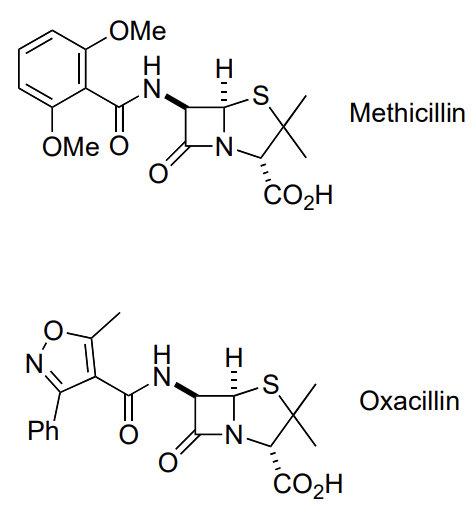
Modifying penicillin to overcome resistance (β-Lactam antibiotics)

  • Large substituted heterocycle acts as a "shield" to regain activity

  • Add bulky groups to side chain of β-Lactam to create steric hindrance around active site

    • Prevent rxn btwn β-Lactamase & penicillin

<ul><li><p>Large substituted heterocycle acts as a "shield" to regain activity</p></li></ul><ul><li><p>Add bulky groups to side chain of β-Lactam to create steric hindrance around active site </p><ul><li><p>Prevent rxn btwn β-Lactamase &amp; penicillin</p></li></ul></li></ul><p></p>
16
New cards

"Shield" provides selectivity

- Modified penicillin can still fit into the transpeptidase active site but not in the β-Lactamase

- Sterics affect how substrate is positioned inside active site to allow certain rxn's to proceed

<p>- Modified penicillin can still fit into the transpeptidase active site but not in the β-Lactamase </p><p>- Sterics affect how substrate is positioned inside active site to allow certain rxn's to proceed</p>
17
New cards

3. Spectrum of activity

  • 2 main bacterial types: gram-positive & gram-negative

  • Early penicillin were active only against gram-positive strains (narrow spectrum of activity)

  • Desirable to have activity against gram-negative strains


<ul><li><p>2 main bacterial types: gram-positive &amp; gram-negative </p></li></ul><ul><li><p>Early penicillin were active only against gram-positive strains (narrow spectrum of activity)</p></li><li><p>Desirable to have activity against gram-negative strains</p></li></ul><p></p>
18
New cards

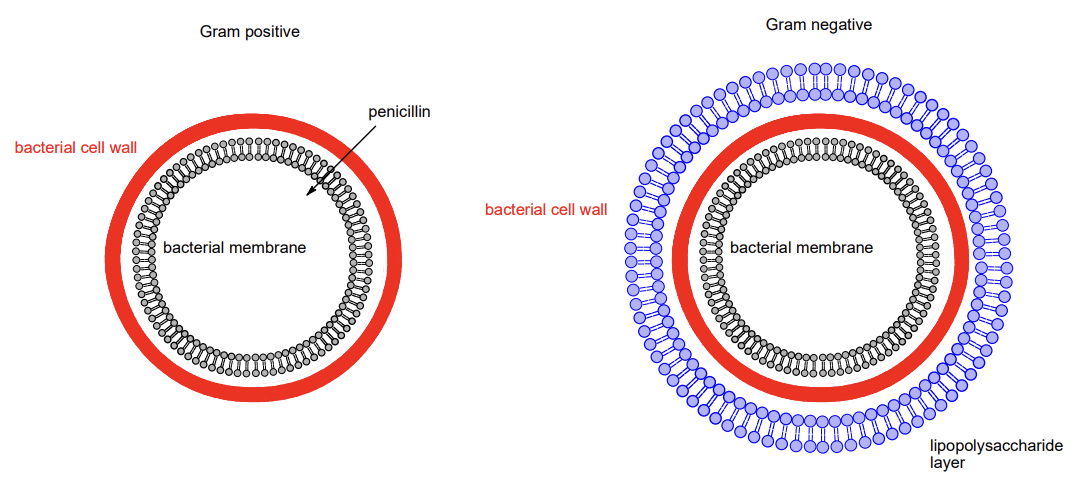
Gram-positive vs. Gram-negative

  • G+: inner bacterial memb inside wrapped in thick peptidoglycan layer. Penicillin can cross both layers.

  • G-: inner bacterial memb inside wrapped in thin peptidoglycan layer wrapped in outer lipopolysaccharide layer. Antibiotic resistant

<ul><li><p>G+: inner bacterial memb inside wrapped in thick peptidoglycan layer. Penicillin can cross both layers.</p></li><li><p>G-: inner bacterial memb inside wrapped in thin peptidoglycan layer wrapped in outer lipopolysaccharide layer. Antibiotic resistant</p></li></ul><p></p>
19
New cards

Improving spectrum of activity

  • At physiolo pH 7.4, -NH2 on ampicillin becomes protonated to NH3+

    • Makes ampicillin more polar, allowing it to pass thru porin channels in bacterial outer memb

  • Once inside bacteria, ampicillin inhibits transpeptidase, preventing cross-link formation (weakens cell wall → death)


<ul><li><p>At physiolo pH 7.4, -NH2 on ampicillin becomes protonated to NH3+</p><ul><li><p>Makes ampicillin more polar, allowing it to pass thru porin channels in bacterial outer memb</p></li></ul></li><li><p>Once inside bacteria, ampicillin inhibits transpeptidase, preventing cross-link formation (weakens cell wall → death)</p></li></ul><p></p>
20
New cards

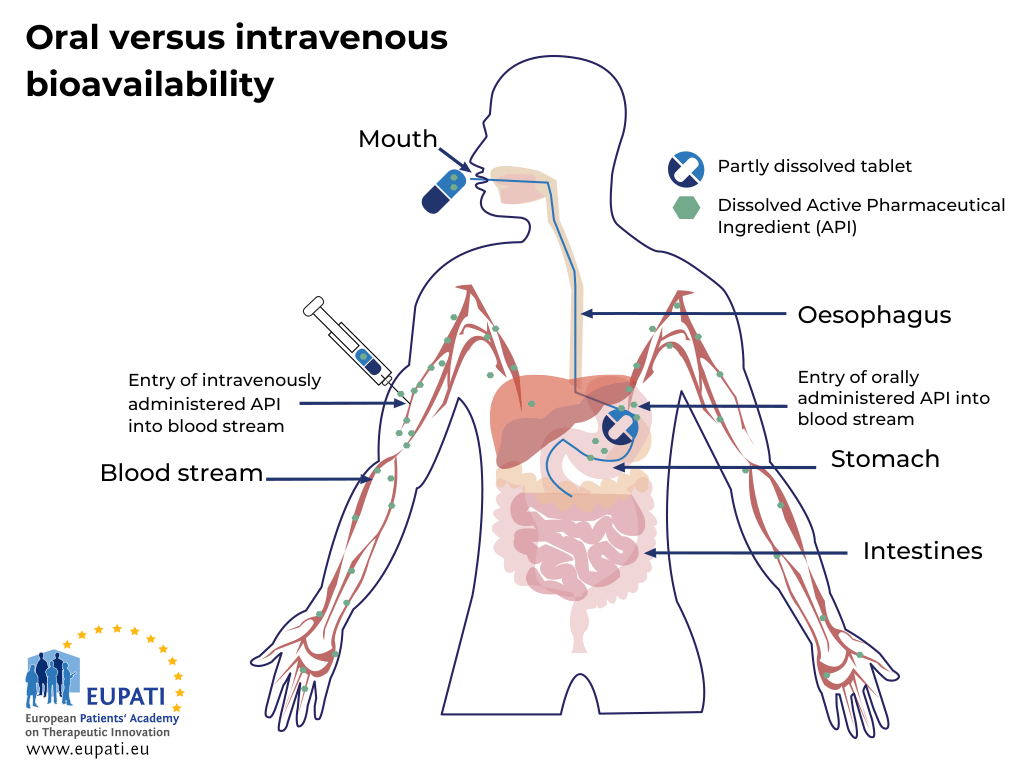
Definition of Bioavailability

Rate and proportion of a D/nutrient that successfully reaches bloodstream or intended biolo destination before decomposing
<p>Rate and proportion of a D/nutrient that successfully reaches bloodstream or intended biolo destination before decomposing</p>
21
New cards

4. Bioavailability

  • Some D's r poorly water-soluble = poor bioavailability (poor intestinal absorption)

  • Ampicillin is initially neutral (low water solubility)

    • At pH 7.4, carboxyl group & amino group r protonated

    • +ve & -ve charges interact w water helping ampicillin dissolve (↑ bioavailability


<ul><li><p>Some D's r poorly water-soluble = poor bioavailability (poor intestinal absorption)</p></li></ul><ul><li><p>Ampicillin is initially neutral (low water solubility)</p><ul><li><p>At pH 7.4, carboxyl group &amp; amino group r protonated</p></li><li><p>+ve &amp; -ve charges interact w water helping ampicillin dissolve (↑ bioavailability</p></li></ul></li></ul><p></p>
22
New cards

Charge & solubility (bioavailability)

  1. D's carboxylate group must be -vely charged to bind transpeptidase

  2. Removable group (R) is added to carboxylate to improve absorption

  3. Inside body, blood enzymes remove R, exposing the -ve carboxylate

  4. Active D can now bind transpeptidases & stop cell wall formation


<ol><li><p>D's carboxylate group must be -vely charged to bind transpeptidase</p></li><li><p>Removable group (R) is added to carboxylate to improve absorption</p></li><li><p>Inside body, blood enzymes remove R, exposing the -ve carboxylate</p></li><li><p>Active D can now bind transpeptidases &amp; stop cell wall formation</p></li></ol><p></p>
23
New cards

Prodrugs

- Attach a temporary group to improve absorption

- Once in bloodstream, enzymes remove this group, releasing the active D

- ↑ bioavailability of active D (ampicillin)

<p>- Attach a temporary group to improve absorption</p><p>- Once in bloodstream, enzymes remove this group, releasing the active D</p><p>- ↑ bioavailability of active D (ampicillin)</p>
24
New cards

Advantages of Cephalosporins fungus

  • Broader spectrum due to improved Gram-negative penetration and β-lactamase stability

  • [4,6] ring is more stable than penicillin [4,5] system.

    • Resistant to β-lactamase due of reduced ring strain

    • Lower risk of allergy than penicillin


<ul><li><p>Broader spectrum due to improved Gram-negative penetration and β-lactamase stability</p></li><li><p>[4,6] ring is more stable than penicillin [4,5] system.</p><ul><li><p>Resistant to β-lactamase due of reduced ring strain</p></li><li><p>Lower risk of allergy than penicillin</p></li></ul></li></ul><p></p>
25
New cards

Disadvantages of Cephalosporins fungus

- Not orally active

- Lower potency, need higher doses

- Improved by semi-synthetic modification

<p>- Not orally active</p><p>- Lower potency, need higher doses</p><p>- Improved by semi-synthetic modification</p>
26
New cards

Semi-synthesis of Cephalosporins → 7-ACA

- Isolate complex core from biolo source

- Use enzyme to hydrolyze the amide bond to generate NH2 = 7-ACA

- Modify 7-ACA to create diff derivatives to target certain limitations (ex: acid sensitivity, bioavailability)
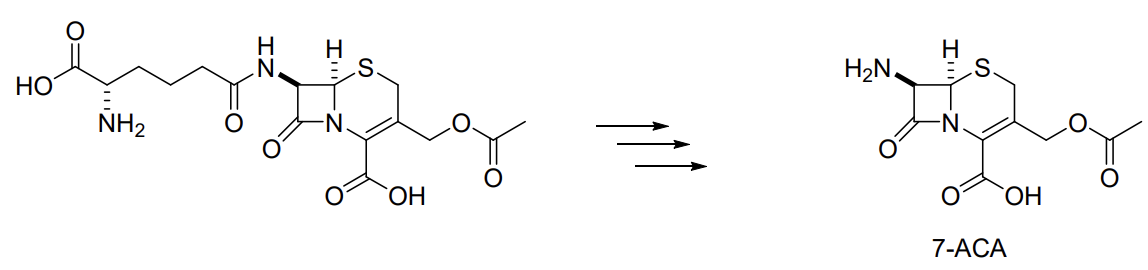
<p>- Isolate complex core from biolo source</p><p>- Use enzyme to hydrolyze the amide bond to generate NH2 = 7-ACA</p><p>- Modify 7-ACA to create diff derivatives to target certain limitations (ex: acid sensitivity, bioavailability)</p>
27
New cards

Clavulanic acid (1976)

Not an antibiotic

- Does not inhibit transpeptidase or kill bacteria

- Inhibits β-lactamase, preventing resistance

<p>Not an antibiotic </p><p>- Does not inhibit transpeptidase or kill bacteria </p><p>- Inhibits β-lactamase, preventing resistance</p>
28
New cards

Clavulanic acid destroys β-lactamase

- Clavulinic acid & β-lactam + β-lactamase = non-functional enzyme

- Clavulinic acid reacts w β-lactamase, preventing it from hydrolyzing penicillin → penicillin can carry out its function

<p>- Clavulinic acid &amp; β-lactam + β-lactamase = non-functional enzyme</p><p>- Clavulinic acid reacts w β-lactamase, preventing it from hydrolyzing penicillin → penicillin can carry out its function</p>
29
New cards

Clavulinic acid & β-lactam (clinical use)

- Combine clavulanic acid w a β-lactam antibiotic sensitive to β-lactam

- Clavulinic acid inhibits β-lactamase and "protects" antibiotic from resistance enzyme

- β-Lactam antibiotic inhibits transpeptidase & kills bacteria

30
New cards

β-lactamase selectivity

- Transpeptidase: antibiotic fits into its active site & blocks cell wall formation

- β-lactamase: fits antibiotic into its active site & opens β-lactam ring, destroying antibiotic

- Clavulanic acid: structurally similar to antibiotic, so β-lactamase binds to it instead, blocking enzyme & protecting antibiotic

<p>- Transpeptidase: antibiotic fits into its active site &amp; blocks cell wall formation</p><p>- β-lactamase: fits antibiotic into its active site &amp; opens β-lactam ring, destroying antibiotic</p><p>- Clavulanic acid: structurally similar to antibiotic, so β-lactamase binds to it instead, blocking enzyme &amp; protecting antibiotic</p>



