Frogs & Toads
 Call Kai
 Learn
 Practice Test
 Spaced Repetition
 Match
 Flashcards
 Knowt Play
1/56

There's no tags or description
Looks like no tags are added yet.
57 Terms
What are the Greek roots of Anura?
An “without” + ura “tail”
What is the Latin root of Salientia?
Saliet “to leap”
What is the node based name for frogs & toads?
Anura
What is the stem based name for frogs & toads?
Salientia
When do proanurans appear?
Early Triassic
What is the oldest of the living lissamphibian groups?
Proanurans
When do discoglossids (Alytidae) and pelobatids appear?
Jurassic
When do paleobatrachids (extinct) and pipids appear?
Cretaceous
Gobiates, a Central Asian proanuran is present in the __________.
Cretaceous
When do many living families, including neobatrachians, appear?
Tertiary

Straddle

Axillary

Glued

Cloacal apposition

Inguinal
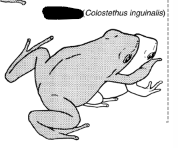
Cephalic

Ascaphidae

Ascaphidae

Ascaphidae

What are the distinctive characteristics of Ascaphidae?
Cloacal and caudal muscles make intromittent organ

Describe the lifestyle of Ascaphidae.
Nocturnal, voiceless, inguinal amplexus, internal fertilization, sperm storage, Type III tadpole

Describe the habitat of Ascaphidae.
Clear, cold streams in the Pacific northwest. Stream edge

Ascaphidae

Leiopelmatidae

What are the distinctive characteristics of Leiopelmatidae?
Tadpoles lack jaw sheaths & denticles, up to 50 mm SVL

Describe the lifestyle of Leiopelmatidae
Streamside/terrestrial, male parental care
What are the only frogs native to NZ?
Leiopelmatidae
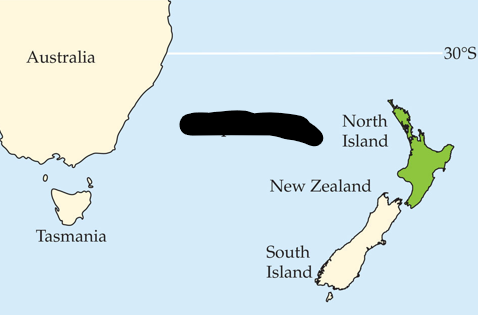
Leiopelmatidae

Bombinatoridae

What are the distinctive characteristics of Bombinatoridae?
Aposematic, 40-100 mm SVL
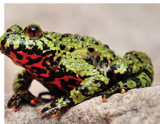
What is the distribution of Bombinatoridae?
Europe, Asia, Philippines, Borneo

Bombinatoridae
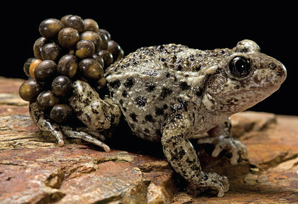
Alytidae

What are the distinctive characteristics of Alytidae?
30-70 mm SVL

Describe the lifestyle of Alytidae.
Nocturnal, terrestrial and burrowing to semi-aquatic. Inguinal amplexus, external fertilization, males call. In Alytes males carry eggs wrapped around legs; Discoglossus deposit eggs directly in water

What is the distribution of Alytidae?
Western Europe and North Africa
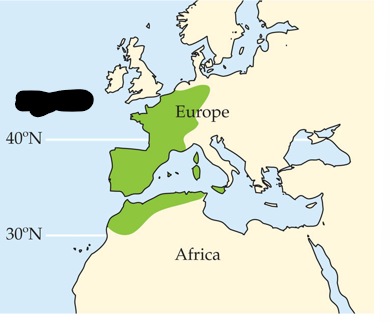
Alytidae
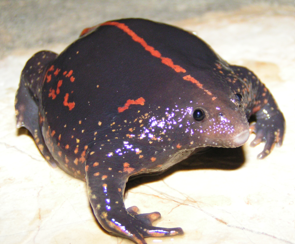
Rhinophrynidae

What are the distinctive characteristics of Rhinophrynidae?
Globular body, short limbs, cone-shaped head, small slit-like mouth, dorso-ventrally flattened, metatarsal tubercle spades on inside of each hindfoot, tadpoles without keratinized jaws and two spiracles, 75-85 mm SVL
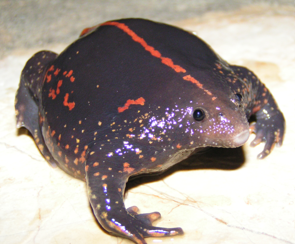
Describe the lifestyle of Rhinophrynidae.
Burrowing, termite and ant egg feeder, inguinal amplexus, breeds in temporary pools, 1000s of eggs per clutch

What is the distribution of Rhinophrynidae?
Texas to Costa Rica
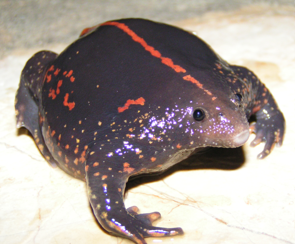
What is Rhinophrynidae convergent with?
Nasikabatrachidae

What is the only species of Rhinophrynidae?
Rhinophrynus dorsalis

What is the common name for Rhinophyrnus dorsalis?
Mexican burrowing toad
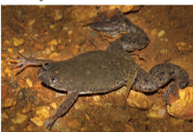
Pipidae

What are the distinctive characteristics of Pipidae?
Lack tongues, dorsoventrally flattened, 40-170 mm SVL

Describe the lifestyle of Pipidae.
Aquatic
What Pipidae species is a model organism in biology?
Xenopus laevis

What is the distribution of Pipidae?
Tropical South America & Africa

What is the red distribution?
Rhinophrynidae
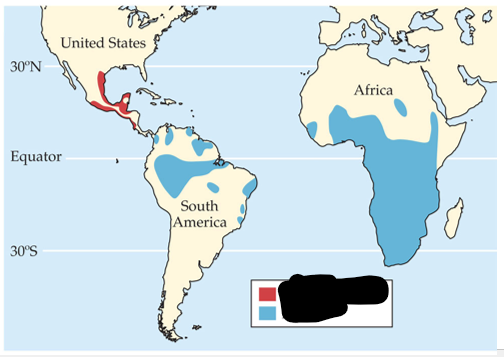
What is the blue distribution?
Pipidae

Scaphiopodidae

What are the distinctive characteristics of Scaphiopodidae?
Spade-like tubercle on outer edge of each hindfoot, sinistrial spiracle in larvae, 50-80 mm SVL

Describe the lifestyle of Scaphiopodidae.
Some species have cannibalistic tadpoles, fossorial

What is the distribution of Scaphiopodidae?
Southern Canada and USA south to temperate southern Mexico

Scaphiopodidae

Scaphiopodidae