Structure and function of cells and tissues
 Call Kai
 Learn
 Practice Test
 Spaced Repetition
 Match
 Flashcards
 Knowt Play
1/48

There's no tags or description
Looks like no tags are added yet.
49 Terms


Describe the role of the nucleus.
The nucleus is part of the cell that contains DNA and controls the activities of the cell.
What happens in mitochondria and why is this important?
Mitochondria is the part of the cell in which aerobic respiration occurs, this provides energy for the cell.
What is the job of the cell membrane?
The cell membrane controls the movement of substances into and out of the cell.
Why is a cell membrane important?
without it, the cell would not be able to function, it would not have any oxygen or glucose to use in the mitochondria for energy.
Describe the function of the ribosomes.
The ribosomes synthesise proteins for use both inside and outside the cell.
draw and label the nucleus

function of Nuclear Envelope
Surrounds the nucleus and encases the genetic information
It has a double membrane
function of Nuclear Pores
Gaps in the membrane to allow transport of large molecules into and out of the nucleus
function of Nucleoplasm
Jelly like material
Makes up the bulk of the nucleus
Contains enzymes needed for DNA replication
function of chromosomes
Made up of chromatin (DNA and proteins)
Carry genetic information in the form of genes
function of nucleolus
Small dense region within the nucleoplasm
Makes ribosomes
What do we already know about the mitochondria?
Where aerobic respiration takes place
Glucose + oxygen → Carbon dioxide + Water + Energy
draw and label mitochondria

match up
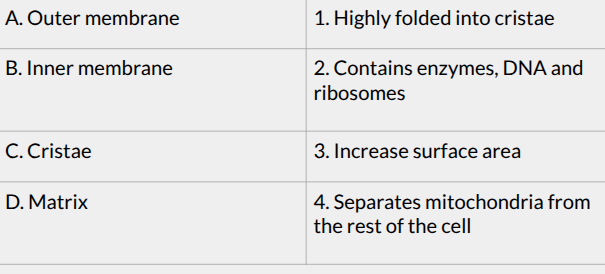
a. 4
b. 1
c. 3
d. 2
What do we already know about the ribosomes?
Very small
Responsible for making proteins for the cell
80S Ribosomes

80S is the size
Made of RNA and proteins
Free-floating or attached to rough endoplasmic reticulum
Site of protein synthesis - they assembly the amino acids into the correct order according to the instructions from mRNA
draw and label animal cell

Endoplasmic reticulum

rough er
Has membrane-bound flattened sacs (cisternae)
Contains ribosomes on surface
Site of protein synthesis - provides larger surface area
smooth er
Has membrane-bound tubular sacs
Does not contain ribosomes
Site of lipid synthesis
Golgi apparatus
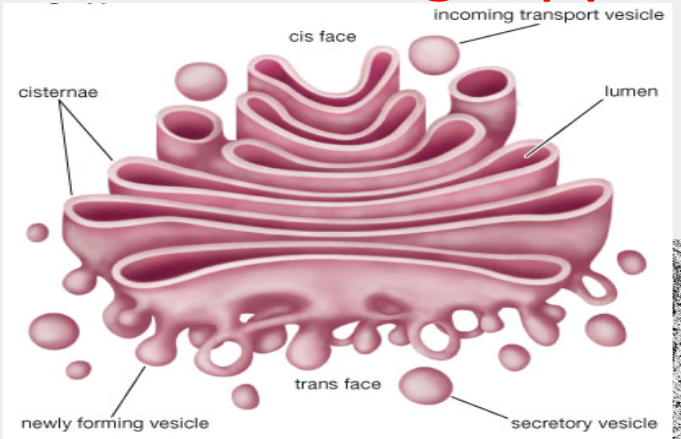
Consists of stacks of membranes that make up flattened sacs with small rounded hollow structures clustered around called vesicles
Newly made proteins are modified here and packaged into vesicles
Vesicles transport and secrete proteins
Lysosomes
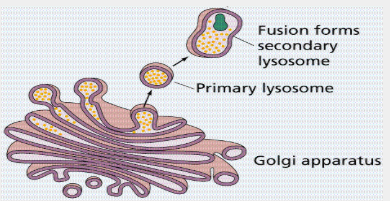
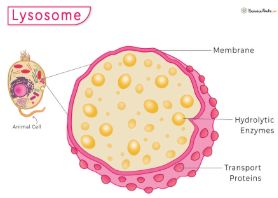
Specialised forms of vesicles
Contain digestive enzymes that break down waste material and organelles in cells
Important role in immune system as they break down pathogens
Centrioles

2 hollow cylinders that are arranged at right angles to each other
Form spindles during cell division, which separate the chromosomes
What is a phospholipid made of?

The head of a phospholipid contains phosphate, and is water-loving.
The tail is made up of fatty acid chains (aka lipids), and is water-hating.
Phospholipids in membranes
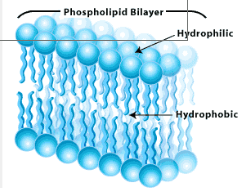
The phospholipid molecules form a bilayer
The hydrophilic heads arrange themselves on the outside
The hydrophobic tails on the inside
whats the fluid mosaic model
a model describing the arrangement of biological membranes; where all cell membranes as well as nuclear membranes have this arrangement
Fluid: The phospholipids can move freely through the bilayer
Mosaic: The phospholipid bilayer has proteins embedded in it
What do the Fluid mosaic model membranes consist of?
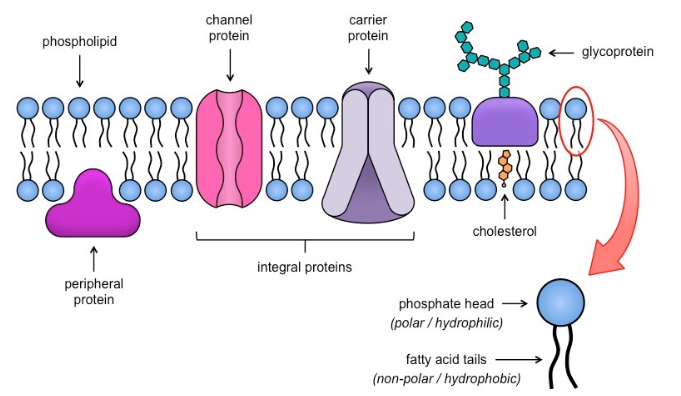
Phospholipid bilayer forms the basic structure (two layers of phospholipid molecules)
Protein molecules which are present within the phospholipid bilayer
Extrinsic proteins are embedded on the surfaces of the membrane
Intrinsic proteins completely span the bilayer.
Membrane proteins
Intrinsic proteins: span the membrane and act as channel and carrier proteins. Made of protein only.
Extrinsic proteins: are on the surface of the membrane (internal or external) and give mechanical support or act as receptors or enzymes. May have carbohydrates bound to them (glycoproteins).
Glycolipids
Carbohydrate bound to lipid
Lipid portion embedded in phospholipid bilayer, carbohydrate portion extends outside cell
Act as recognition and binding sites
E.g. as receptors for specific chemicals like in the ABO blood system
Glycoproteins
Carbohydrate bound to extrinsic proteins
Act as recognition and binding sites (for hormones)
Help cells attach to one another to make tissues
Allow cells to recognise each other - lymphocytes recognise cell as ‘self’
Cholesterol
Fatty substance
Hydrophobic so pulls together phospholipid tails
Adds strength and some rigidity to the membrane (particularly at high temperatures).
Embedded within the membrane
Reduces the movement of other molecules in the membrane
label
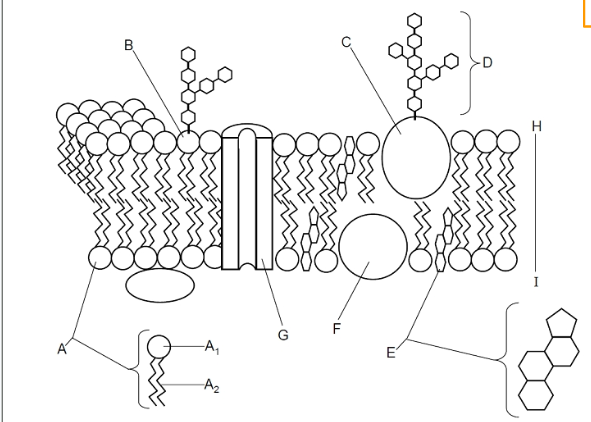
A phospholipid
A1 phosphate head
A2 fatty acids tail
B glycolipid
C glycoprotein
D carbohydrate chain
E cholesterol
F extrinsic protein
G intrinsic Protein
H phospholipid bilayer
what is Passive movement
refers to when particles are moving from a high concentration to a lower concentration- even when concentration is the same on both sides movement does not stop (particles keep moving to maintain equilibrium)
Simple diffusion
Facilitated diffusion
Osmosis
Simple diffusion
when particles move from a high to low concentration- simple diffusion will only occur if:
membrane is permeable (pores are big enough)
particle is not charged
particle is soluble
Cell membrane proteins
the intrinsic (inside) proteins (those that span the lipid bilayer) act as protein channels.
These are used for active transport and also for facilitated diffusion.
Facilitated diffusion
It is still a passive process where particles move from a high to low concentration, however it uses proteins embedded in the membrane.
Large molecules and charged particles (like ions) move via facilitated diffusion.
Channel proteins
Water filled hydrophilic channels across the membrane
Allow specific water-soluble ions to pass through
Channels are selective, opening only for specific ions
Channel will remain closed unless specific ion is present
Quicker than carrier protein method
Carrier proteins
Molecule has to be specific to protein
Molecule binds to protein, which causes it to change shape and is then released
Large molecules such as glucose are transported by facilitated diffusion by carrier proteins
Slower than channel protein method
Diffusion & Facilitated Diffusion
Similarities:
-Both passive (no external energy input)
-Both happen down the concentration gradient (high to low concentration)
Differences:
-Diffusion directly through plasma membrane
-Facilitated diffusion via channel proteins/carrier proteins
Which type of molecules is diffusion directly across phospholipid bilayer for?
Small, lipid-soluble, uncharged molecules
e.g. Oxygen, carbon dioxide, Nitrogen, steroids, hormones
which type of molecules is facilitated diffusion using channel proteins for?
Small, polar molecules and ions
e.g. Na+ ions, H+ ions, K+
which type of molecules is facilitated diffusion using carrier proteins
Larger, lipid-insoluble molecules
e.g. glucose, amino acids
Osmosis definition
The movement of water from a solution with a high water potential to a low water potential across a partially permeable membrane.
Osmosis through cell membrane
some water passes through the membrane, however most is facilitated (aided) by channel proteins (quicker).
Why does it need to be facilitated (aided) by channel proteins?
because water is polar so is repelled by the hydrophobic fatty acid tails inside the phospholipid bilayer.
Active transport
Active transport is the movement of a substances against the concentration gradient (low to high concentration)
It requires energy from respiration (ATP)
Molecules move across the membrane via carrier proteins
Proteins are highly specific
What is bulk transport?
an energy-requiring cellular process that moves large molecules, particles, or big quantities of fluid across a cell membrane inside membrane-bound sacs called vesicles
Endocytosis & Exocytosis
These processes happen during bulk transport at the cell surface membrane, when the membrane is moved to form a small packet called a vesicle.
This requires energy in the form of ATP.
endocytosis
Molecules entering the cell, taking a portion of the phospholipid bilayer to make a vesicle, requires ATP
exocytosis
Molecules exiting the cell, giving back a portion of the phospholipid bilayer, requires ATP