Test 3 Concepts
 Call Kai
 Learn
 Practice Test
 Spaced Repetition
 Match
 Flashcards
 Knowt Play
1/36

There's no tags or description
Looks like no tags are added yet.
37 Terms
Kinetic Molecular Theory of Gases (KMT): 5 assumptions
(and whether each one is true and WHY)
Deviations from ideality are the worst for:

how does pressure arise according to KMT?
from particles colliding with the walls of a container
Increase in the # of moles (n) = ____ in Pressure
Increase in Temperature (T) = ___ In pressure
Decrease in Volume (V) = _____ in Pressure
Increase in the # of moles (n) = INCREASE in Pressure due to more collisions
Increase in Temperature (T) = INCREASE In pressure due to presence of more KE
Decrease in Volume (V) = INCREASE in Pressure due to more collisions
Diffusion is ____, resulting in ____
Effusion is _____
both is driven by ____
Diffusion is the random dispersal of molecules, resulting in even distribution.
Effusion is the passage of molecules trhough a small opening
both iare driven by entropy.
Gases at the same temperature have the same ______
Gases at the same temperature have the same kinetic energy
Pressure is ____ related to volume
Inversely (Boyles Law)
PV=PV
Temperature is ___ related to volume
Temperature is directly related to volume (Charles’ Law)
As temperature increases, volume increases.
V/T=V/T
Volume is ____ related to the # of moles
Volumes of gases are ____ to the # of moles
(both at same pressures and temperatures)
Volume is DIRECTLY related to the # of moles
Volumes of gases are PROPORTIONAL to the # of moles
Equal volumes of different gases at the same temperature and pressure contain an equal number of particles (# of moles)
V/n=V/n
the total pressure of a gas mixture ____ the sum of the partial pressures of the component gases
the total pressure of a gas mixture EQUALS the sum of the partial pressures of the component gases
Mole Fraction
The ratio of moles of one component in a mixtrues to the total # of moles of all components (can also apply to pressure of the mole compared to total pressure)
Why is the effect of particle volume not negligible especially at high pressure?
The volume of ideal gases is smaller than the volume of real gases.
actual free volume left for molecules to move around in is significantly smaller than the actual volume of the container, as distance between the particles decreases rapidly.
Why are the effect of attractions not negligible especially at low temperatures
The pressure of ideal gases is more than the pressure of real gases.
If molecules are interacting, then they are colliding with the walls of the container less often resulting in an apparent decrease in pressure (remember classroom metaphor)
All reactions in the physical world are accompanied by _______
All reactions in the physical world are accompanied by Changes In Energy
State functions definition & examples
State functions only depend on the FINAL and INITIAL values, not on the path taken
examples: Pressure, volume, temperature, energy, enthalpy
typically shown via capital letter and can have delta to indicate “change in”
Path Functions definition & examples
Path Functions depend on the path taken (gas mileage depends on road taken, driving speed, driving habits)
Work (force applied over a distance) and Heat (transfer of energy between bodies at diff temperatures) are path functions
First Law of Thermodynamics: the total change in energy conists of…
the total change in energy conists of HEAT transferred to and Work done on a system
ASSIGN POS/NEG signs to these statements:
Heat is transferred from the system
Heat was gained from the system
5 Joules of work were done by the system
5 joules of work were done on the system
Heat is transferred from the system (—)
Heat was gained from the system (+)
5 Joules of work were done by the system (—)
5 joules of work were done on the system (+)
POSITIVE E, q, or w means heat was transferred from ___ to ___
NEGATIVE E, q, or w means heat was transferred from ___ to ___
POSITIVE E, q, or w means heat was transferred from the surroundings to the system
NEGATIVE E, q, or w means heat was transferred from the system to the surroundings
Enthalpy:
Heat at a constant pressure
usually the primary means of energy transfer except in reactions of gases

Change in Enthalpy (Delta H) =
Delta H = H(of products) — H(of reactants)
Calorimetry is defined ___
Relies on a property called ____, which means what?
Calorimetry is defined as the experimental measure of heat flow
It relies on a property called heat capacity, which is the amount of heat (q) neeeded to raise the temperature of a substance
can be given as molar head capacity or specific heat capacity
Exothermic reactions
sign of DeltaH and potential energy graph
heat flows out of the system into surroundings

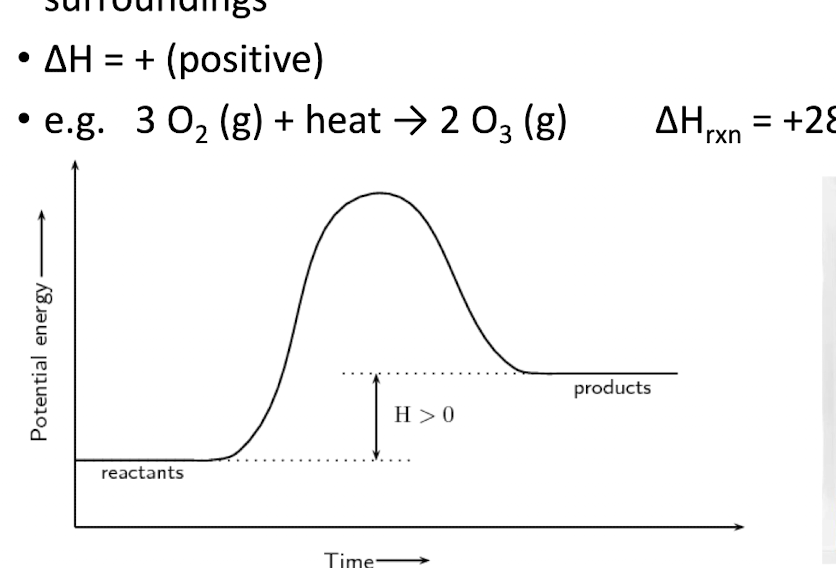
Endothermic reactions
sign of DeltaH and potential energy graph
Heat flows into system from surroundings
Bond Dissasociation Energy:
(definition, exothermic or endothermic?)
Bond Energy is the energy needed to BREAK A BOND
all bond energies are ENDOTHERMIC
when a bond is formed, energy is released (exothermic)
Effect of magnitude of bond energy of breaking/forming on DeltaH of the reaction? Why?

Entropy
Inherit ranking of States of Matter’s entropies
A measure of disorder/chaos
In order of most disordered to least: gas>solution>liquid>solid
Reaction equation will have a positive enthalpy sign if products are in a more disordered state than the reactants.
What is favorable and unfavorable for enthalpy and entropy?
Nature prefers reactions that release heat, so —ΔH is favorable
Universe prefers increase in chaos, so +S is favorable
Types of of predicted reactions based on ΔH and Δ and at what temperature

When discussing state changes, ΔH and ΔS will always _____
When discussing state changes, ΔH and ΔS will always Have The Same Sign
Hess’ Law (for enthalpy and entropy)
ΔHrxn/ΔSrxn = products - reactants

Gibbs free energy reaction meaning (and units)

Spontaneity
ΔHrxn = bonds ____ - bonds _____
ΔHrxn = bonds broken - bonds formed

gives the enthalpy needed to form 1 mol of a compound from its constituent elements (enthalpy of formation)
the defined ΔHf of elements in standard state (25C and 1 atm) is 0 kj/mol

When to use calorimetry & warnings
Use this when question gives a mass, change in temp, and a heat capacity (either molar or specific)
Careful- the Q value you get is usually for the SURROUNDINGS, not the system. if the qeustion asks you for the system, you must flip the sign

When to use Hess’s Law & warnings
use when the ΔH value or other chem. reactions are given
You may need to manipulate the chem. equations to cancel everything you don’t need or reverse reactions

When to use Bond DIssociation Energy & warnings
The number and type of bond in each reactant and product must be considered in the calculation