7. Nervous System: Introduction, Neurons, Neuroglia
 Call Kai
 Learn
 Practice Test
 Spaced Repetition
 Match
 Flashcards
 Knowt Play
1/42

There's no tags or description
Looks like no tags are added yet.
43 Terms
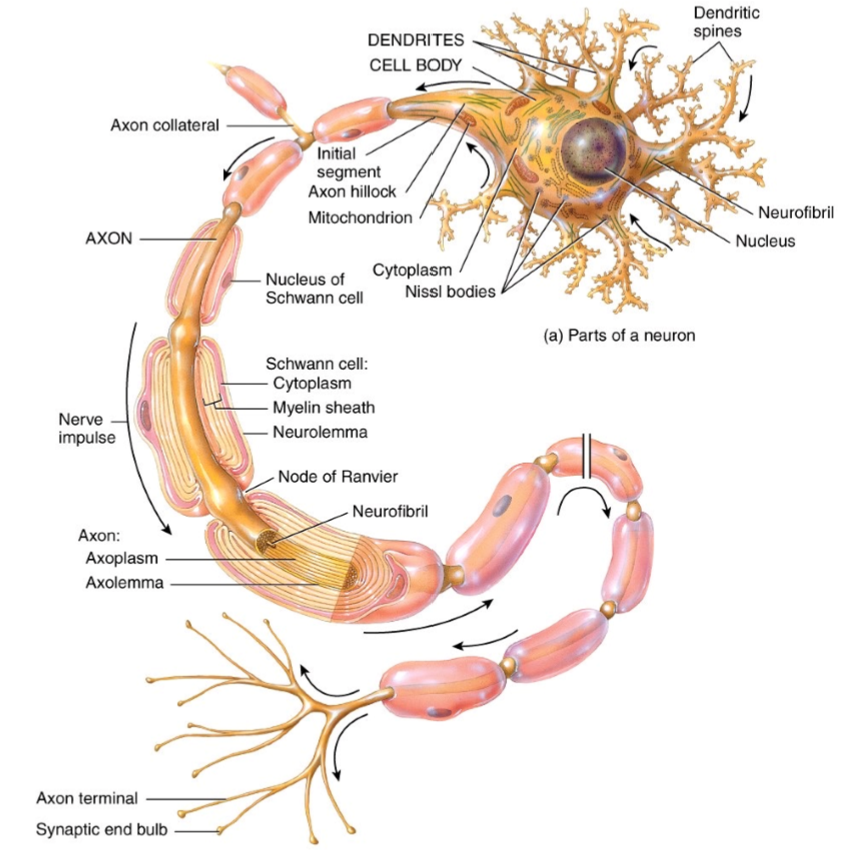
neurons
cell of nervous system
electrical excitability
can respond to stimulus
transmit propagating electrical signals (APs) along length (axon)
high metabolic rate
requires continuous supply of O2 + glucose
long-lived
cannot undergo mitotic divisions
neuroglia
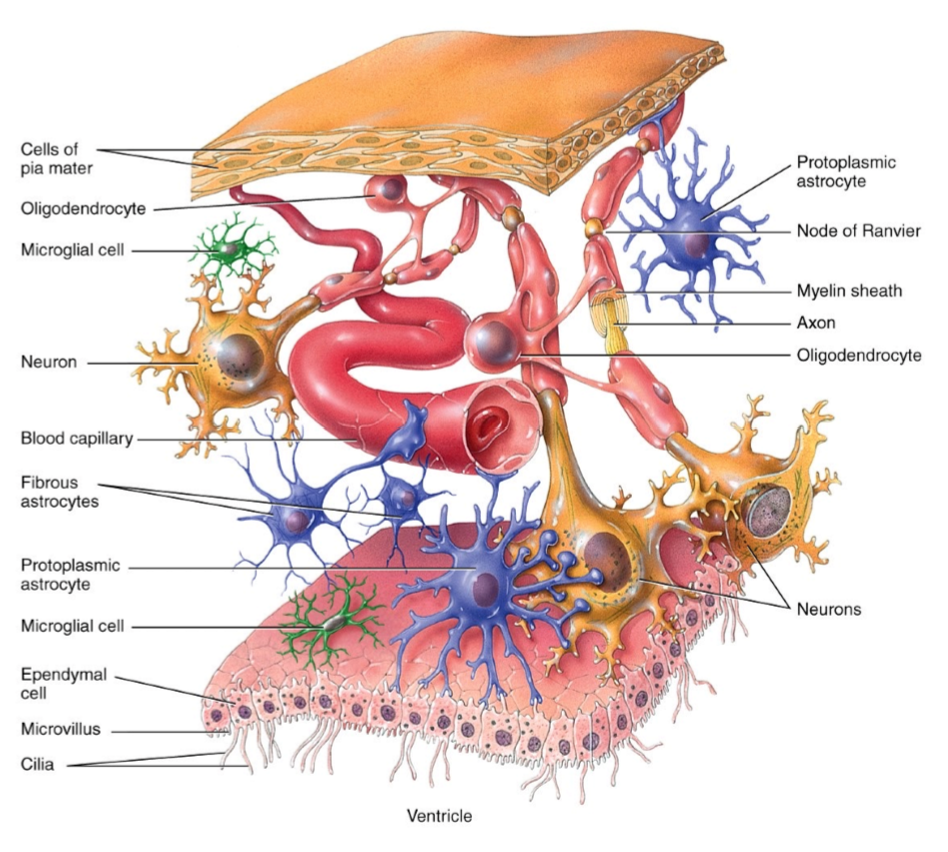
cell of nervous system
support cells
no electrical excitability
retains ability to replicate
CNS
astrocytes
microglia
ependymal cells
eoligodendrocytes
PNS
satellite cells
Schwann cells
central nervous system (CNS)
brain
spinal cord
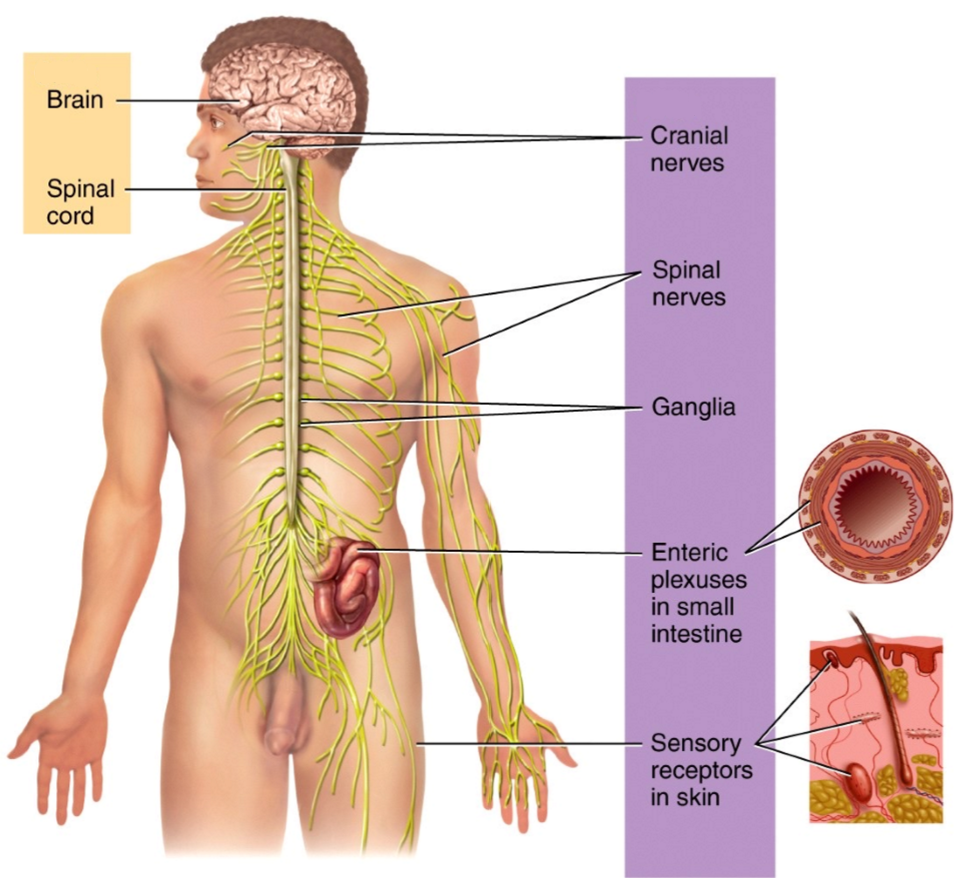
peripheral nervous system (PNS)
cranial nerves
spinal nerves
nerve plexuses
peripheral nerves

functional organization of nervous system
neurons transmit in different directions
sensory → CNS
CNS = integrates info → motor neurons → motor components

afferent
neurons going towards CNS
sensory neurons
efferent
neurons going away from CNS
motor neurons
somatic nervous system (SNS)
conscious nervous system
voluntary
targets skeletal muscles
muscles you can control
autonomic nervous system (ANS)
unconscious nervous system
involuntary → sympathetic + parasympathetic
targets smooth/cardiac muscles + glands
muscles you cannot control
can target enteric motor neurons
muscles of GI tract
enteric nervous system (ENS)
subdivision of ANS
targets muscles of digestive system
sympathetic + parasympathetic
smooth/cardiac muscle + glands
____
smooth muscle, glands, endocrin cells of GI tract
neuron cell body
has typical cell organelles
has short branches processes = dendrites
usually organized in discrete collections:
PNS → ganglia
CNS → nuclei
dendrites
short branched processes on cell bodies of neurons
receive signals from neighbouring neurons/sensory receptors
determine if action potential is initiated at initial segment
axon terminals
end of axon that meets dendrite of next neuron
enlarged distal end = synaptic end bulbs
synaptic end bulbs
enlarged distal ends of axon
contain synaptic vesicles → store NTs
NTs released into synaptic cleft → bind to receptors on another cell
excite/inhibit neuron/myofiber/gland cell
neural synapse
point of contact b/w pre-synaptic + post-synaptic neuron
nerves
PNS axons
contain many axons packaged within connective tissue layers
epineurium = entire nerve
perineurium = fasicle of neurons
endoneurium = individual neurons
can be:
sensory
motor
mixed

epineurium
connective tissue packaging surrounding entire nerve

perineurium
connective tissue packaging surrounding fascicle of neuron

endoneurium
connective tissue packaging surrounding individual neurons

tracts
CNS axons
bundles of axons transmitting similar info within CNS = white matter
white matter
primarily myelinated axons
gray matter
primarily neuron cell bodies

white matter
tracts of myelinated axons in CNS
spinal cord → outside layer
brain → inside layer
gray matter
primarily neuron cell bodies
spinal cord → inside layer
brain → outside layer
multipolar neurons
(1) several dendrites + 1 axon
most neurons of brain + spinal cord
ie. interneurons
motor neurons
ie. efferent neurons

bipolar neurons
(2) 1 main dendrite + 1 main axon
neurons involved in special senses
eye, inner ear, olfactory area

pseudounipolar neurons
(3) short single process leaving cell body → dendrite + axon continuous
sensory neurons in PNS
ie. afferent neuron

neuron interaction

astrocyte
CNS neuroglia
strength + support
BBB
microglia
CNS neuroglia
phagocytes
ependymal cell
CNS neuroglia
production of cerebrospinal fluid
oligodendrocytes
CNS neuroglia
myelination of axons in CNS
possess processes responsible for myelin sheath formation
1 can myelinate multiple axons

satellite cells
PNS neuroglia
regulates extracellular environment of PNS neurons
similar to astrocytes in CNS
Schwann cells
PNS neuroglia
myelinating = myelination of axons in PNS
unmyelinating = nutritional support → nerve development + regeneration
myelination
multilayers lipid + protein covering = myelin sheath
myelinated axons → has myelin sheath
unmyelinated axons → no myelin sheath
made by 2 types of neuroglia
CNS = oligodendrocytes
PNS = Schwann cells
myelin sheath
multilayered lipid + protein covering
electrical insulation for axon = ⬆ speed of AP propagation → saltatory conduction
nodes of Ranvier
gaps in myelin sheath along axon

multiple sclerosis
autoimmune inflammatory demyelinating disease of CNS
formation of scars/lesions (plaques)
sensory symptoms in limbs/face
vision loss
motor weakness
gait + balance problems

myelinating Schwann cells
wraps around PNS axons to form myelin sheath
1 Schwann cell myelinates 1 axon
given axon can have multiple Schwann cells contributing to myelin sheath along its length

unmyelinating Schwann cells
encases unmyelinated neurons + hold them in place
forms remak bundles
unmyelinated Schwann cell + unmyelinated axon
provides nutritional support for neurons
role in nerve development + regeneration

neuron plasticity
plasticity maintained throughout life
sprouting of new dendrites
modifying proteins synthesized
altering synaptic contacts w/ other neurons
neuron regeneration
PNS = limited capacity
CNS = not possible for most part
PNS neuron regeneration and repair
damage to peripheral nerve axon
distal to injury site → degeneration of axon + myelin via macrophages
Schwann cells proliferate along path of original axon
macrophages move into area → remove degenerating debris distal to injury site
regeneration of axon into injury site + distally → along path created by Schwann cells
Schwann cells help guide axon regrowth
axon elongates → Schwann cells wrap around
axon re-establishes normal synaptic contacts = normal function regained
axon stops growing/wanders off = normal function will not return

ganglia
neuron cell bodies in PNS
nuclei
neuron cell bodies in CNS