Anatomy Chapter 12 (Nervous System)
 Call Kai
 Learn
Learn Practice Test
 Spaced Repetition
 Match
Match Flashcards
 Knowt Play
1/154

There's no tags or description
Looks like no tags are added yet.
Name | Mastery | Learn | Test | Matching | Spaced | Call with Kai | Chat |
|---|
No analytics yet
Send a link to your students to track their progress
155 Terms
What are the three functional types of neurons?
sensory (afferent), motor (efferent), and interneurons (associative neurons)
What are sensory (afferent) neurons?
neurons that conduct info from receptors to other neurons; receptors → CNS
What are motor (efferent) neurons?
neurons that conduct info from other neurons to muscle or glans; CNS → effector
What are interneurons (associative neurons)?
neurons that conduct info from neuron to neuron; between motor and sensory neurons
What two systems can afferent and efferent neurons be found?
sensory and autonomic systems
What is the central nervous system (CNS)?
consists of the brain and spinal cord, control center, runs along the center/midline axis of the body
What are cerebral hemispheres?
main integrator centers of the brain
What is the peripheral nervous system (PNS)?
consists of the cranial and spinal nerves, 2 parts
What are the 2 parts of the PNS?
somatic and autonomic nervous system
What is the somatic nervous system?
voluntary system in which sensory neurons convey info from cutaneous and special sense receptors to the CNS, motor neurons in the CNS then send impulses to skeletal muscle
What is the autonomic nervous system?
involuntary system in which visceral sensory neurons convey homeostatic info from visceral receptors to the CNS, motor neurons then conduct info from the CNS to smooth and cardiac muscle as well as glands
What are the 2 components of the autonomic nervous system?
parasympathetic/craniosacral division and the sympathetic/thoracolumbar division
What is the parasympathetic/craniosacral division?
division of the autonomic nervous system that stimulates organs for “normal” function, rest and digest; in the cranium and sacrum
What is the sympathetic/thoracolumbar division?
division of the autonomic nervous system that stimulates organs during stress, fight or flight, kick into gear or shut down in relation to a threat/problem
How are organs innervated by the autonomic system?
organs all have nerves from both the autonomic divisions, the only specialized area is the adrenal gland in which only the sympathetic nervous system innervates (don’t want adrenaline for normal function)
What are ganglion?
an aggregation of neuronal cell bodies
What are visceral sensory neurons?
sensory neurons that receive info from organs and convey info to the CNS
What is the common effector of the nervous system?
skeletal muscle
What are neurons?
specialized conducting cells, often have “wire-like” processes, have super fast communication
What is the cell body of a neuron?
part of the neuron that contains the nucleus and most of the organelles/cytoplasm, often offset from the axis of the neuron
What are dendrites?
“root-like” extension from the cell body of a neuron, receive signals and communicate with other neurons
What is an axon?
long, wire-like extension of a neuron, transmits impulses to muscle, other neurons, etc. via release of neurotransmitters
What are axons wrapped in, why?
myelin sheath, fatty acid insulation, allows for a rapid signal which increases the speed of conduction of the electrical signal
What are neuroglia cells?
support cells of the nervous system, smaller than neurons and 5-10 times more numerous, form supporting structures and sometimes myelin sheath
What are the different types of neuroglia cells?
astrocyte, oligodendrocyte, microglia, ependyma, neurolemmocytes, satellite cells
What are astrocytes?
neuralgia cells that are the most abundant, star shaped and found in the CNS and support neurons, metabolize neurotransmitters and act as an interface with the circulatory system, help form blood-brain barrier
What are oligodendrocytes?
neuroglia cells that are associate with CNS neurons, Schwann cells of the CNS, produce myelin sheath around axons of multiple cells
What are microglia?
neuroglia cells that are “brain macrophages”, mobile cell in the CNS
What are ependyma?
neuroglia cells that are epithelial cells which line ventricles of the brain and central canal of the spinal cord, ciliated, assist with production and movement of cerebrospinal fluid
What are neurolemmocytes?
neuroglia cell that are Schwann cells of the PNS, form myelin sheath around axis of peripheral neurons
What are satellite cells?
neuroglia ells that are associated with cell bodies of peripheral neurons in ganglia
What is the main functional component of the nervous system?
neurons
In what direction do dendrites conduct electric impulses?
conduct impulse toward the cell body of the neuron
In what direction do icons conduct electric impulses?
conducts impulse away from the cell body
How long can neural axons get?
1-1000mm
What is the longest nerve in the body?
sciatic
What are axon collaterals?
side branches of an axon
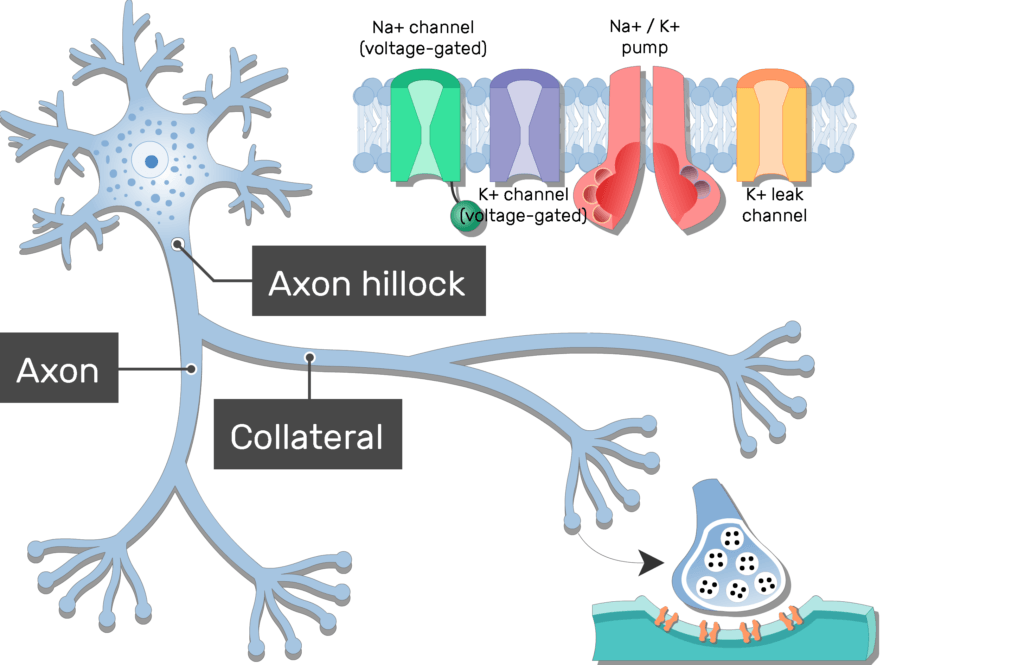
What are axon terminals?
end of an axon, synaptic end bulb that contains synaptic vesicles filled with a neurotransmitter
How can damaged PNS cells regenerate?
can only regenerate if the cell body is intact and there is a sufficient amount of neurilemma remaining (outermost cytoplasmic layer of shwann cells in PNS)
What are unmyelinated axons?
axons that lack a myelin sheath and have continuous conduction
What are myelinated axons?
axons that have a myelin sheath consisting of neurolemmocytes, the myelin insulates fiber and increases the rate of impulse conduction
What are neurofibril nodes?
gaps in the myelin sheath which allows for saltatory conduction
What is saltatory conduction?
conduction of impulses along an axon in which the impulses jump from neurofibril node to node
How do neurolemmocytes grow myelin on axons?
neurolemmocytes wrap around axons and grow around it, they create thicker and thicker sheets as the sheath grows
What type of component of the nervous system are neurolemmocytes?
indirect and living component
How do we structurally classify neurons?
by the number of processes relative to the cell body
What is a multipolar neuron?
neuron with one axon and several to many dendrites

Where can multipolar neurons be found?
brain and spinal cord, somatic motor neurons
What is a bipolar neuron?
neuron with one axon and one dendrite

Where can bipolar neurons be found?
retina and olfactory areas, inner ear
What are unipolar or pseudo polar neurons?
axons with only one process extending from the cell body
Where are unipolar neurons found?
posterior root ganglia of spinal nerves and somatic sensory neurons of the CNS
What is an action potential?
nerve impulse, electrochemical current that initiates and then is propagated along the membrane of a neuron
What are action potential primarily based on?
flux of sodium and potassium ions through specific channels in the membrane
What are action potentials the basis of in the nervous system?
action potentials are the basis of cell-cell communication within the nervous system
What is the at rest voltage of cell membrane?
-70mV
What is the basic sequence of an action potential?
stimulus causes ion channels to open and the depolarize the cell (cell becomes more positive)
depolarization occurs and is propagated down an axon, at the synaptic end bulb vesicles fuse with the axon terminal membrane and neurotransmitters are released into the synaptic cleft
neurotransmitters diffuse across the synapse, bind to a receptor, and depolarization is transmitted to a second site for further propagation of the signal
What is a synapse?
junction between a neuron and other cells
What are the two types of synapses?
gap junctions and chemical synapses
What is a gap junction synapse?
tubular connect between cells which allows for direct propagation of an electrical signal
What is a chemical synapse?
tiny space between pre and post synaptic cells, take an electrical signal and convert it to chemical (neurotransmitters) which then converts once more into an electrical signal
What is an excitatory neuron?
neuron that propagates a signal
What is an inhibitory neuron?
neuron that turns off an electrochemical signal
What is a nerve?
cable-like bundle of parallel axons
What are the three types of connective tissue wrappings around nerves?
endoneurium, perineurium, and epineurium
What is the endoneurium?
connective tissue that surrounds individual axons
What is the perineurium?
connective tissue that surrounds fascicles of neurons
What is the epineurium?
connective tissue that surrounds an entire nerve
What is the brain?
main central processor of the CNS, has a shit ton of neurons, think of it as a motor
What are the main components of the brain?
brain stem, cerebrum, cerebellum, and the meninges
What is the brain stem?
part of the brain that is continuous with the spinal cord, helps in basic life functions
What are the substructures of the brain stem?
medulla oblongata, pons, midbrain, reticular formation, diencephalon, thalamus, hypothalamus, and the pituitary gland
What is the medulla oblongata?
major point of communication between the brain and the spinal cord, think of it as the transmission
What is the pons?
part of brain stem that contains neurons from the medulla and midbrain to the cerebellum and back
What is the reticular formation?
portion in the brain stem and diencephalon, arouses cerebrum and alerts consciousness; helps with being conscious, alert, and awake
What is the diencephalon?
part of the brain stem that is continuous with it, lies above the brain stem
What is the thalamus?
relay center for sensory impulses, except smell, to the cerebral cortex
What is the hypothalamus?
important point of communication between the CNS and most other parts of the body
What does the hypothalamus help regulate?
cardiovascular system, body temperatures, water/electrolyte balance, GI activity, sleep, sexual response, emotions, endocrine function
What is the pituitary gland?
endocrine organ which has both a neural and endocrine part, interface between the circulatory system and the CNS
Where is the pituitary gland housed?
sell turcica
What is the cerebrum?
dominant structure of the brain, primarily involved in processing and integrating info
How can we monitor neuronal activity within the cortex of the cerebrum?
can utilize electroencephalography to produce and EEG, can compare brain scans with “normal” brain patterns
What is the cerebellum?
2nd largest part of the brain that lies below and behind the cerebrum, above the brain stem; functions in coordinating skeletal and muscle activity by recruiting precise motor units with muscle
What are the meninges?
protective coverings of the brain, continuous with spinal meninges with covers connective tissue
What are the three parts of the meninges?
dura mater, arachnoid, and pia mater
What is the dura mater?
dense connective tissue that surrounds the CNS, separates brain from bone; “tough mother”
What is the arachnoid?
middle layer of the meninges, thin collagenous and elastic fibers, has a web-like packing
What is the pia mater?
thin areolar connective tissue closely adhered to the brain, contains numerous blood vessels, “delicate mother”
What is cerebrospinal fluid (CSF)?
fluid that circulates through the subarachnoid space and within ventricles of the brain, protects and allows distribution of materials/nutrients
What is hydrocephaly?
condition in which there is a blockage of the flow of CSF, can cause pressure damage which can lead to intellectual disability and occasionally fatality
What are the cranial nerves?
nerves part of the PNS, 12 of them
Where do CN I and II originate?
originate from the cerebrum, extensions of brain tissue
Where do cranial nerves exit from?
skull foramina
What brain region are CN I and II associated with?
cerebral hemisphere
What brain region are CN III and IV associated with?
midbrain
What brain region are CN V-VIII associated with?
pons
What brain region are CN VIII-XII associated with?
medulla
How does the brain first develop?
flat plate of neural ectoderm, edges rise and a neural groove forms, later the edges of the neural crest fuse to form a neural tube which closes in several places
What can happen if the spinal tube doesn’t close during development?
can result in spina bifida, can lead to anencephaly which is fatal, can have leaks of CSF which if caught early can be treated