Biology Lecture Exam 3
 Call Kai
 Learn
 Practice Test
 Spaced Repetition
 Match
 Flashcards
 Knowt Play
1/98

There's no tags or description
Looks like no tags are added yet.
99 Terms

What is this
Ctenophors washed up on pacific coast poor movement and fearsome weapons
Eumetazoa
True Animals
Metazoa
Multi Celled animals, has no tissue compared to eumetazoa
Cnidarian Characteristics
Aquatic (Most Marine)
Radial Symmetry
Two Forms (Polyp, Medusae)
Two layers (Epidermis, Gastrodermis)
Stinging cells (nematocysts)

Polyp form of Cnidarians
Attached to a surface, uses tentacles to capture prey

Medusae form of Cnidarians
Free swimming-bell shaped form

Epidermis in Cnidarians contains
Epitheliomuscular Cells
Gland Cells (Secrete sticky substance or gas)
Cnidocytes (Hunting Cell)
Nerve Cells
Gastrodermis within Cnidarians contain
Muscle and glands that produce enzymes
Why is it important for Cnidarians to be radially symmetrical
Since it has poor movement, radial symmetry allows it to sense the same in all directions

Nematocysts
Extend at 2 m/s
Covered by lid or Operculum
Made by Cnidocyte
Cnidocil - Trigger Like cilia
Groups of Cnidarians we talked about
Anthozoa (Flower Animals)
Hydrozoa (Water Serpent Animals)
Schyphozoa (Cup Animal)
Cubozoa (Cube Animal)

Anthozoans
No Medusae
Sea Anemones (Solitary , One Polyp)
Corals (Colonial, many individual polyps)
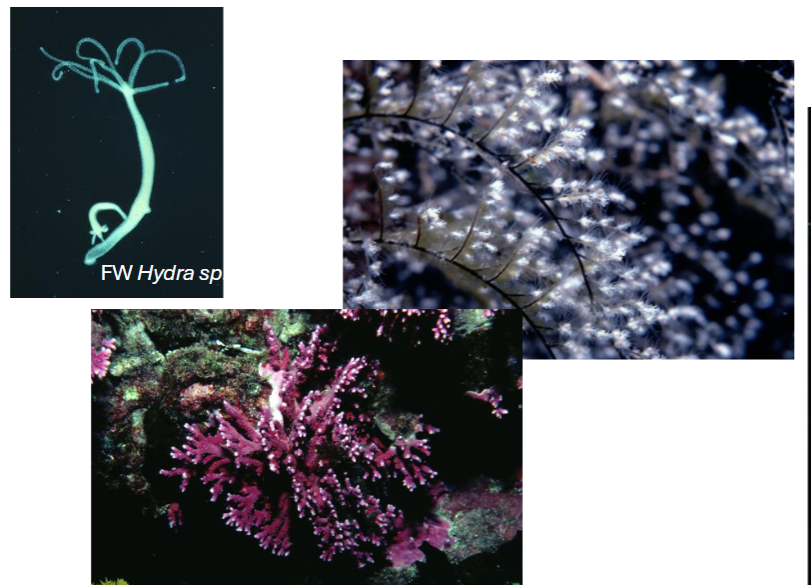
Hydrozoans
Colonial Soft bodied Cnidarians
Has Polyp + Medusa life Stages (Metagenesis)
Polymorphic Polyps
Polyp stage dominant
Portuguese Man O War
How do hydrozoans asexually reproduce
Budding

Polymorphic
Different polyps with different jobs

Schyphozoa
Jellies
Medusa Stage dominant
Rhopalia (Sense Organs)

Rhopalium
Contains Ocellus used for vison (light detection, and Statocysts for balance/equilibrium

Cubozoa
Box Jellies and Sea Wasps
Medusa is dominant and Box like
Toxic
Complex Rhophalia with camera eyes

Camera Eyes
Human like eyes in cubozoans, contains similar structures to humans

Characteristics of Sponges (Porifera)
Sessile (stationary)
No tissues or organs
Fibrous proteins or spikes in mesohyl
Main Cell Types of Sponges
Choanocytes
Amoebocytes
Epidermis

Choanocytes
Cells in sponges that capture food particles

Ameobocytes
Digest and distribute nutrients from choanocytes

Epidermis of sponge
Also known as pinacoderm, protective outer layer of sponge that helps regulate water flow

How do sponges reproduce
Asexual (Budding, Fragmentation)
Sexual - Choanocytes make sperm and Amoebocytes make eggs (Hermaphroditic

How do sponges disperse?
From larvae that can move
Three types of sponges we talked about
Calcareous Sponges
Glass Sponges
Demosponges

What animal did we talk about that sponges help
Hermit crab

Calcareous Sponge
Calcium carbonate spicules
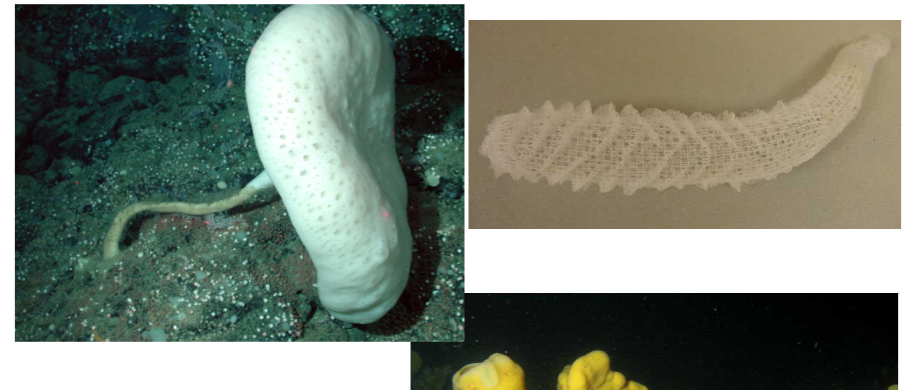
Glass sponges
Silica spicules with 6 rays

Demosponges
Mostly produce spongin, some have silica spicules
Bilateria
Organisms with bilateral symmetry

Protostomes
Eight cell stage is spiral and determinate, first thing to develop was mouth

Deuterostomes
Eight cell stage is radial and indeterminate, first thing to develop was the anus

Lophotrochozoa
Group of species, Eumetazoa→Bilateria→Protostomia, name based off of larval characters
Lophotrochozoans We talked about
Platyhelminthes
Annelida
Mollusca

Platyhelminthes (Flat worms)
group in lophotrochozoans
Turbellaria (Planarians)
Trematoda (Flukes)
Cestoda (Tapeworms)
What are the three types of Coeloms (Body Cavitys)
Acoelomate
Eucoelomate
Pseudocoelomate

Acoelomate
Body cavity does not exist, space between organs is filled with tissue, example would be a flatworm
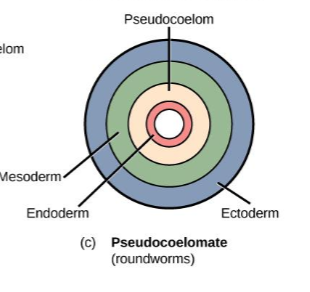
Pseudocoelomate
Partial cavity present, not completely lined by mesoderm, example: roundworms

Eucoelomate
True/complete cavity, examples include annelids, mollusks, arthropods, echinoderms, chordates
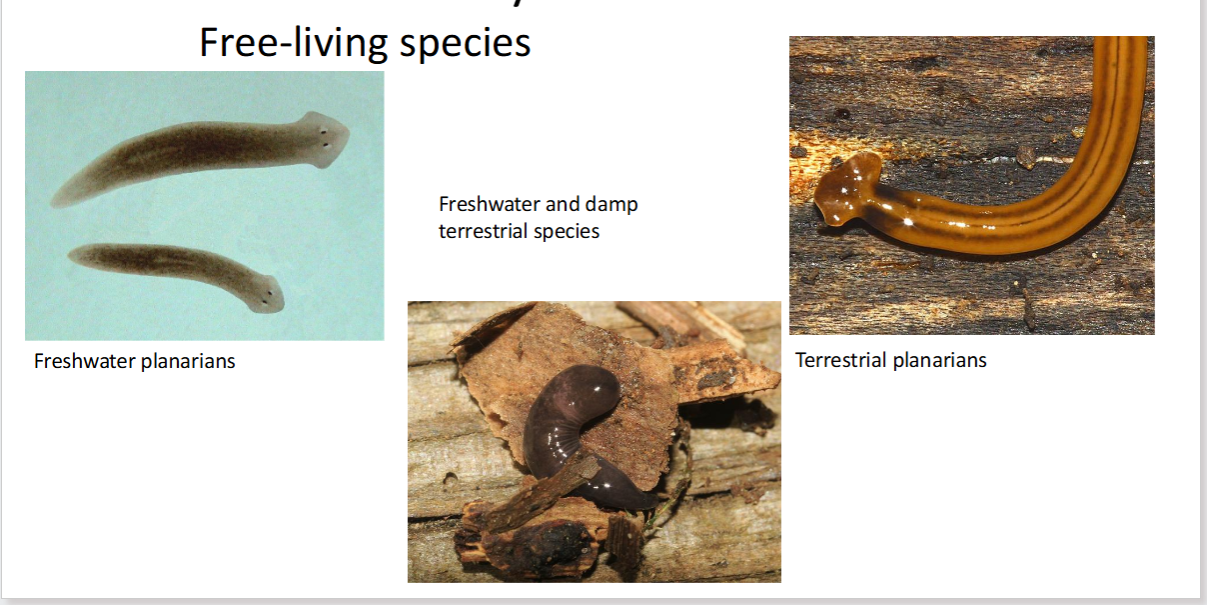
Turbellaria (Planarians)
Type of platyhelminth, consist of freshwater and terrestrial planarians, free living species

Planarian
Mating is weird because of hermaphrodism species fight to be the impregnater, gut has only one opening
Trematoda (Flukes)
Type of platyhelminth, parasitic species that absorbs nutrients across the body surface due to not having a gut
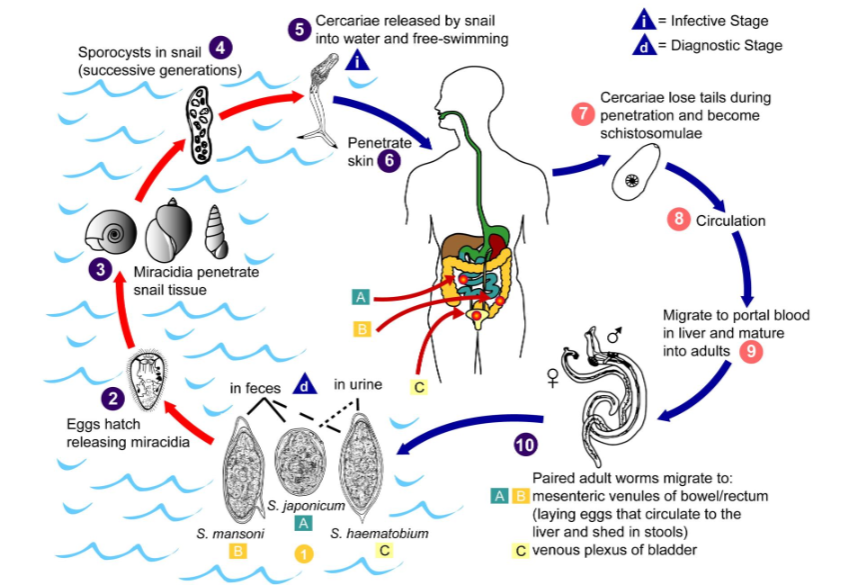
Schistosoma
Type of blood fluke that causes schistosomiasis

What is this
Life cycle of a blood fluke

Cestoda (Tapeworms)
Parasitic species that has digestive system on outside of them, Hermphroditic, type of platyhelminth

Structures of a tapeworm
Scolex - Head that attaches
Proglottids - Individual body segments, contain reproductive structures
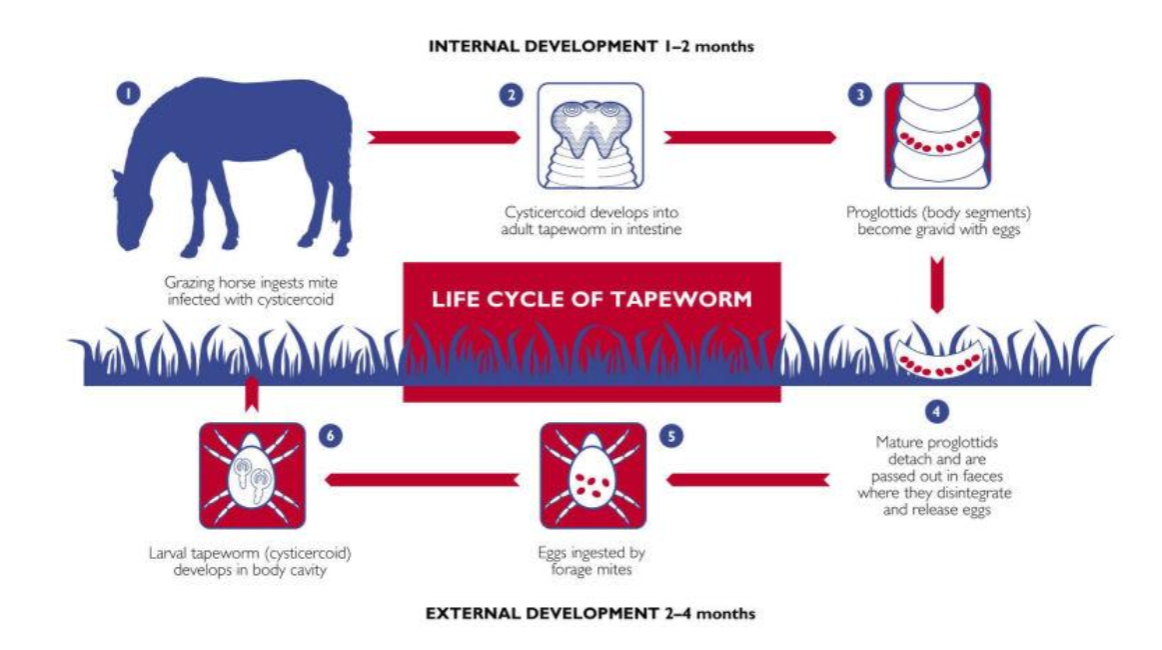
Life cycle of a tapeworm
Egg → Larva in intermediate host → Cyst → Adult in intestine → Gravid proglottids (pregnant) → Eggs
Annelida Characteristics
Circular and Longitudinal muscles
Chitinous Chaetae
Closed circulatory system
Metameric (repeating body parts)
Types of Annelida we talked about
Bristleworms
Earthworms
Leeches

Bristleworms
Bristles (Chaetae/Setae)
Parapodia - appendages
Many construct protective tubes
Marine
Type of Annelida

Earthworms
Live in Damp Terrestrial areas
No parapodia
Clitellum (Thick band around it that secretes mucus)
Aerate Soil

Leeches
Mostly freshwater
Type of Annelida
Clitellum
No chaetae
Secrete anesthetic and anticoagulant that prevents blood clotting (hirudin)

Mollusca Characteristics
Not metameric
Mantle that secretes shell
Radula (tongue)
Foot
Developed Direct eye
Types of Mollusca we talked about
Chitons
Bivalves
Gastropods
Cephalopods

Chitons
Live in Intertidal zones (high-low tide)
8 shell plates
No eyes or antennae
Homing Ability brain (direct path home)
Type of mollusca

Bivavles (Clams, Oysters, Mussels)
2 shells
No head, no radula
Filter feeds through incurrent and excurrent siphons
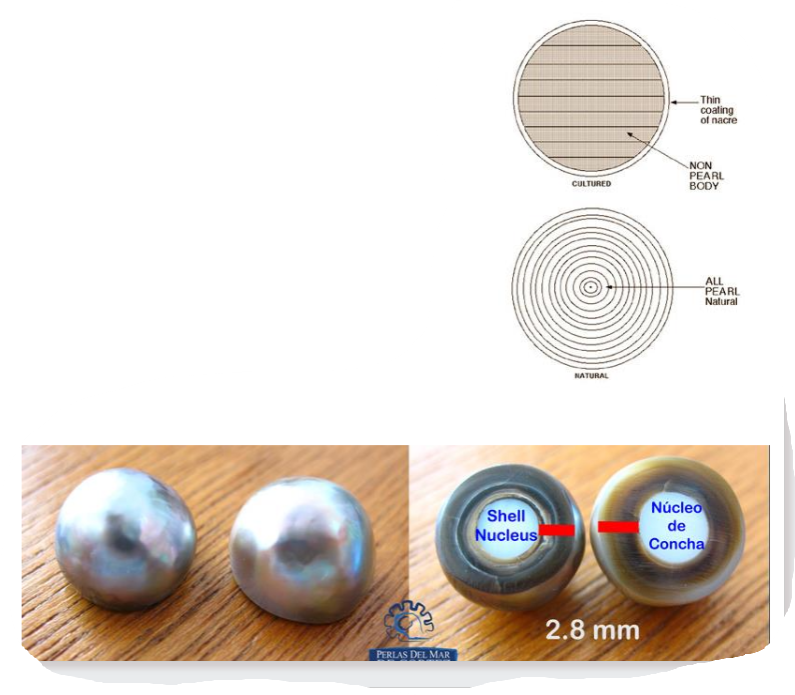
Pearls
Created by bivalves, it is secreted by the mantle. Most pearls are cultured and can be identified by X-ray

Gastropods (Snails + Slugs)
Lungs, Not gills
Eyes and Antennae
Terrestrial or Freshwater
Undergo Torsion during development

Gastropod torsion
visceral mass and mantle rotate 180°, moving the mantle cavity and anus from the posterior to the anterior end above the head.

Sea Slugs
Type of gastropod
Tentacles
Torsion reversed (moves the mantle cavity and anus back toward the posterior end.)
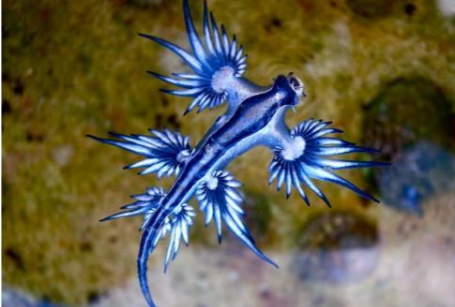
Glaucus atlanticus (blue dragon)
Type of sea slug that goes after Portuguese Man O’ War, eats their cnidocytes and uses it for itself in its appendages

Nautilus Cephalopods
Living fossils
Pinhole eye (water filled)
No long-term learning

Cephalopods (Cuttlefish, Squid, Octopuses)
Good eyes
Large brains
Long term learning
Movement with jet propulsion
Beaks are modification of radula
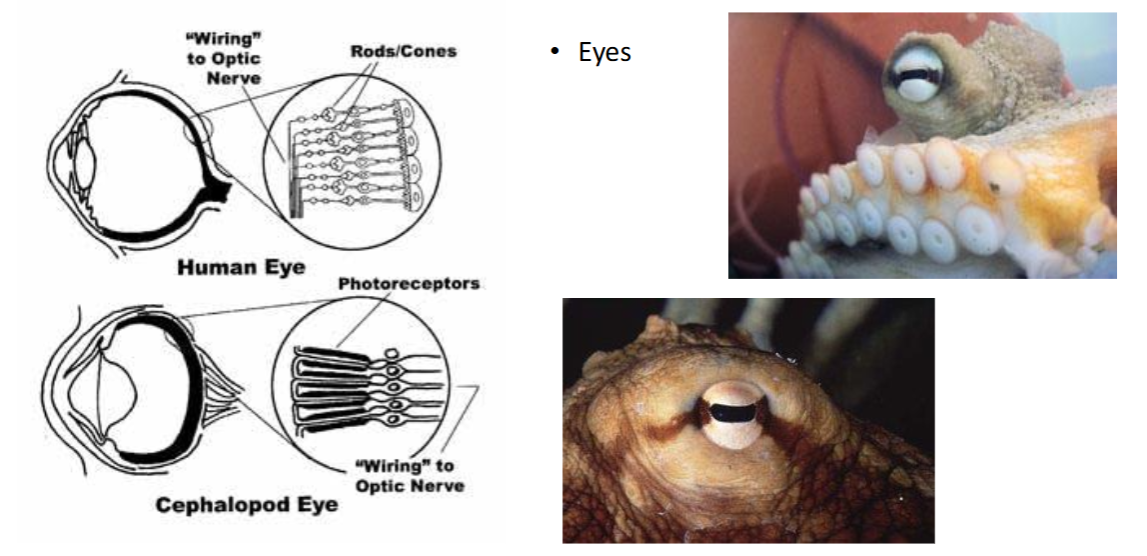
How are cephalopod eyes different from human eyes
Signals go straight to the brain, has no blind spots
Chromatophores
Pigment containing cells found in cephalopods that let them change color rapidly

What is special about cephalopod nerve cords
They extend into each arm, each arm has a mind of it’s own
Brooding
Cephalopods keeping eggs with the parent until they hatch, instead of releasing them and leaving.
Cephalopod independent intelligence
cephalopods became intelligent on their own evolutionary path, not because they inherited a large brain from vertebrate ancestors.
Ecdysozoans
Shedding animals, another group derived from Protostomia

Types of Ecdysozoans we talked about
Nematoda
Arthropods
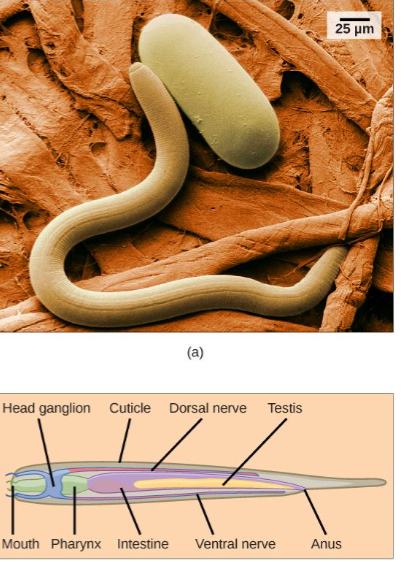
Nematodes
Can’t do peristaltic locomotion, has no circular muscles
Not Segmented
Aquatic, Soil, can be parasitic in both plants or animals
Complete gut (mouth and anus)
Tough skeleton (cuticle) - Molts

Trichinosis
Infection causes by Trichinella spiralis, a type of nematode
What type of organism has the most parasitic worms
Trees
What did the nematologist Nathan Cobb say about nematodes
If everything were to disappear but the nematodes, we would still be able to tell the outline of the earth

Why are fungi predators of nematodes
Some fungi are predatory because they trap and digest nematodes using specialized structures such as constricting rings and sticky nets.
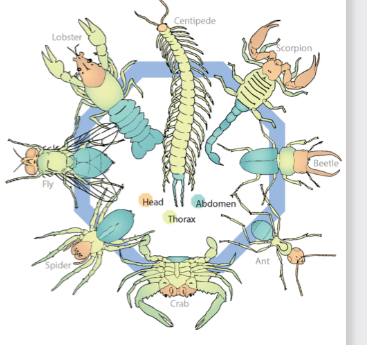
Arthropods
Type of ecydsozoan
Animals with jointed legs and segmented bodies
Cuticle (exoskeleton)
Well-developed sense organs (eyes, antennae)
Open circulatory system

Three types of eyes
Simple Lens eye
Simple corneal eye
Compound eye
Types of Arthropods we talked about
Trilobites
Insects
Crustaceans
Myriapods
Chelicerates
Groups of insects we talked about
Coleoptera
Diptera
Hymenoptera
Lepidoptera
Hemiptera
Orthoptera
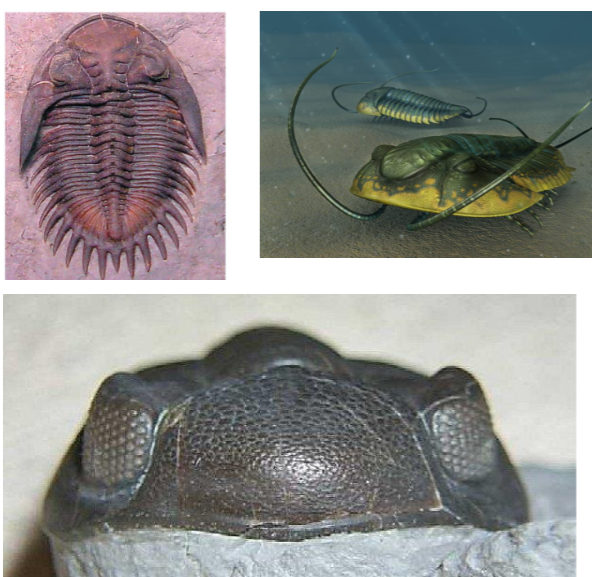
Trilobites
Type of arthropod
3 Lobes and 3 Body regions
Extinct marine animal

The three lobes and 3 body regions of Trilobites
Regions = Cephalon (Top), Thorax(middle), Pygidium (bottom)
Lobes = Left and Right Pleural Lobe, Axial lobe
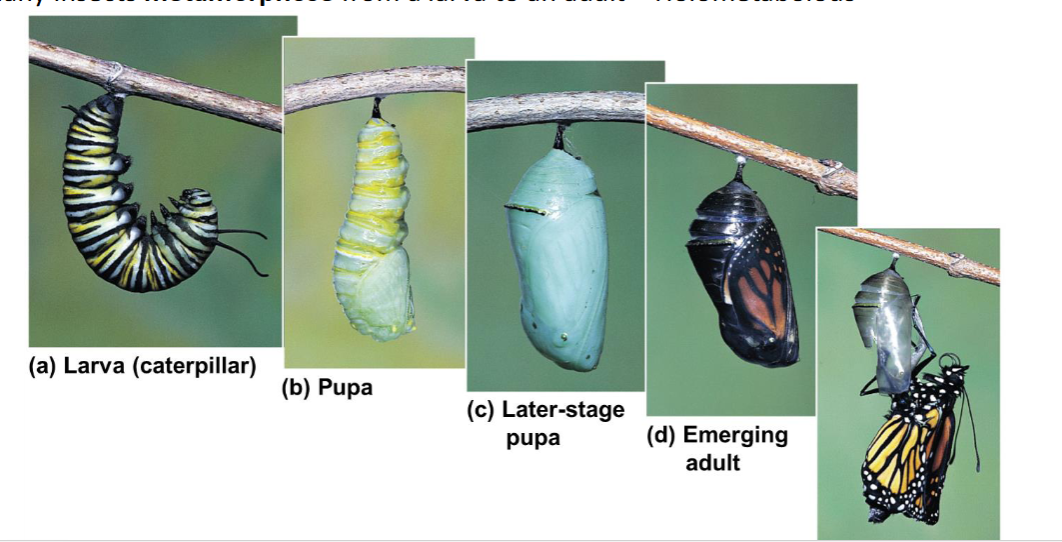
Complete metamorphosis
The larva looks completely different from the adult. Holometabolous organisms do this

Incomplete metamorphosis
The nymph resembles a small adult but usually lacks wings and reproductive organs. Hemimetabolous organisms do this.
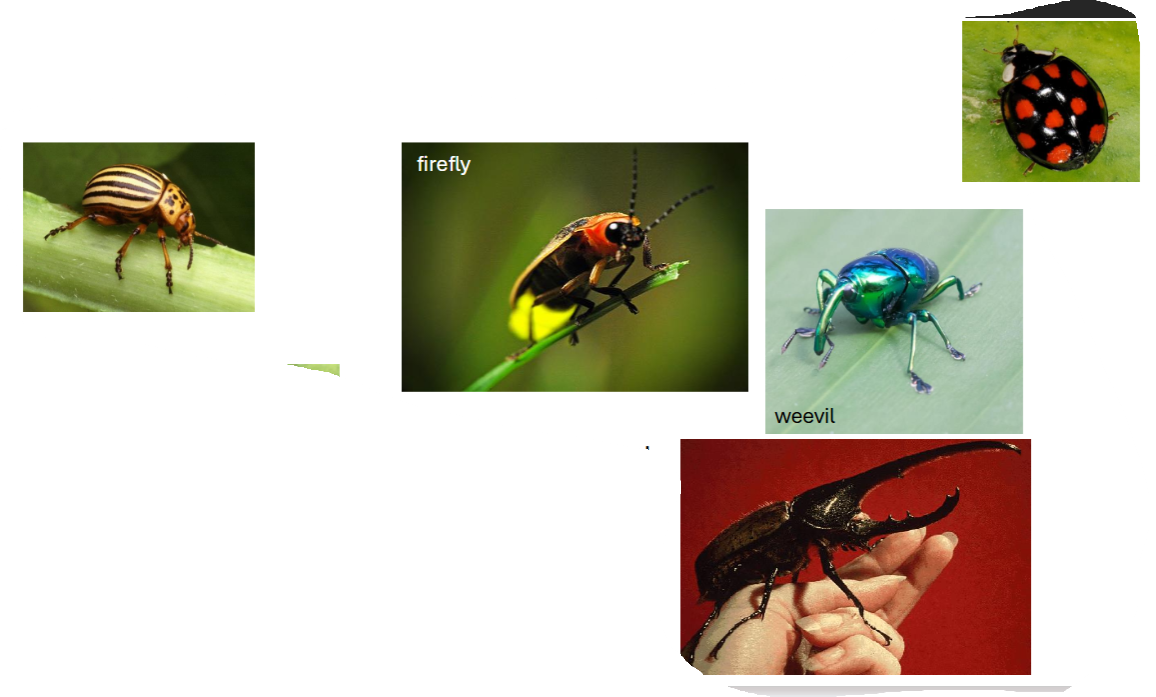
Coleoptera
Beetles, Weevils, Fireflies
30% of all animals
Hard outer wings (Elytra)

Diptera
Flies, Mosquitoes
1 pair of flight wings
1 pair reduced wings (balancers

Hymenoptera
Wasps, bees, ants
Many eusocial (colonies)
Stingers
Bent antennae
Two pairs of wings hooked together

Lepidoptera
Butterflies, Moths
Caterpillars damaging to plants
Long probing mouth parts in adults

Hemiptera (True bugs)
Stinkbugs, Bed bugs, Boxelders bugs
Forewings leathery
Piercing mouthparts

Cochineal bug
Hemiptera Bug on cactus that when crushed produces red dye, used for food coloring and lipstick

Orthoptera
Grasshoppers, Crickets
Large Jumping legs
Sound Production

Crustaceans
Type of arthropod
Shrimp, Crabs, Lobsters

Myriapods
Centipedes and Millipedes
Centipede = 1 pair of leg per segment, Venomous, Predators
Millipede = 2 pair of leg per segment, eat dead plant matter

Chelicerates
Type of arthropod
Horseshoe crabs and Arachnids
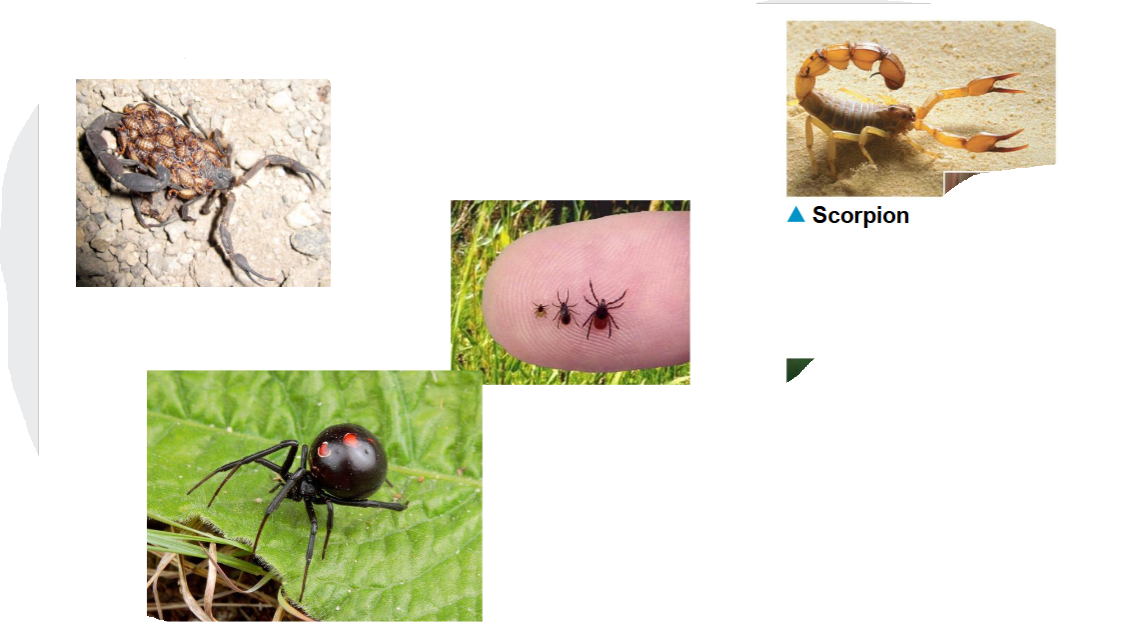
Arachnids
type of Chelicerate that has 4 pairs of legs(8 total legs)
Scorpion, Spiders, Ticks, Mites
80% of crop pollination is done by who
Bees
What percent of known animal species are arthropods
80%, 1,065,000 million described species and 9 million estimated species (12% described)
Open Circulatory system
A circulatory system in which the blood is not always enclosed within blood vessels and can be pumped into open spaces