P-Chem Unit 3
 Call Kai
 Learn
 Practice Test
 Spaced Repetition
 Match
 Flashcards
 Knowt Play
1/31

There's no tags or description
Looks like no tags are added yet.
32 Terms
Chemical Equilibruim
Spontaneous change towards lower Gibbs
Dynamic Equilibrium
THe reaction will eventually reach this where there is no net chage

Finite change
the extent of the reaction
Exergonic
if Delta G < 0, forwards reaction is spontaneous
Endergonic
If delta G> 0 reverse reaction is spontaneous
Q
Reaction quotient
Pb/Pa
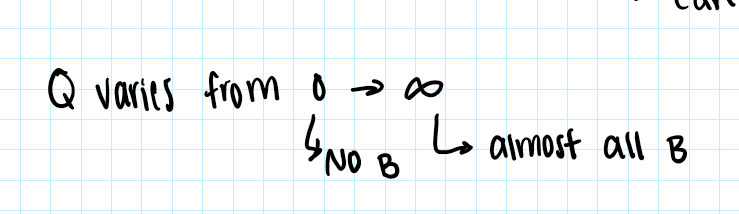
Q=0 before rxn happens
Q= infinity almost to completion, dividing by a really small number, almost any amount of A is gone
Can vary
Q=
K equilibrium constant
K
is equilibrium constant ratio of products and reactants
This is described as fugacity or activity
Does not impact results just definition

Activity
Means effect of concentration

Signed stoichianetric coefficient
+ for products and - for reactants
Q
activity of products/ activity of reactants

Activity are replaced by
certain forms and includes the activity unit
3 Ways to change a reaction
Pressure due to changes in volume degree of dissociation
Temperature K changes
Change concentration
Van’t Hoff eqn
The dependence of equilibrium constant K as a function of temp can be expressed by the
This For vapor pressure equilibrium, Slope is delta H, Non calorimetric way to find the equilibrium constants are
Galvanic Cells
These take advantage of spontaneous process of electrons going from one electrode to the other. Not to be confused with the ones you have to supply energy to have them
Vertical line
Means half reaction
phase boundaries- one is solid and the other is an ion
Couple them
node junction potential (double line) set up for salt bridge
Reduction
happens at the cathode (on the right)
Oxidation
Happens at the anode, is the reverse of the reduction
Kinetic Theory of gases
The gas sample consists of molecules of mass in constant random motion
The size of molecules is negligible “point like”
The molecules interact only through brief elastic collisions
(in reference to a near by molecule, the diameters of these molecules are much smaller than the distance between them)
A partition within a container with an opening
gas particles are not pulled through because of difference in pressure. As the gas molecule does its random walk- from A-B of gas molecules it is not a straight line- the reality is gases will go in whatever direction the Collison takes them why it is called the random walk
Diffusion
Movement of one species through another open a perfume bottle will eventual diffuse through the room
Effusion
Escape from an opening
Deflating of a balloon filled with He will deflate much faster than if you were to use a graph because they are moving faster- rate of effusion is a comparison
Molecular collision
Assume hard sphere approximation
Occurs when the separation between 2 spheres is distance d
Collisional frequency
Number of collisions per time
The most common type is from the side very unlikely for them to be lined up opposing
These resulting collusions are really from the side and has momentum in two direction and will have to follow diagonal which is why we have radical 2
Collisional Frequency
number of collisions a single molecule has per unit time
If we have a molecule that is considered to be spheric there is a certain collusion volume that it will have and that is where these terms come from
Mean free path
the average distance a molecule travels between collisions
Mean free path equation can from
simple assumptions- gas molecule is a simple sphere, there is only a collusion if it is within the collisional volume, we can look at the collusions in terms of time, this is where collisional frequency comes from
These equation tells you the distance traveled between collisions
Kinetic model of gases is only valid

Grahams law of effusion
Gives you the factor of how much faster the smaller is compared to bigger or how much slower the bigger is compared to the slower
Maxwell distribution
At a certain temperature gas molecules do not want to travel at same speed because they have collisions some will be faster and some will be slower due to the collisions-
collusion cylinder
As the molecule moves describe this known as
there is a collusion where the distance to outer edge is 2d - if something is outside that