AP Physics U1
 Call Kai
 Learn
Learn Practice Test
 Spaced Repetition
 Match
Match Flashcards
 Knowt Play
1/70

There's no tags or description
Looks like no tags are added yet.
Name | Mastery | Learn | Test | Matching | Spaced | Call with Kai | Chat |
|---|
No analytics yet
Send a link to your students to track their progress
71 Terms
Scalar Quantities
Can be fully described by magnitude
MUST be positive
EX: Distance and Displacment
Distance
Total length of an object’s path
SCALAR
CANNOT be negative
Speed
How fast an object is moving
Scalar (MUST be positive)
Distance/Time
Vector Quantities
Need to be described by both magnitude and direction
CAN be negative OR positive
YOU determine what direction is positive and what direction is negative
EX; Displacment and velocity
Displacment
Difference between object’s starting and ending posistion
VECTOR
Negative = one direction
Posistion = another direction
Velocity
The rate at which an object’s posistion changes
VECTOR
AKA rate of displacment/times
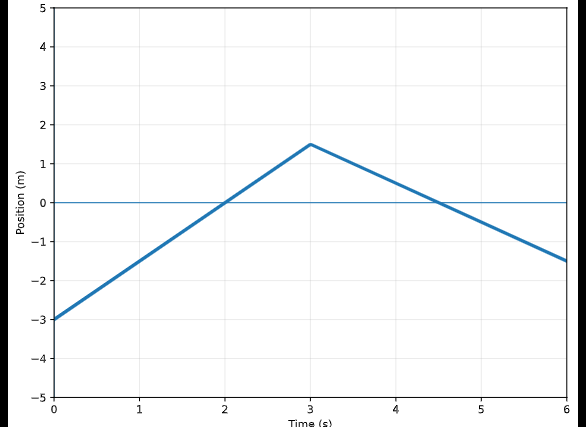
Graphing over time displacment over time
Rest: Flat line
Change direction: The sign of the slope changes
Fast: Steeper slope
Slow: Smaller slope

Graphing over time velocity over time
Rest: the line goes to y = 0 (meaning the displacment is NOT changing)
Change direction: crosses the x-axis
Fast: Larger magnitude (looking @ absolute value)
Slow: Smaller magnitude (looking @ absolute value)
NOTE: Can be also pretty blocky if there are just linear sections on the displacement v time graph)

Graphing over time acceleration over time
Rest: WE DO NOT KNOW if an object is at rest UNLESS we know the initial velocity!
Zero acceleration does NOT mean at rest but means CONSTANT SPEED
Change direction: WE DO NOT KNOW if an object is changing direction UNLESS we know velocity
When velocity crosses zero (looking at area under the curve (aka the area from the curve —> x axis) to look at total velocity which will tell you negative or postitive, negative meaning negative dircetion and posittive meaning posititve direction)
Fast/Slow: WE CANT TELLL without knowing the sign of the velocity!
If velocity + accelration sign MATCH —> SPEEDING UP
If velocity + accelreation sign DO NOT MATCH —> SLOWING DOWN
BASICALLY WE NEED TO KNOW THE VELOCITY!
If it crosses the x-axis we break it up, its now positive or negative vleocity

How to get velocity from acceleration curve
Accumulated area under the acceleration curve until that point PLUS the inital velocity
YOU NEED to know the starting velocity
ex starting velcoity of 50 and then accumulated (from acceleration) is -10 would be final = 40
POSITIVE velocity means postitive direction
NEGATIVE velcotiy means negative direction
ACCELERATION ONLY TELLS YOU THE CHANGE!!
instantaneous veloicty v average velocity
Instantaneous velocity: the velocity at the time
pin point the time and the velocity
average velocity:
looking at the average
ex: looking at the area under the curve of the velocity v time graph (representng total/net displacment) and divide by total time
Displacment —> Velocity
Slope of displacment over time = velocity!
Calculate it in chunks

Velocity —> Displamcent
Area under the curve of displamcent over time

Posistion —> velocity
Find the slope of the posistion-time graph

Velocity —> Acceleration
Find the slope of the velocity-time graph

Acceleration —> change in velocity
Find the area under the curve of the acceleration-time graph
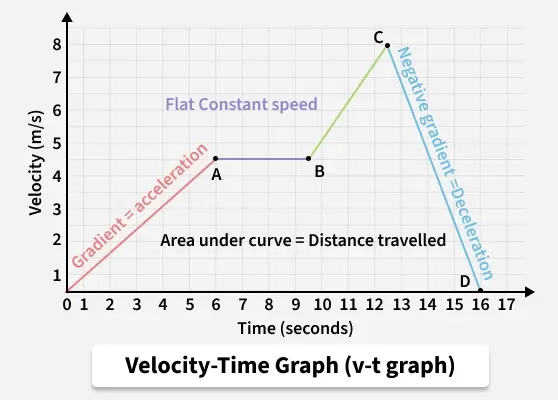
Velocity —> Change in posistion/Displacment
Find the area under the curve of velocity-time graph

Object runing around (vlocity v time & displacment v time)

Positive velocity
the displacment slope is POSITIVE meaning the object is moving towards the positive side
does NOT matter the origin only what direction we are headed
remember its VECTOR (can be positive OR negative)
Negative velocity
the displacment slope is NEGATIVE meaning the object is moving towards the NEGATIVE side
does NOT matter the origin only what direction we are headed
remember its a VECTOR (can be positive OR negative)
Sign of velocity is soley dependent on
the slope of distance over time
direction in relation to origin


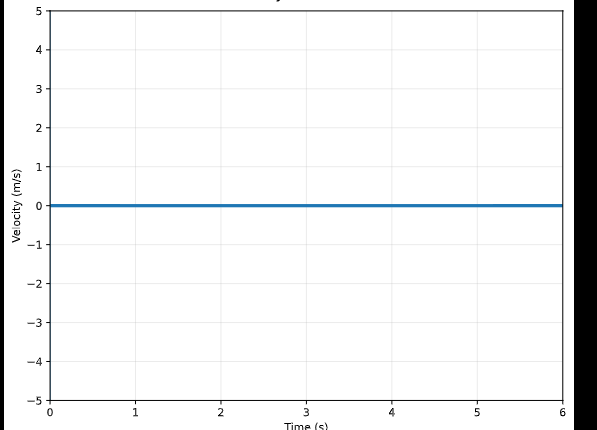


Looking ONLY at velocity we don’t know…
where it started
where it ended
Acceleration
the rate of change of the object’s displacment
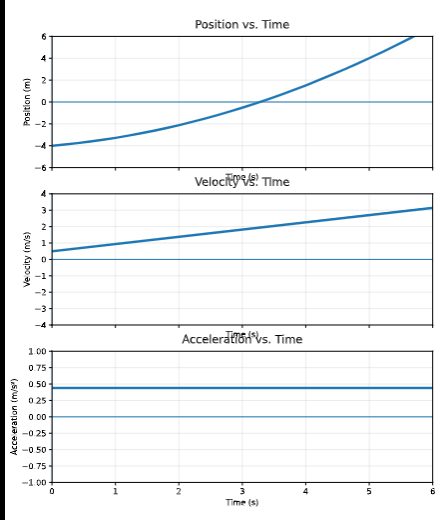
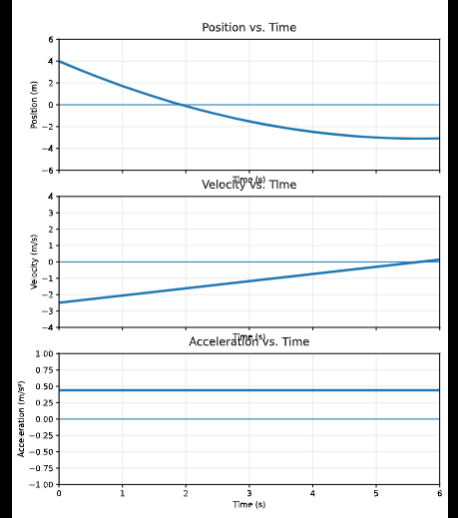
AKA: The slope of velocity v time
velocity/time
If the sign of acceleration and velocity match —> speeding up
if the sign of acceleration and velocity dont match —> slowing down
ONLY exists if the object’s velocity is NOT constant
Posistion versus time graph must be curved to have a linear velocity v time and thus have acceleration




Linearization
changing the axes on a graph to force the data into a linear relationship
if (var 1) = (con)(var 2) is a TRUE equation graphing….
(var 1) over (var 2) will produce a line with slope (con)
y = mx + b
y = mx+b
(var 1) = (con) (var 2)
—>
(vertical axsis) = (slope)(horizontal axis)
When can you use the kinematic equations
When acceleration is constant.
How do you choose a kinematic equation?
List your knowns and unknown. Choose an equation containing your knowns and only one unknown.
What is the basic process for solving a kinematics problem?
List givens
Choose + direction
Identify unknown
Choose equation
Substitute
Solve
Check units/sign
V0
nitial velocity: the object's velocity at the beginning of the time interval.
Vx
Velocity
ax
acceleration
t
time
x
final posistion
x0
inital posistion
how to solve free fall problems
treated like a kinematics problems but using acceleration = gravity
if up is positive what is accerlaation due to gravity
if down is positive what is acceleration due to gravity
up is postitive? acceleration is negative
down is posititve? acceleration is positive
What is the velocity at the highest point of an upward throw?
v = 0 momentariyly
At rest
velocity at 0
starts from rest
v0 = 0
Stops
v = 0
Comes to a stop
v = 0
dropped/released
inital velocity = 0
thrown
the object has a nonzero inital velocity
accelerates
acceleration is non zero
free fall
GRAVITY!
Returns to starting point
displacment/x final - x inital = 0
X final - X inital
DISPLACMENT
if you dont have displacment

If you dont have final velocity (vx)

if yu dont have acceleration (ax)

Free fall
the motion of an object only under the influence of gravity
all objects (free falling) fall at the same rate regardless of shape or mass
NEGLECTING air resistance for analyzing the free falling objects
objects at a given location and in absence of aiar resistence in freee fall have the same constant acceleration (GRAVITY!)
- 9.81m/s²

1: speeding up (moving awar from 0) in positive direction
2: constant movmenet in postitive direction
flat line = constant
rest = 0
3: slowing down in positive direction
4: speeding up in the negative direction
5: slowing down in the negative diection
Direction of speeding up/slowing down is SOLEY dpendenant on the….
VELOCITY
postitive velocity = postivie direction
negative velocity = negative direction
NOT THE SLOPE! LEGIT JUST ABOVE THE X AXIS OR BELOW IT.
Linearization
Identify function that relates all your variables, most of the time from an euqation we know/derive (or sometimes through shape)
Manipulate the equation until it’s in the form (variable 1) = (constants)(variables 2)
Put (variable 1) on the vertical axis and (variable 2) on the horizontal axis
Make new column in data table corresponding to each new axis
Plot data on new axes- should produce line!
Draw line of best fit and find its slope using two points on the line (NOT real data points)
(usually) Solve for desired quantity from slope
How do directions work
The second thing always goes first
ex: NE —> north of east = east first and then north
Quadratic forumla