Molecular and Cell Biology - Cell Signaling Pt.2
 Call Kai
 Learn
 Practice Test
 Spaced Repetition
 Match
 Flashcards
 Knowt Play
1/31

There's no tags or description
Looks like no tags are added yet.
32 Terms
Define signal transduction
When a ligand binds to a receptor on the cell surface, which initiates intracellular reactions
What are G-proteins?
They are the largest family of cell surface receptors derived from the guanine nucleotide-binding proteins
G-proteins are the receptors for many hormones and neurotransmitters
Responsible for smell, sight, and taste
Describe the important components of G-protein-coupled receptors
Carbohydrates are required for proper folding of receptor
G protein coupled receptors have seven transmembrane alpha helices, spanning across the cell membrane
Intracellular ligand binding domain - has guanine nucleotide exchange factor (GEF) activity
An extracellular ligand binding domain

Describe the activation of adenylyl cyclase by epinephrine
Hormone (epinephrine) binds to extracellular domain of the receptor
Binding of the hormone cause a conformational change in the intra-cellular domain, which activates the G protein associated with it
G protein dissociates from the receptor and carriers the signal to the intracellular target (enzymes, ion-channels)

What is the function of epinephrine?
Epinephrine regulates the synthesis of cyclic AMP, cAMP is an important secondary messenger that mediates a number of cellular responses

Understand the diagram showing the GPCR signaling

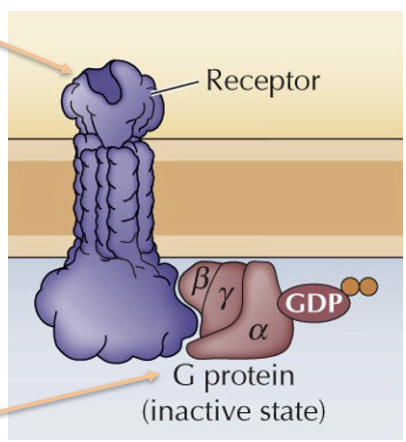
What do G-proteins look like when they are inactivated
They are inactivated when there is an absence of the hormone
In this state the a subunit is bound to GDP in complex with B and y
Describe the G-proteins when the hormone binds
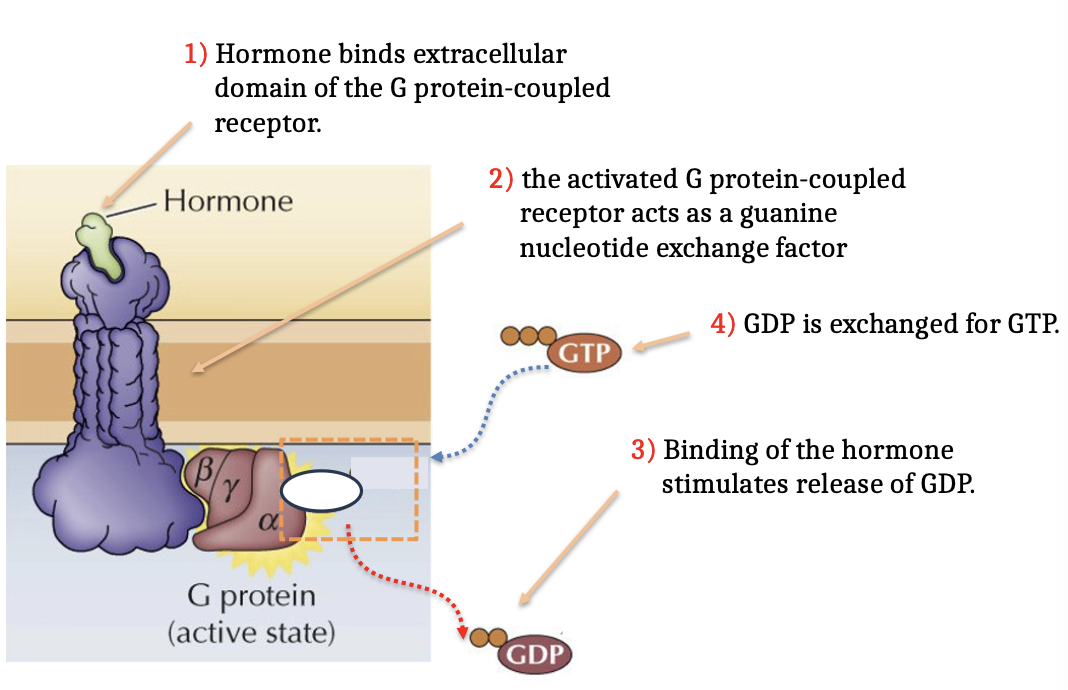
Hormone binds to the extracellular domain of the G protein-coupled receptor
The activated G Protein couple acts as a guanine nucleotide exchange factor
Binding of the hormone stimulates the release of GDP
GDP is exchange for GTP
Describe G-proteins that are activated
GTP is bound to the a subunit activating the G protein
The activated GTP-bound a subunit and By complex dissociate from the receptor
The a subunit and By complex interacts with their targets

What are G-proteins regulated by?
GTPase-activating protein (GAP)
GTP hydrolysis is facilitated by GAP
Without GAP, G proteins are constitutively on because of their slow hydrolytic activity and GEFs constantly replacing GDP. This results in unregulated cell division
What signaling molecule signals the “fight or flight” response
Epinephrine
Why does the epinephrine signaling pathway have so many steps in the liver?
Allows for cross talk
Allows for amplification
Describe the specificity of cell signaling
The final effect is mostly determined by the signaling pathway that is activated by the receptor
The same signal can activate different responses in different cells

How are G proteins divided into their four families
G proteins are divided into four families based on their a subunit
Each family triggers a different signaling pathway
The effect a ligand will have in a cell depends on the specific pathway that is triggered

What are Gi proteins?
Gi proteins have a subunits that inhibit target enzymes (Adenylyl cyclase
Describe the G-protein in the eye
It is called Rhodopsin
Light (signal) changes the conformation of retinal from cis to trans
This causes activation of the receptor and exchange fro, GDP to GTP in the G protein (transducing)
Phosphodiesterase turns cGMP into GMP
Lack of cGMP will have an effect in the cell

Understand the pathway of G protein epinenephrine activation

Describe the process of how G-proteins pass information into the nucleus
Signals leads to activation of the catalytic domain of Protein Kinase A
Signal translocates from the cytoplasm to the nucleus
PKA catalytic subunit then phosphorylates a transcription factor called CRE-binding protein (CREB)
Co-factor binds CREB
Transcription of cAMP-inducible genes

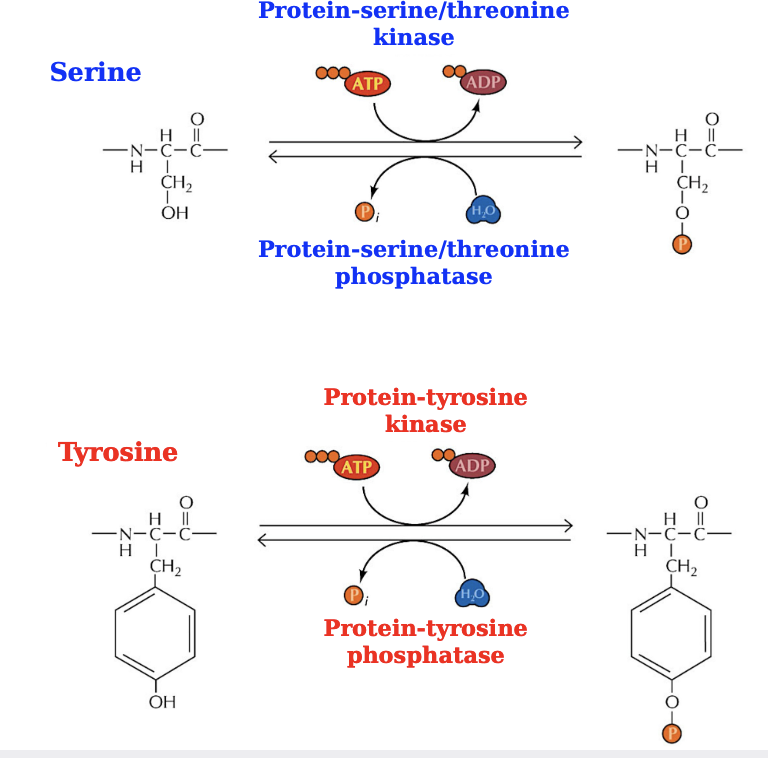
Define what kinasese do and what Phosphatases
Kinases: phosphorylate
Phosphatases: de-phosphorylate
What are the two classes of kinases/phosphatases?
Serine/theronine kinase
Tyrosine kinase
What is the result of phosphorylation?
Can change the shape of the protein (usually means activation)
Can create a binding site for other proteins (mostly true for tyrosine)
What are the two functions of Receptor Tyrosine Kinases (RTKs)?
Bind to a signal
Function as a kinase

What form do RTKs take? Describe the process of how they change forms
Some can be in a dimeric form, but the majority dimerize after ligand bonding
Ligand bonding causes dimerization which brings the kinase domains together
Leads to cross-phosphorylation (the kinase domains will phosphorylate each other)
Phosphorylation of the receptors creates binding sites for other proteins (specifically those that have SH2 domain)

Describe Non-Receptor Tyrosine Kinases
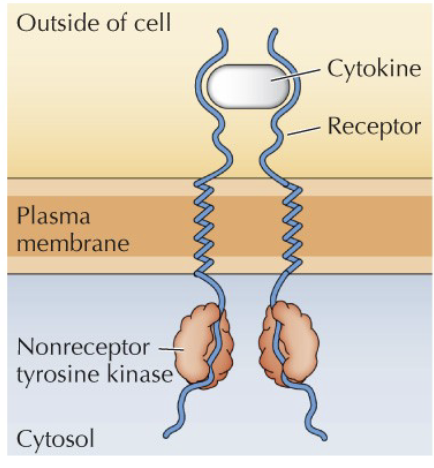
The receptor only binds to the ligand
does not have kinase activity
The receptor does that a protein assocaited with it that functions as a kinase
The receptor and kinase are different proteins
This allow different proteins to be matched together
What does ligand bonding lead to in Non-Receptor Tyrosine Kinases?
Ligand bind causes dimerization which brings the kinases together
Leads to cross-phosphorylation AND phosphorylation of the receptor
This creates binding sites for proteins that have SH2 domains

What is the JAK/STAT Pathway activated by? Define what JAK and STAT are in this pathway
This pathway can be activated by cytokines
cytokines are peptides that allow immune cell to communicate)
JAK (the kinase) phosphorylates the receptor, creating binding sites
A non-receptor tyrosine kinase
STAT has an SH2 domain and binds to the receptor where it will be phosphorylated
Singal transducer and activator of transcription
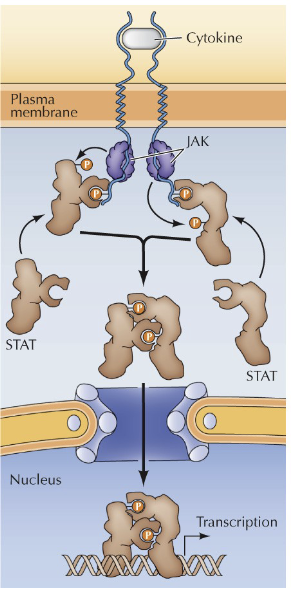
Describe what ahppens once STATs are phosphorylated. What is the end result of this pathway?
Phosphorylated STATs dimerize and move to the nucleus to act as a transcription factor
Cells release cytokines to tell other cells to produce specific proteins
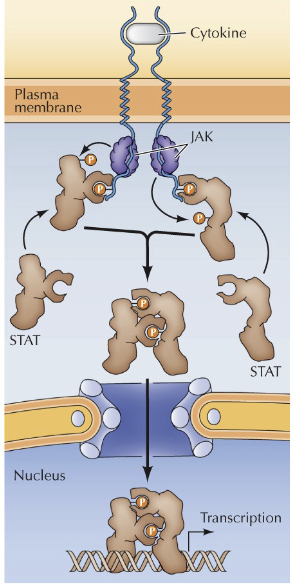
What are integrins? What is a non-receptor tyrosine kinase that is a integrin?
Integrins are transmembrane proteins that interact with the extracellular matrix
Play a major role in migration, poliferation, and cell survival
FAK is the n-RTK
FAKs interaction with the extracellular matrix causes the integrins to cluster leading to cross-phosphorylation

What are MAP kinase pathways?
They are a major pathway activated by enzyme-linked receptors
Refer to a cascade of protein kinases that is highly conserved in eukaryotes
They are serine/threonine kinases
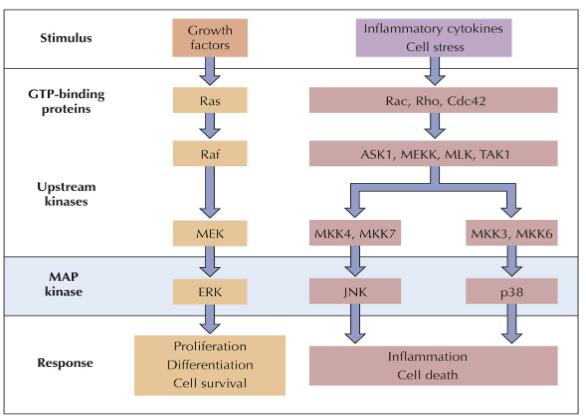
Ras is a growth factor associated with MAP kinase pathways, describe Ras and its function
Ras is a lipid-anchored protein that with the help of a GEF can become activated
GEF is a guanine nucleotide exchange factor

How do the different proteins of the MAP pathway find each other inside the cell?
Scaffold proteins bring different component of the signaling pathway in close proximity
This aids in the regulation of this pathway. If left unregulated can cause cancer

Describe how PI3-kinase/Akt pathway is activated and what is its function
Usually activated by a receptor tyrosine kinases
Can also be activated via G-protein coupled receptors
Important for cell proliferation and survival
