Baby beef - exam 2
 Call Kai
 Learn
Learn Practice Test
 Spaced Repetition
 Match
Match Flashcards
 Knowt Play
1/84

There's no tags or description
Looks like no tags are added yet.
Name | Mastery | Learn | Test | Matching | Spaced | Call with Kai | Chat |
|---|
No analytics yet
Send a link to your students to track their progress
85 Terms
Heterosis by trait

Bull Selection
Bull selection is one of the most important genetic decisions made for purebred and commercial producers
Even more important when replacement females are in the picture
One bull can make or break a herd
Bulls culled bc they’re sterile, disease, bad temperament
Good commercial bull can cost up to what calves are worth
4-5 steer calves
$6,000-8,000
Where do I buy a bull???
Avoid buying bulls with an unknown background
The neighbors “good crossbred bull calf”
Got data???
Cull bulls
Wonder why they were culled??
Where you should buy a bull
A breeder that specializes in producing quality genetics for commercial producers
Reputation
Data, data, data!!!!
Fertile
Healthy (Trich)
Ex. Value of bulls

What do we base our selection criteria on????
Visual Appraisal
Individual records
EPDs
Ultrasound data
Genomics Data: allows for more accuracy of traits for progeny
Objective Measurements
Individual and Progeny Records
Birth Weight
Weaning Weight
Average Daily Gain
Feed Efficiency
Yearling Weights
Quality and Yield Grades
Expected Progeny Difference (EPD
Expected Progeny Differences (EPDs)
The difference in predicted performance of future progeny of a sire, when compared with that predicted from future progeny of bulls in the same sire summary
or the breed average
An estimated measure of the genetic impact of a particular parent on his/her offspring
Expected Progeny Difference (EPD)
EPD is the most effective genetic selection tool
Adjusts data for environmental effects and accounts for genetic relationships between traits and among animals
Most breeds have EPD for BW, WW, YW, Maternal WW plus many other
Expected Progeny Differences (EPD) example
An estimated measure of the genetic impact of a particular parent on his/her offspring
If both bulls were mated to similar cows, Bull B’ calves would be predicted to be 5 lbs lighter at birth than Bull A.

Example
both bulls mated to similar cows
calves from bull B would be expected to average 20 lbs heavier at weaning

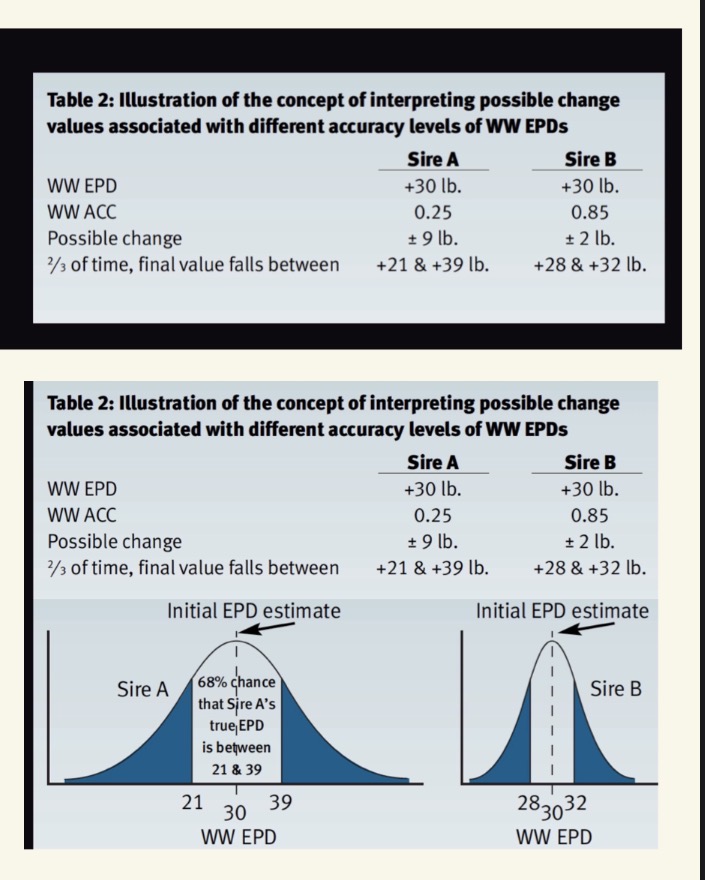
Accuracy (ACC)
indicates reliability of EPD – possible change as future data is added

ACC EX
Genomic Enhanced EPDs
Genomic EPDs use SNPs to accurately describe genetic relationships which improve the accuracy of the EPD by essentially one calf crop on young (unproven) sires.
Most major breed associations participate.

Calving ease related to percent assisted

In what units are EPDs reported?
Pounds
BW, WW, YW, CW
milk, TM (lbs of calf weight not milk)
percentage
CED, CEM
stayability
docility
heifer pregnancy
inches
YH
fat thickness
REA (square inches)
centimeters
SC
USDA marbling degrees
Marb
Example

Growth EPD Traits
Reported by all breeds using EPD are:
Birth weight - excluding maternal influence
Weaning weight - excluding maternal influence
Yearling weight - excluding maternal influence
Reproduction EPD Traits
Direct calving ease - calf’s ease of birth
Maternal calving ease - dam’s birthing ease
Gestation length
Heifer pregnancy percent
Scrotal circumference - related to testicle mass, age at puberty (male and female)
Stayability - longevity in the herd
Carcass EPD Traits
Weight
Marbling - main factor in Quality Grade
Ribeye area –factor in Yield Grade
Fat thickness – factor in Yield Grade
Retail product % - predicted by Yield Grade
Ultrasound - for ribeye, fat thickness, retail product, ribeye IM fat (estimates marbling
Cowherd EPD Traits
Milk in pounds weaning weight
Total Maternal (Maternal Weaning Weight) - combines weaning weight and milk
Daughter Mature Weight and Height
Docility
Cow Maintenance Requirements
Yearling Height - predicts mature size
$ Value Index EPDs
Combine relevant biological EPDs, weighted for importance and assigned $ value of trait, to estimate $ value of production
Adjusts for $ cost of necessary inputs (nutrition, etc.)
Weightings of biological effects and assignment of costs can vary results of indexes

$ Index Caution
Individuals with the same $ index value can differ tremendously for individual EPDs
Next slide shows the range in individual EPDs for Angus sires with $ Beef at 50th percentile level in the breed ($112.52)
Spring, 2018, Non-parent
There were 6 sires
$ Beef Individual EPD Range
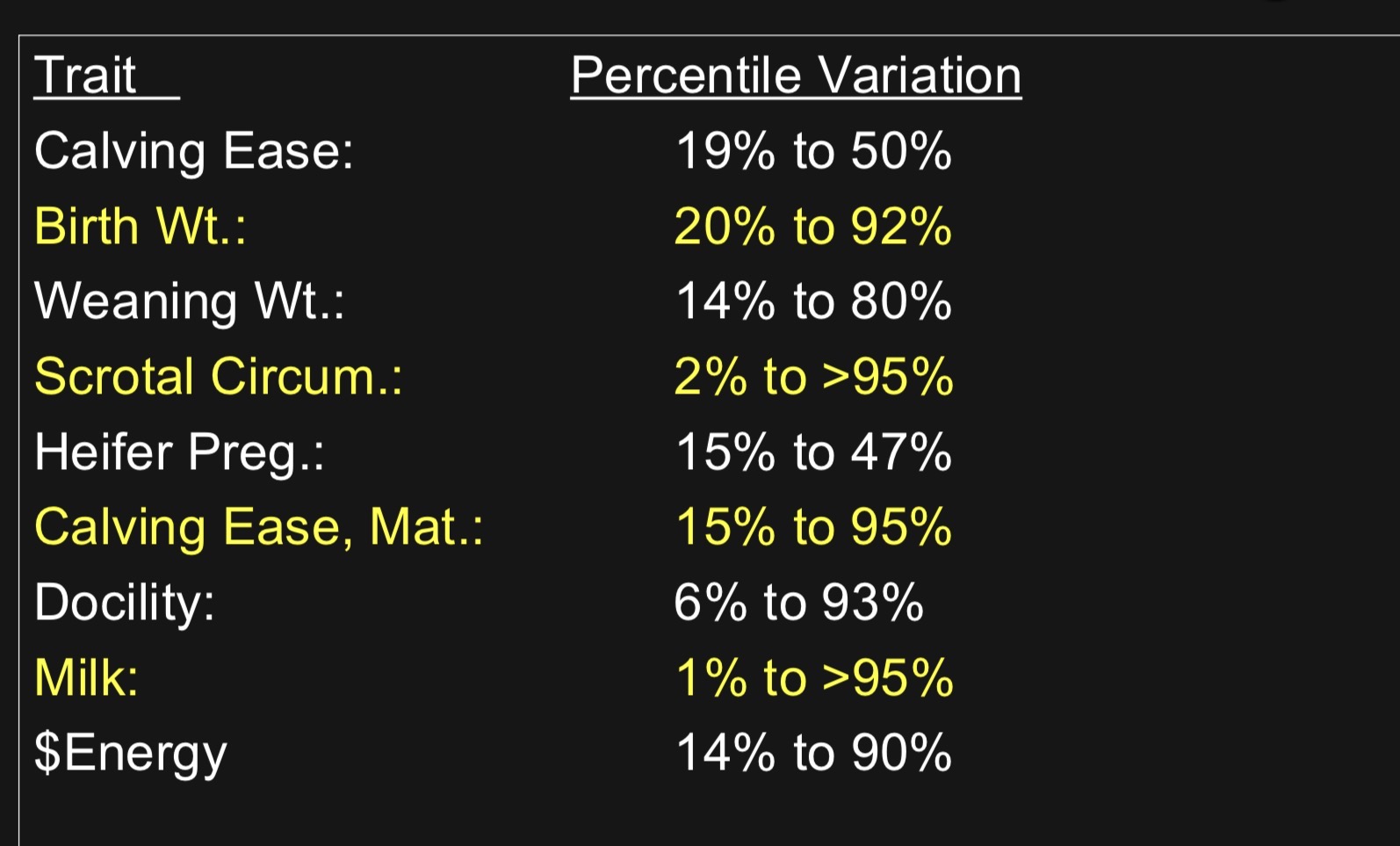
$ Beef Individual EPD Range
Angus sires with $ Beef at 5 percentile level in the breed ($59.26) ± 0.25</span></p></li><li><p><span>Therewere13sireswithinthisrange Beef Individual EPD Range

Utility of $ Value EPDs
In other breeds with $ Value Indexes, similar variation exists for individual EPDs
Preceding does not mean $ Value Indexes are useless
Probably best used as a screening tool with attention to individual EPDs
$ Value Indexes should not be used for single-trait selection
Relevant EPDs
Some EPDs should be of no importance in your operation
The importance of an EPD depends on:
breeding system (terminal or continuous)
when and how you marke
Summary on EPDS
Each producer should assess their production conditions and markets to decide what traits to select for and how much emphasis to give to each trait
Traits that are important to one producer may be of no importance, or even counterproductive, to another producer
So, concentrate on things that affect your profit, not somebody else’s
Subjective Evaluations
Visual Appraisal
Structural Soundness
Composition of Gain
Muscling
Temperament
Balance
General Eye Appeal
Reproductive Soundness
Visual evaluation

Structural correctness
Hoof size important
Issues, such as weak pasterns, can lead to pressure problems
Can be related to founder and acidosis
Feet should not point straight forward, can affect angle of shoulder

Feet

Rear leg conformation
Angle 90
Too much angulation better than no angulation (less downward pressure)
Defects can lead to problems down the road

Muscling
Ribeye Area
Visual Evaluation of Muscle Shape
Ultrasound measurements
Areas to evaluate for muscling and shape

Muscling cons
Larger Birth Weights
Increased Incidence of Dystocia
Decreased Marbling
Muscle inverse to marbling
Smaller Pelvic Area
What breed is bred intentionally for double muscling
Belgian blue
Capacity
Shape of rib
Width and depth of the chest floor

Other things to look for

Maternal Performance
Cow’s Milk Performance and Calving Characteristics
Basic formula for EPD: Measuring additional pounds of weaning weight from daughters due to genes for milk.
Temperament
Ease of handling
Tenderness???
Research is indicating a high relationship between disposition and tenderness
Ex. Unassisted births
Longhorns discounted for color pattern & muscling

What to avoid
AVOID single trait selection!!!!!
Avoid buying bulls that you don’t know the background of!!!!!!!
Monogastric GIT

ruminants GIT and function

Mouth
Has no upper incisors. Lower incisors and dental pad function in harvesting forages.
Source of saliva secretion.
about 12 gallons per day in adult cattle
ESOPHAGUS
Functions in movement of ingested food by a series of muscular contractions
can move food either from the mouth to the stomach or from the stomach back to the mouth in the cud-chewing process
Regurgitation: cud nation → fermentation
The stomach is divided into 4 compartments:
Reticulum
Rumen
Omasum
Abomasum
RETICULUM
First part of the stomach. Not completely separated from the rumen, so the two are often referred to as the reticulo-rumen
Hardware disease in reticulum
Rumen
Carbohydrates in feed/forage are broken down by bacteria producing volatile fatty acids (VFA)
absorbed through the rumen wall and used as a source of energy.
Bacteria combine nitrogen (from dietary protein or non-protein sources) and carbon (from a carbohydrate) to form protein. Bacteria are then digested and the bacterial protein is used by the animal.
Issues with rumen
Can be seen in left side
Bloat, in grain based diets
Issues can be seen going straight from forages to grain based diets
Melt, losing weight rapidly
Urea
Non protein nitrogen
Not seen as much as it’s expensive
Used in combination with feedyard diets (molasses)
RUMINATION
Allows for rapid harvest with minimal chewing, and then completion of chewing later through the cud process.
Cattle average ruminating around 8 hours per day, depending on the diet.
Microbial fermentation in the rumen produces large amounts of gas.
If gas is not released by belching, bloat can occur possibly resulting in deat
A key to ruminant nutrition
Microbes supply nutrients to host Microbes have requirements
Nitrogen
Energy
Cow has protein and energy requirements
Major proportion fulfilled by microbial protein and fermentation end products
Omasum
Function appears to be reduction of particle size.
Some water absorption also occurs
Abomasum
First glandular portion of the ruminant gastro-intestinal tract.
Extremely acidic environment (pH 1.5-2.0) compared to the neutral (pH 6.8-7.2) rumen, reticulum, omasum.
Functions essentially the same as the stomach in non-ruminants.
Muscular movements cause physical breakdown of food
“True stomach”
Some digestive juices are secreted
Small and large intestine
Small intestine - food digestion continues, primary site of nutrient absorption.
Large intestine - storage and transportation of undigested gastro-intestinal contents for elimination from the body
Nutrients Cattle Require
Protein
Essential amino acids(not essential in diet)
Energy
Carbohydrates
Lipids
Short or long chain
Excess protein
Vitamins
A (Green plants), D(sun), E(green leafy forages and whole grains, K(not essential in diet), B(not essential in diet)
Nutrients cattle require part 2
minerals
macro: Ca P Na Cl K Mg S
micro: Mn Zn Fe Cu Co Se Mn I
Water
Enhanced by seasons and diet and quality
Division of nutrient requirements
Energy: most important, 14-18 lbs per day
Protein: 1.5-2.5 lbs per day
Minerals: most expensive, best in advertising

Nutrient requirements are important for
Maintenance
maintenance energy – the amount of energy it takes to maintain an animal
Influenced by temperature and activity
Pregnancy
Lactation
Gain
Factors Affecting Nutrient Requirements
weight
breed
physiological status
lactation
energy req. ↑ 50%
protein req. ↑ 100%
fetal size
milk production
weather
activity
genetics
animal to animal variation
age
ENERGY REQUIREMENTS 1000 LB COW, 11 LB PK MILK, 70 LB BW

Crude Protein Requirements of Mature Cows

TDN RequirementS of Mature Cows

Nutrient Requirements of Beef Cows

Forage digestibility

Feed values for various forages

The effect of forage quality' on predicted forage dry matter intake of ruminants.

Determining Nutrient Intake - fecal pad scoring
1 = High quality
CP > 12%
TDN > 65%
2= Medium quality
CP 10 – 12
TDN 50 – 65%
3 = Low quality
CP < 10
TDN < 50%

Supplementation
To provide nutrients deficient in forages that limit forage intake and digestion
Forages should be the main source of nutrition for cow-calf or stocker producers
Economical source of protein and energy
Limited during droughts and when you want to increase gain
A small amount of supplement stimulates forage intake and digestibility
The supplement has an additive effect on the forage
Will eventually have negative forage intake

Forage intake in relation to crude protein content in the forage

Supplemental feeding
Animal intake is usually the limiting factor associated with nutrient deficiencies on dormant forages or poor quality hay
When the protein content of a forage drops below 7 percent, dry matter intake will decline rapidly
Feeding a protein supplement will improve the protein and energy status of cattle by improving forage digestibility and intake
Adequate forage is …
Adequate forage is necessary when supplementing protein
If not, the protein source becomes an expensive source of energy
Re-group and explore other alternatives to meet the energy requirements of the animal
Supplementation strategies
To add to the value of low-quality forage and increase diet quality
Also could be to stretch out forage, limiting forage
Enhancement feeding
Enhancement Feeding
Poor quality hay (<6% CP)
Feeding medium quality hay to lactating cows in poor or borderline body condition
20% protein breeders cube to lactating cows during the winter
Increasing body condition of thin cows
Forage is limited
Nutrient Requirements (Last 1/3 Gestation, .9 ADG, and Early Lactation, maintenance)

Example of feeding cows
1,100 lb dry cow needs
1.6 lbs CP
11.2 lbs TDN
Our hay is 8% CP and 52% TDN. She will eat 22 lbs per day
CP - 0.08 x 22 = 1.76 lbs
TDN - 0.52 x 22 = 11.4 lbs
Value of forage quality

Feedstuffs That May Be Available - protein sources
cottonseed meal, most common
soybean meal, most common
corn gluten meal, most common
sunflower meal
peanut meal
40% cubes
alfalfa hay, most expensive
winter pastures (cows)
Feedstuffs That May Be Available - energy sources
Gradually increase levels in diet
corn
12% cubes
soybean hulls
wheat midds
rice bran
rice mill feed
Feedstuffs That May Be Available - Energy and Protein Sources
Gradually increase levels in diet
20% cubes
corn gluten feed
distillers grains
whole cottonseed
(max. 25% of diet)
High Risks Feeds
acidosis and founder concerns
bakery products
bread
flour
flour tortillas
many others
any feed with rapidly fermentable CHO, wheat
bloat concerns due to blocking of the esophagus
potatoes
sugar beets
What feed to use
Good quality hay
Byproducts (cheapest)
Cottonseed meal
Soybean meal
Corn
Personal supplement mix
Cubes
Liquid
Protein block
most expensive because processing but most convenient