CH 236 - Ch. 8: Reactions of Alkenes
 Call Kai
 Learn
 Practice Test
 Spaced Repetition
 Match
 Flashcards
 Knowt Play
1/48

There's no tags or description
Looks like no tags are added yet.
49 Terms
Addition Reactions in Alkenes
add a variety of substituents accross the double bond creating two new sigma bonds

Pi Bond acting as a Bronsted Base
takes a proton

Pi Bond acting as a Nucleophile
bonds with an electrophile

Favorable temperatures of addition reactions
- lower temp but not by heat
- favors enthalpy and lower temperatures
(elimination reactions favor entropy and higher temperatures)
Markovnikov's Rule
• H is added to the alkene carbon with more Hs attached
• Other is added to the more substiutude carbon
Hydrohalogenation Reactions
• Addition of HX to an alkene
• HCl, HBr, or HI added across a pi bond to make an alkyl halide
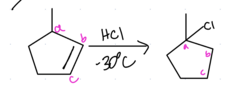
Hydrohalogenation Reagents
HBr, HCl, HI
Hydrohalogenation Additions
H and X
Hydrohalogenation Regioselectivity
Markovnikov's Rule
Hydrohalogenation Rearrangement
• carbocation intermediate (stability
• 1,2-hydride or 1,2-methyl shifts as needed
Hydrohalogenation stereoselectivity
• Not stereoselective because the carbocation is sp2 hybridized
• if chiral, enantiomers is in a racemic mixture
Hydrohalogenation Mechanism
1.) Formation of Carbocation (P.T.) (RDS)
2.) Carbocation Rearrangement if needed
3.) Nucleophilic Attack at Most Stable Carbocation

Acid-Catalyzed Hydration Reaction
• addition of water across an alkene (hydration)
• product is an alcohol
• Requires sulfuric acid catalyst
• Electrophile is hydronium
Acid-Catalyzed Hydration Reagents
H2O, H2SO4 (cat)

Acid-Catalyzed Hydration Additions
H and OH
Acid-Catalyzed Hydration Regioselectivity
• Markovnikov's Rule
Acid-Catalyzed Hydration Rearrangement
• carbocation intermediate
• 1,2-hydride or 1,2 methyl
Acid-Catalyzed Hydration Stereoselectivity
• if chiral, racemic mixture of both enantiomers
• nonstereoselective
Acid Catalyzed Hydration Reaction Mechanism
1. Formation of the hydronium electrophile
2. Formation of the Carbocation using Alkene as the base (P.T)
3. Nucleophilic Attack of Water to the Carbocation
4. Deprotonation of the Oxygen to lead to product (P.T)

Oxymercuration/Reduction Reaction
• two steps that form an alcohol
1.) Coordination of Mercury acetate
2.) Reduction reaction with NaBH4

Oxymercuration/Reduction Reagents
1) Hg(OAc)2, H2O
2) NaBH4

Oxymercuration/Reduction Additions
H and OH
Oxymercuration/Reduction Regioselectivity
Markovnikov's Rule
Oxymercuration/Reduction Rearrangement
• does not rearrange
• limited to two carbons of alkene
Oxymercuration/Reduction Stereochemistry
• chrial = racemic
• Anti-steroselective
Hydroboration Reaction
• forms alcohol through two steps
• 1) BH3 delivers hydride; THF: solvent
• 2) NaOH adds the OH

Hydroboration Reagents
1. BH3, THF
2. H2O2, NaOH

Hydroboration Additions
H and OH
Hydroboration Regioselectivity
• Non-Markovnikov
• OH adds to less substituted Carbon; H to the more substituted
Hydroboration Rearrangement
• No rearrangement because no carbocation intermediate
Hydroboration Steroselectivity
• synsteroselective
• racemic mixture of both enantiomers
Hydroboration Mechanism
• Boron coordinates to the least substituted C because steric effects and delivers hydride to the most substituted

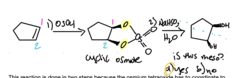
Dihydroxylation Reaction
• Makes 1,2-diol product (2 OHs on alkene carbons) through 2 steps
1.) Osmium tetraoxide coordinates two alkene
2.) cyclic osmate intermediate reduced to make syn diol
Dihydroxylation Reagents
1. OsO4
2. NaHSO3, H2O
(Can also include KMnO4 but less common)
Dihydroxylation additions
2 OHs
Dihydroxylation Regioselectivity
adds OH to alkene
Dihydroxylation Stereoselectivity
• If chiral, syn
• watch for meso!
Dihydroxylation Rearrangement
no rearrangement
Dihydroxylation Mechanism
1.) Osmium tetraoxide coordinates two alkene
2.) cyclic osmate intermediate reduced to make syn diol
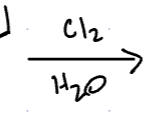
Halohydrin Reaction
• reaction adds OH and a halogen (Cl or Br) across alkene
Halohydrin Reagents
X2, H2O
Halohydrin Regioselective
Markovnikov
• OH adds to most substituted carbon
• Halogen adds to less substituted
Halohydrin Stereoselectivity
anti-stereoselective
chiral = racemic mixture of enantiomers
Halohydrin Rearrangement
• no carbocation intermediate
• no rearrangement
Halohydrin Mechanism
1.) Formation of Bromium or Chlorinium Cation (Bridged 3-membered ring)
2.) Nucleophilic attack of water to the most substituted Carbon, opening 3 ring
3.) Deprotonation of water to yield product

Ozonolysis Reaction
• Ozone + DMS is used to split the alkene into 2 carbonyls (aldehydes or ketones)
Ozonolysis Reaction/Reagents
O3, DMS or (CH3)2S

Ozonolysis Acyclic Prediction
1. Divide alkene into two halves
2. If alkene has 2 carbon chains attached = KETONE
3. H attached to one or both of alkene C = ALDEHYDE
**alkene carbons becomes the carbonyl carbons

Ozonolysis Cyclic Prediction
1. Start 1 carbon of the double bond and count backwards around the ring and draw a zig zav carbon chain of same length; first and last carbon both become your carbonyl carbon
2. add substituents
