SE (C1) - Software products
 Call Kai
 Learn
 Practice Test
 Spaced Repetition
 Match
 Flashcards
 Knowt Play
1/17

There's no tags or description
Looks like no tags are added yet.
18 Terms
The demand on software products.
Product companies control product lifecycle, while customers dictate custom software lifespan and support.
Speed to market is crucial for product success, but customer loyalty can hinder product switching.
The two alternatives to stand-alone software products.
Hybrid products combine local and remote processing, often offloading heavy tasks to servers.
Service-based products primarily run on remote servers, accessed via web or app, offering flexibility and new business models.
the key characteristic of product development. (Internal Market Orientation
)
there is no external customer who generates software requirements and pays for the software, without external customers or revenue generation.
No external customer: There's no direct payment or specific requirements coming from outside the organization.
Internal needs drive development: The software is created to solve problems or improve efficiency within the company.
Internal evaluation: The success of the software is measured by its impact on internal processes and operations.
(17)
Product development. (Internal Market Orientation)
External customer: The website's primary goal is to attract and retain paying subscribers (external customers).
Revenue generation: The company's income is directly tied to the number of subscribers and their subscription fees.
Market-driven development: The website's features, content, and user interface are designed to appeal to the target audience and drive subscriptions.
The product vision should answer four fundamental questions.
What is the product that you propose to develop?
What makes this product different from competing products?
Who are the target users and customers for the product?
Why should customers buy this product?
Questions concern the commercial viability of the product.
FOR (target customer)
WHO (statement of the need or opportunity) The (PRODUCT NAME) is a (product category)
THAT (key benefit, compelling reason to buy)
UNLIKE (primary competitive alternative)
OUR PRODUCT (statement of primary differentiation)
(19)
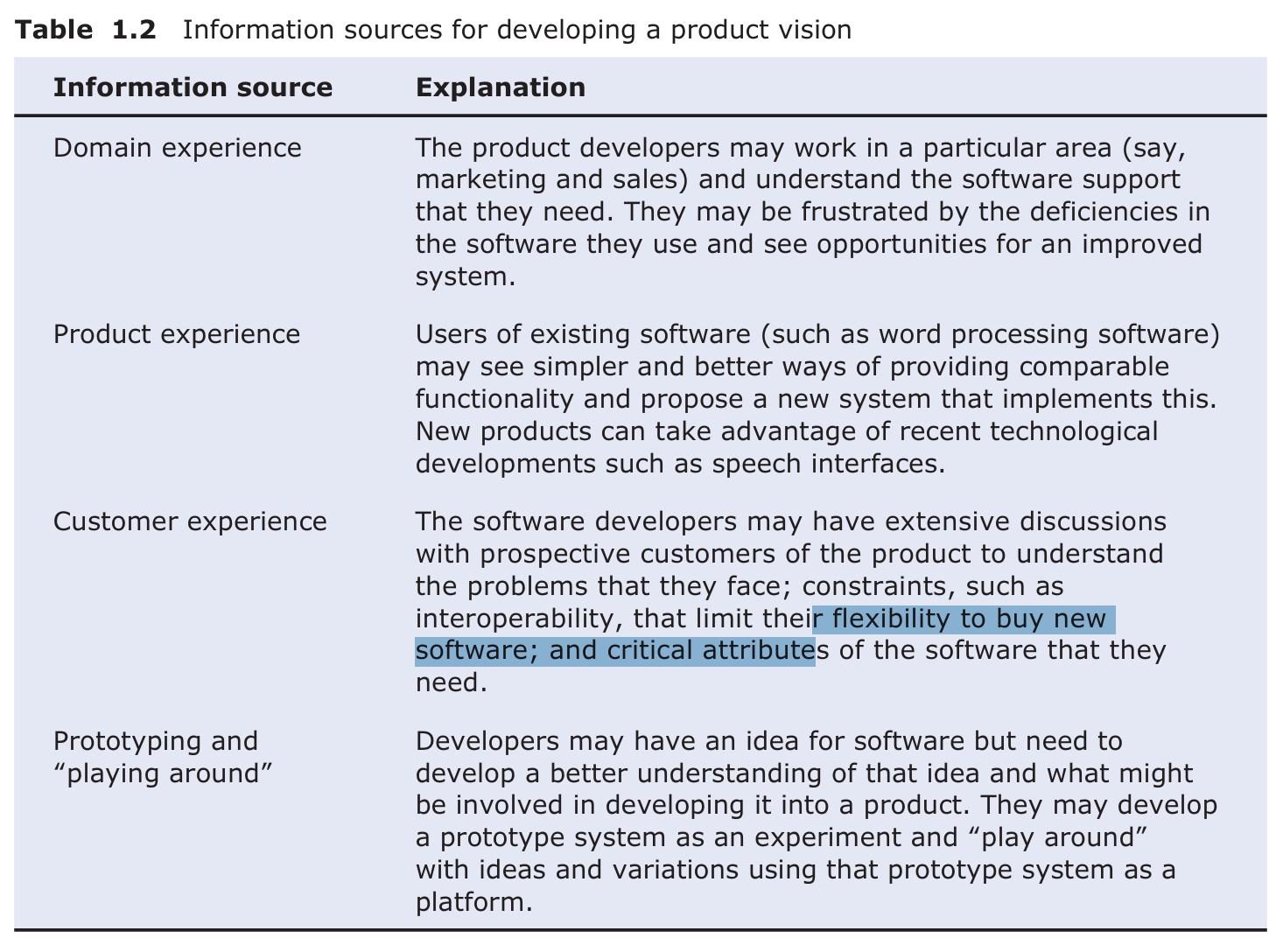
Other Several different sources of information contribute to the product vision
Domain experience: Developers identify software needs based on their own frustrations with existing tools.
Product experience: Users suggest improvements to existing software, leading to new product ideas.
Customer experience: Understanding customer problems and constraints drives software development.
Prototyping and "playing around": Experimenting with prototypes to refine product ideas.
(21)
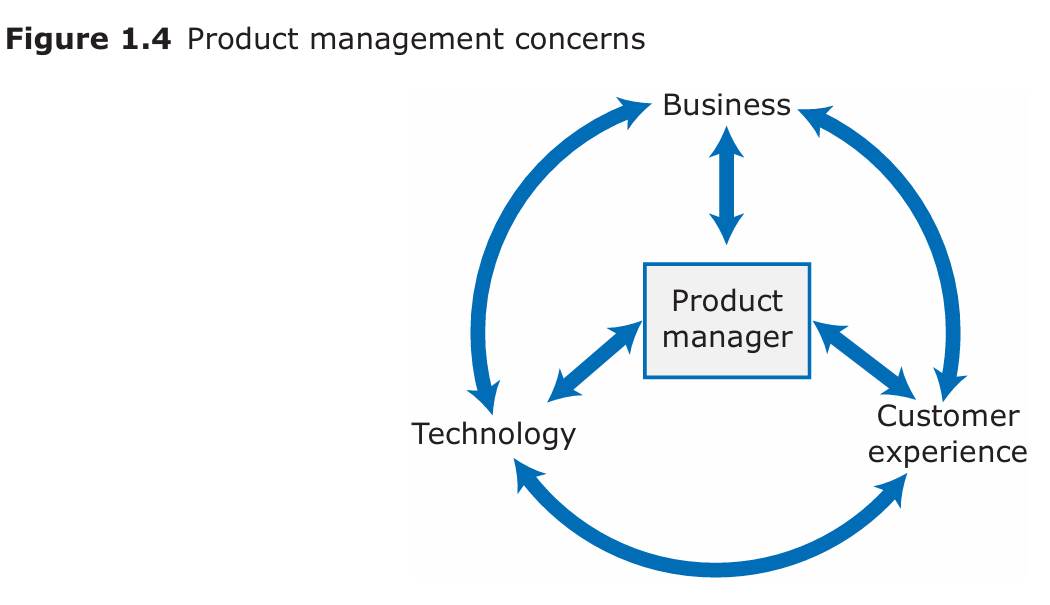
Software product management
Software product management is a business activity focusing on the software products that are developed and sold by the business.
Software product managers (PMs)
Product managers oversee the entire product lifecycle, bridging business, development, and customers. They ensure alignment by actively participating in the development team.
(22-23)
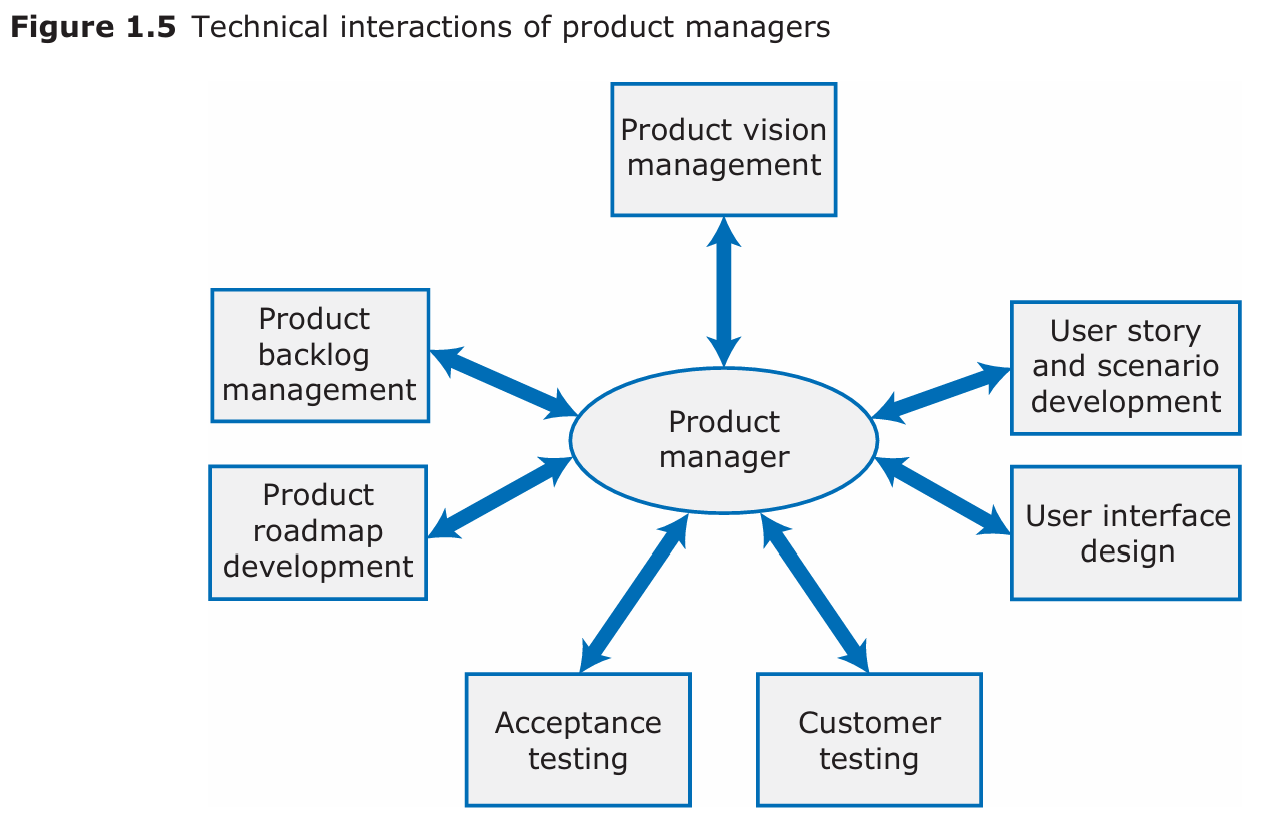
7 Technical interactions of PMs
Product vision management.
User story and scenario development
User interface design
Customer testing
Acceptance testing
Product roadmap development
Product backlog management
(24-28)
Product roadmap development
A product roadmap is a plan for the development, release, and marketing of the software product.
User story and scenario development
User stories and scenarios are widely used to refine a product vision to identify features of the product.
Product backlog management
A product backlog is a to-do list that sets out what has to be done to complete the product development. The backlog is added to and refined incrementally during the development process.
Acceptance testing
Acceptance testing is the process of verifying that a software release meets the goals set out in the product roadmap and that the product is efficient and reliable.
Customer testing
Customer testing involves taking a release of a product to existing and getting feedback from customers on the product’s features, its usability, and the fit of the product to their business.
User interface design
The user interface (UI) of a product is critical in the commercial acceptance of a software product. Technically excellent products are unlikely to be commercially successful if users find them difficult to use or if their UI is incompatible with other software that they use.
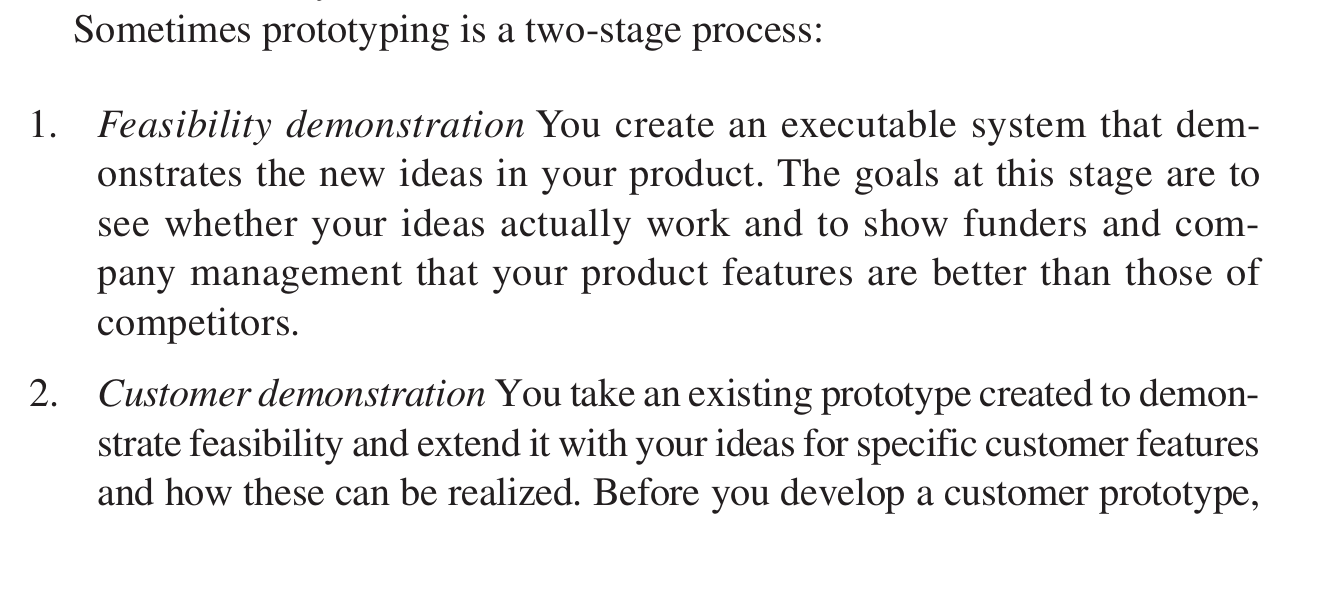
Product prototyping
Product prototyping is the process of developing an early version of a product to test your ideas and to convince yourself and company funders that your product has real market potential.