new england flora quiz 2
 Call Kai
 Learn
Learn Practice Test
 Spaced Repetition
 Match
Match Flashcards
 Knowt Play
1/45

Earn XP
Description and Tags
flowers, inflorescences, fruits, general points from habitats and communities
Name | Mastery | Learn | Test | Matching | Spaced | Call with Kai | Chat |
|---|
No analytics yet
Send a link to your students to track their progress
46 Terms
sepal
first outermost whorl
protects developing flower
sometimes attractive

petals
second whorl
sometimes attracts animal pollen-vectors

androecium
third whorl
stamens produce and protect pollen
stamens together
made of anther, pollen grains, pollen sacs, anther, filament

gynoecium
fourth innermost whorl
ovaries produced
protec ova → seeds
carpels together
consists of stigma, style, loculus, funicle, ovule, placenta, ovary, ovule

corolla
petals together
calyx
sepals together
tepal
colored sepal
perianth
outer whorls
parts of carpel
stigma, style, loculus, finicle, ovule, placenta, ovary, ovule

parts of stamen
anther, pollen grains, pollen sacs, filament

rules of floral morphology
the whorls may NEVER SWITCH PLACES
any whorl(s) may be present, reduced in size, or absent
inner two whorls may be functional or sterile
number of parts in each whorl can range from 0-many
all whorls have a common attachment point called the RECEPTACLE
the parts within any whorl may be attached to one another (connate) or not
parts of any whorl may be attached to the parts of a neighboring whorl (adnate) or not
connate
parts within a whorl are attached to each other
adnate
parts of any whorl are attached to the parts of a neighboring whorl
radial symmetry

bilateral symmetry

superior ovaries
gynoecium positioned above receptacle

receptacle
where all plant parts meet
inferior ovaries
gynoecium positioned below receptacle

what type of ovaries do apples have?
inferior

what type of ovaries do cherries have?
superior

perfect
androecia and gynoecia on same flower
also known as bisexual, androgynous, hermaphroditic
imperfect
flower lacking either androecia or gynoecia
also known as unisexual
sterile
flower lacking both androecia and gynoecia
monoecious
androecia and gynoecia in separate flowers on the same plant
dioecious
androecia on one plant, gynoecia on another plant
polygamous
plant with both unisexual and bisexual flowers
complete
plant with all 4 whorls
incomplete
plant missing any whorls (including outer)
flower vs inflorescence
flowers evolved from axis with whorled leaves
inflorescences evolved from axis with brances
pedicel
stalk just below a single flower in an inflorescences of 1 flower
peduncle
stalk just below an inflorescence of 1+ flowers
indeterminate
inflorescence that terminates in growing tip
based on raceme
determinate
inflorescence with a terminal flower
based on cyme
raceme
indeterminate inflorescence
oldest flowers near base and younger closer to apical meristem

panicle
raceme but compound
series of racemes with oldest at base
indeterminate

spike
raceme without pedicels

secund spike
one sided spike

corymbs
indeterminate inflorescence
raceme with lengthened lower pedicels and shorter upper pedicels
looks like flat/domed platform which pollinators can land on
simple or compound

umbel
raceme without internodes
indeterminate inflorescence

compound umbel
modular repetition of umbel horizontally

verticil
modular repetition of umbel along pedicel

capitulum
umbel that expanded receptacle
very common among asterceae

ray flower
inferior ovary
limb (petal-like part)
also has claw which is attached to stamen tube and stigma
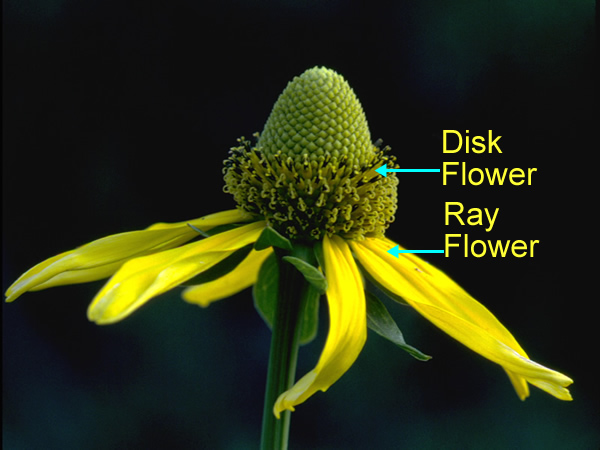
disk flower
inferior ovary
tubular corolla with lobe and stigma/stamen tube on top

phyllaries
individual, leaf like bracts that form a protective cup/whorl beneath the flower head of plants in asteraceae

spadix with spathe
modified congested spike with separate m & f flowers
