Module 7 Overview - Chapter 11 DNA Replication
 Call Kai
 Learn
 Practice Test
 Spaced Repetition
 Match
 Flashcards
 Knowt Play
1/142

Earn XP
Description and Tags
DNA Replication: Meselson–Stahl, Forks, Polymerases & Telomeres
143 Terms
11.1 What is DNA replication?
The process by which the genetic material is copied.
What are the original DNA strands used for in replication?
They serve as templates for the synthesis of new strands with identical sequences.

What is the AT/GC rule?
A pairs with T and G pairs with C in DNA.
What are the two types of strands involved in DNA replication?
Parental strands (original) and daughter strands (newly made).
What is the process of DNA replication?
The process is:
• The two complementary DNA strands come apart
• Each serves as a template strand for the synthesis of new complementary DNA strands
• The two newly-made DNA strands = daughter strands
• The two original DNA strands = parental strands

Experiment 11A: What were the 3 different models that were proposed for the replication of DNA?
Conservative model: Both parental strands stay together after DNA replication
Semiconservative model: Double stranded DNA contains one parental and one daughter strand following replication
Dispersive model: Parental and daughter DNA segments are interspersed in both strands following replication
Conservative model:
Both parental strands stay together after DNA replication

Semiconservative model
The correct model

Dispersive Model

What model of DNA replication is considered correct?
The semiconservative model.
What does the semiconservative model state?
Each double-stranded DNA contains one parental and one daughter strand after replication.
Who conducted the experiment to test the models of DNA replication?
Matthew Meselson and Franklin Stahl.
What hypothesis did Matthew Meselson and Franklin Stahl have about DNA replication?
Based on Watson’s and Crick’s ideas, the hypothesis was that DNA replication is semiconservative
Experiment 11A: What method did Meselson and Stahl use to distinguish between daughter and parental strands?
They used light and heavy nitrogen isotopes.
What happened in the experiment
1. Add an excess of 14N-containing compounds to the growth medium so all of the newly made DNA will contain 14N.
2. Incubate the cells for various lengths of time. Note: The 15N-labeled DNA is shown in purple and the 14N-labeled DNA is shown in blue.
3. Lyse the cells by the addition of lysozyme and detergent, which disrupt the bacterial cell wall and cell membrane, respectively.
4. Load a sample of the lysate onto a CsCl gradient. (Note: The average density of DNA is around 1.7 g/cm3, which is well isolated from other cellular molecules.)
5. Centrifuge the gradients until the DNA molecules reach their equilibrium densities. 6. DNA within the gradient can be observed under a UV light.
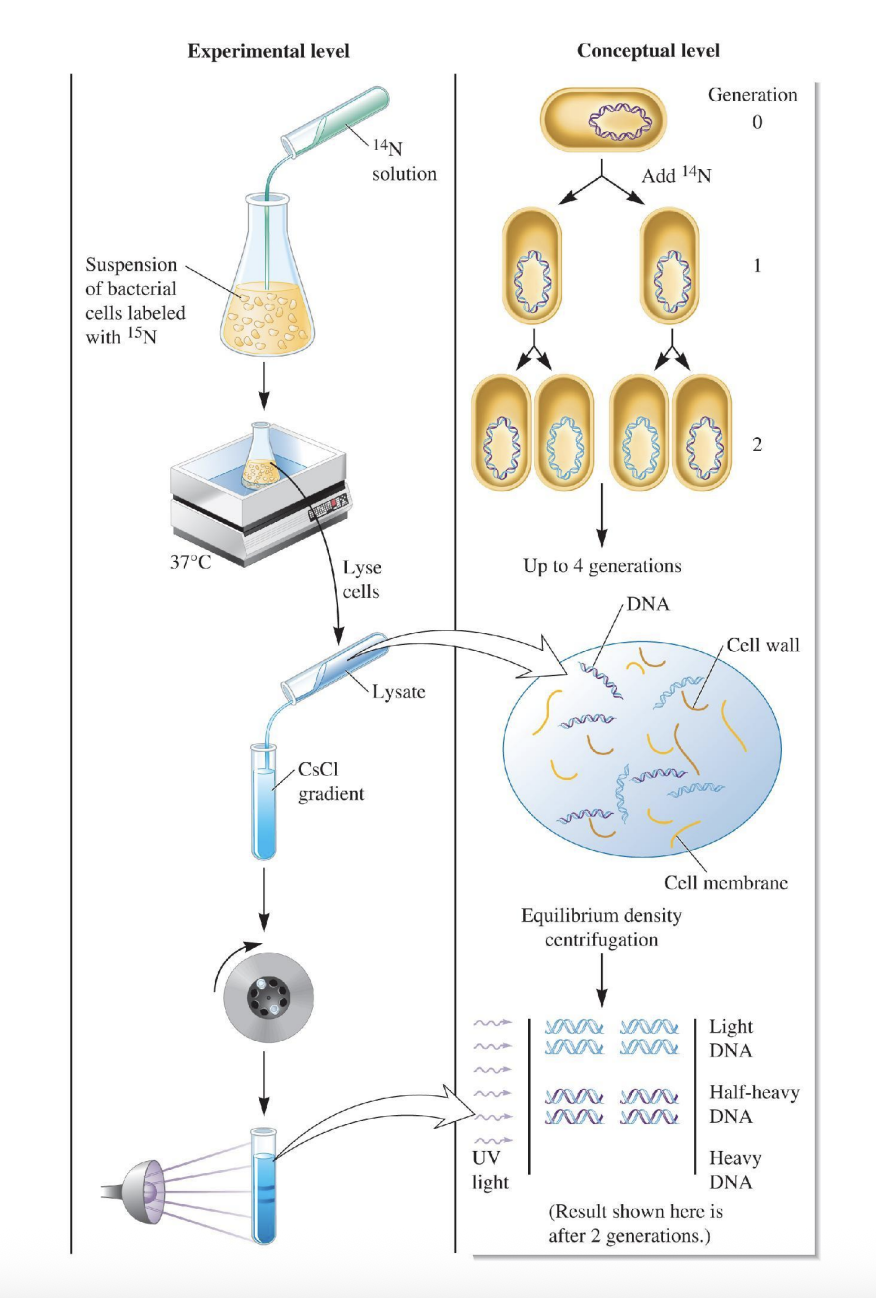
What happens to DNA after one generation in the Meselson-Stahl experiment?
DNA is 'half-heavy', consistent with both semi-conservative and dispersive models.
1.5 in the picture

What happens to DNA after two generations in the Meselson-Stahl experiment?
• Equal amounts of “light” and “half-heavy”
• Consistent with only the semi-conservative model
1.9 in the model (Basically 2 generations)

11.2 Bacterial DNA Replication: The formation of two replication forks at the origin of replication
DNA synthesis begins at a site termed the origin of replication
• Each bacterial chromosome has only one origin of replication
Synthesis of DNA proceeds bidirectionally around the bacterial chromosome
The two replication forks eventually meet at the opposite side of the bacterial chromosome → This ends replication

11.2 What is the origin of replication in E. coli called?
oriC.
What are the three types of DNA sequences important in oriC?
DnaA boxes, AT-rich regions, and GATC methylation sites.
DnaA boxes
sites for the binding of DnaA protein
AT-rich regions
sites where the DNA strands separate
GATC methylation sites
sites that help to regulate DNA replication
Events that Occur at oriC
DnaA proteins bind to DnaA boxes and to each other
• Additional proteins bind and cause the DNA to bend
• Strands separate at AT-rich region DnaB/helicase then binds to the origin
•
Further separates the DNA strands • Composed of six subunits
• Travels along the DNA in the 5’ to 3’ direction • Uses energy from ATP Replication occurs in both directions – bidirectional replication

What role do DnaA proteins play in DNA replication initiation?
They bind to DnaA boxes and cause the DNA to bend, facilitating strand separation.
What is the function of DNA helicase in DNA replication?
It separates the two DNA strands by breaking hydrogen bonds.
What is the role of DNA gyrase (Topoisomerase II) during replication?
It alleviates positive supercoiling generated ahead of the helicase.
What are single-strand binding proteins responsible for?
They bind to separated DNA strands to keep them apart.
What initiates DNA synthesis?
Short RNA primers synthesized by primase.
How long are typical RNA primers used in DNA replication?
Typically 10 to 12 nucleotides in length.
What is the role of DNA polymerase in DNA replication?
They catalyze the attachment of nucleotides to synthesize a new DNA strand.
What is the difference in primer usage between the leading and lagging strands?
The leading strand has a single primer, while the lagging strand needs multiple primers.
What happens to RNA primers after DNA synthesis?
They are removed and replaced with DNA.
What is the significance of GATC methylation sites in DNA replication?
They help regulate DNA replication and ensure initiation occurs on fully methylated DNA.
What is the outcome of DNA replication in bacterial chromosomes?
Two replication forks form at the origin and proceed bidirectionally until they meet.
What is the result of DNA replication after two generations in the Meselson-Stahl experiment?
Equal amounts of 'light' and 'half-heavy' DNA, consistent only with the semiconservative model.
What are the five types of DNA polymerases in E. coli?
DNA pol I, II, III, IV, and V
Which DNA polymerases are primarily responsible for normal replication?
DNA pol I and III
Which DNA polymerases are involved in DNA repair and replication of damaged DNA?
DNA pol II, IV, and V
What is the main function of DNA pol III?
Responsible for most of the DNA replication
How many different subunits compose DNA polymerase III?
10 different subunits
What is the role of the ⍺ subunit in DNA polymerase III?
Catalyzes bond formation between adjacent nucleotides (DNA synthesis)
What is the DNA pol III holoenzyme?
The complex of all 10 subunits of DNA polymerase III
What is the function of DNA pol I?
Removes RNA primers and replaces them with DNA
What is the function of the α subunit of DNA polymerase?
Synthesizes DNA
What is the role of the ε subunit in DNA polymerase?
3' to 5' exonuclease site that removes mismatched nucleotides (proofreading)
What does the θ subunit do in DNA polymerase?
Accessory protein that stimulates the proofreading function
What is the function of the β subunit in DNA polymerase?
Clamp protein, which allows DNA polymerase to slide along the DNA without falling off
What is the purpose of the clamp loader complex in DNA polymerase?
Helps the clamp protein bind to the DNA
How does the structure of DNA polymerase resemble a human hand?
Template DNA is threaded through the palm, with the thumb and fingers wrapped around the DNA.
What is the limitation of DNA polymerases regarding initiation of DNA synthesis?
DNA polymerases cannot initiate DNA synthesis by linking two individual nucleotides on a bare template strand.
How do DNA polymerases overcome the limitation of initiation of DNA synthesis?
By using RNA primers synthesized by primase.
What is the direction of nucleotide attachment by DNA polymerases?
Only in the 5' to 3' direction.
What are Okazaki fragments?
Small DNA fragments synthesized on the lagging strand, typically 1000 to 2000 nucleotides in bacteria.
What is the function of DNA ligase in DNA replication?
Catalyzes the formation of a covalent bond to connect the DNA backbones, linking Okazaki fragments.
What is the primosome?
A complex formed by the physical binding of DNA helicase and primase.
What are ter sequences in DNA replication?
Termination sequences that stop the movement of replication forks.
What is the role of the protein tus in DNA replication?
Binds to ter sequences to stop the movement of replication forks.
What happens when oppositely advancing replication forks meet?
DNA replication ends and DNA ligase covalently links the two daughter strands.
What are catenanes?
Intertwined circular molecules resulting from DNA replication.
What is a temperature-sensitive (ts) mutant?
A conditional mutant that can survive at a permissive temperature but fails to grow at a nonpermissive temperature.
What is the significance of fidelity in DNA replication?
DNA polymerase makes only one mistake per 108 bases, ensuring high accuracy.
What mechanism does DNA polymerase use for proofreading?
Uses a 3' to 5' exonuclease activity to remove mismatched nucleotides.
What is the difference between bacterial and eukaryotic DNA replication?
Eukaryotic DNA replication is more complex, involving multiple origins of replication and tightly packed chromatin.
What evidence supports the existence of multiple origins of replication in eukaryotes?
Studies showing DNA replication proceeds bidirectionally from many origins.
What is the role of DNA polymerase III in DNA synthesis?
It synthesizes the daughter strand and remains attached to the template during the process.
What is the effect of the β subunit on DNA polymerase III's processivity?
It allows DNA polymerase III to polymerize up to 500,000 nucleotides, significantly increasing its rate.
What happens to DNA polymerase III in the absence of the β subunit?
It falls off the DNA template after about 10 nucleotides have been polymerized.
What is the role of the incoming deoxyribonucleoside triphosphate in DNA synthesis?
It forms a covalent bond with the 3'-OH of the sugar of the previous deoxynucleotide.
What is released during the formation of a covalent bond in DNA synthesis?
The last two phosphates of the incoming nucleotide are released in the form of pyrophosphate (PPi).
What role does the ε subunit of DNA polymerase play?
It has a 3' to 5' exonuclease site that removes mismatched nucleotides (proofreading).
What is the function of the θ subunit in DNA polymerase?
It is an accessory protein that stimulates the proofreading function.
What is the role of the β subunit in DNA polymerase?
It acts as a clamp protein, allowing DNA polymerase to slide along the DNA without falling off.
What is the function of the clamp loader complex in DNA polymerase?
It helps the clamp protein bind to the DNA.
Can DNA polymerases initiate DNA synthesis on a bare template strand?
No, they cannot; this problem is overcome by RNA primers synthesized by primase.
In which direction can DNA polymerases attach nucleotides?
Only in the 5' to 3' direction.
What is the leading strand in DNA replication?
The strand synthesized continuously in the 5' to 3' direction toward the replication fork.
What is the role of DNA pol I in DNA replication?
It removes RNA primers and fills the resulting gaps with DNA.
What is the function of DNA ligase?
It catalyzes the formation of covalent bonds to connect the DNA backbones, linking Okazaki fragments.
What are catenanes in DNA replication?
Intertwined circular molecules that are separated by DNA gyrase.
What is the fidelity of DNA replication?
DNA pol III makes only one mistake per 10^8 bases, exhibiting high fidelity.
What mechanisms contribute to the high fidelity of DNA replication?
Stability of base pairing, configuration of the DNA polymerase active site, and proofreading function.
How does DNA polymerase proofread its work?
It identifies mismatched nucleotides and removes them using a 3' to 5' exonuclease activity.
11.5 Why is eukaryotic DNA replication more complex than bacterial replication?
Eukaryotes have large linear chromosomes, tightly packed chromatin, and more complicated cell cycle regulation.
11.5 Why do eukaryotes require multiple origins of replication?
To ensure that DNA can be replicated in a reasonable amount of time.
11.5 What is the significance of the β subunit in DNA polymerase III?
It forms a dimer that acts as a clamp around the template DNA, enhancing processivity.
11.5 What is the rate of nucleotide polymerization for DNA polymerase III with the β subunit?
Up to 750 nucleotides per second.
11.5 What is the role of helicase in DNA replication?
It unwinds the DNA double helix ahead of the replication fork.
11.5 What is the function of primase in DNA replication?
It synthesizes RNA primers necessary for DNA polymerase to initiate synthesis.
11.5 What is the purpose of adding lysozyme and detergent in cell lysis?
To disrupt the bacterial cell wall and cell membrane.
11.5 What is the average density of DNA?
Around 1.7 g/cm3.
11.5 What is the significance of two types of DNA after two generations in the Meselson-Stahl experiment?
There are equal amounts of 'light' and 'half-heavy' DNA, consistent only with the semi-conservative model.
11.5 How many origins of replication does each bacterial chromosome have?
Only one origin of replication.
11.5 What is the role of DnaA proteins at the origin of replication?
They bind to DnaA boxes and help initiate DNA replication.
11.5 What is the function of DNA helicase?
To separate the two DNA strands by breaking hydrogen bonds.
11.5 What is the role of DNA gyrase in DNA replication?
To alleviate positive supercoiling generated ahead of the replication fork.
11.5 What enzyme synthesizes RNA primers during DNA replication?
Primase.
11.5 What is the function of DNA polymerase I?
To remove RNA primers and replace them with DNA.
11.5 What is the composition of DNA polymerase III?
Composed of 10 different subunits, with the α subunit catalyzing bond formation.
11.5 What is the function of the β clamp protein in DNA polymerase III?
It allows DNA polymerase to slide along the DNA without falling off.