Acids and Solutions
 Call Kai
 Learn
 Practice Test
 Spaced Repetition
 Match
 Flashcards
 Knowt Play
1/21

There's no tags or description
Looks like no tags are added yet.
22 Terms
acid + base -->
salt + water
acid + metal oxide/ hydroxide -->
salt+ hydrogen
acid + carbonate -->
salt + water + carbon dioxide
How do you convert between dm³ and cm³?

What ion does acids contain?
hydrogen ions
when dissolved in water acid releases hydrogen ions as protons into solution
eg HCL (g) + aq → H+ (aq) + Cl- (aq)
Define strong acid
completely dissociates in aqueous solution - releases all of its H atoms into solutions as H+ ions
eg HCl (aq) → H+ (aq) + Cl- (aq)
Define weak acid
partially dissociates in aqueous solution - releases a small proportion of its available H atoms into the solution as H+ ions
eg. CH3COOH(aq) < -- > H+ (aq) + CH3COO- (aq)
What is a base?
neutralises an acid to form a salt
What is an alkali?
a base that dissolves in water releasing OH- ions into solution
eg NaOH (s) + aq → Na+ (aq) + OH- (aq)
Define neutralisation
H+ ions and OH- ions react to form H2O
acids react with bases to form salts
What is the purpose of a titration?
technique used to accurately measure the volume of 1 solution that reacts exactly with another solution
used for :
finding concentration of a solution
identifying unknown chemicals
finding purity of a substance
What is a standard solution?
solution of known concentration measured using a volumetric flask
How do you prepare a standard solution?
solid weighed accurately
then dissolved into a beaker using less distilled water than volume needed to fill the volumetric flask to the mark
solution transferred to vol flask
last traces of solution are rinsed into flask with distilled water
flask filled to graduation line - add distilled water dropwise - until bottom of the meniscus lines up with the mark (view at eye level for accuracy)
volumetric flask inverted several times to mix solution well (without this titration results are likely to be inconsistent
How do you carry out an acid-base titration?
add a measured vol of 1 solution to conical flask using a pipette
add the other solution to burette - record initial burette reading to nearest 0.05cm³
add a few drops of indicator to flask
run burette solution into flask solution and swirl flask to mix solutions
indicator colour changes at END of titration - the end indicates the volume of 1 solution that exactly reacts with the volume of the 2nd solution
record final burette reading - the vol of solution added from burette is called the titre (= initial - final burette reading)
a quick trial titration can be carried out first to find approximate titre
titration can then be repeated accurately adding solution dropwise near end point
repeat titrations until 2 accurate titres are concordant (within 0.1 cm³)
What are concordant titres?
titres within 0.1cm³ of each other
use only concordant titres when calculating the mean titre
What can titration results be used to calculate?
concentration and reacting volume of one of the solutions
the reacting volume of the other solution
What are the measurements of volume?
1 cm³ = 1ml
1 dm³ = 1000 cm³ = 1000ml = 1 l
What is gas measured in?
volume
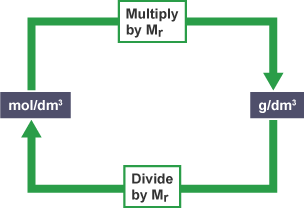
How do you convert between mol/dm³ and g/dm³?
What is a titre?
The volume added from the burette when the volume of one solution has exactly reacted with the other solution
Describe the process of identifying a carbonate
use the titration technique to identify unknown carbonate: eg X₂CO₃.
Prepare a solution of an unknown carbonate, X₂CO₃, in a volumetric flask
Using a pipette, measure 25.00 cm³ of your prepared solution into a conical flask
Using a burette, titrate this solution using 0.100 mol dm⁻³ hydrochloric acid.
Analyse your results to identify the carbonate.
see worked example
Tips for titration
Often a sample is a smaller volume taken from the larger volume in a volumetric flask
If sample X is titrated against sample Y: • Sample X is in the conical flask.• Sample Y is in the burette
Draw a storyboard of the:• Volumetric flask• Burette• Conical flask
On the storyboard label:• solutions• volumes• moles• concentrations given