Anatomy Exam 4
 Call Kai
 Learn
 Practice Test
 Spaced Repetition
 Match
 Flashcards
 Knowt Play
1/20

There's no tags or description
Looks like no tags are added yet.
21 Terms
What parts form the brain?
brain stem (medulla oblongata, pons, mesencephalon/midbrain)
Diencephalon
Cerebellum
Cerebrum
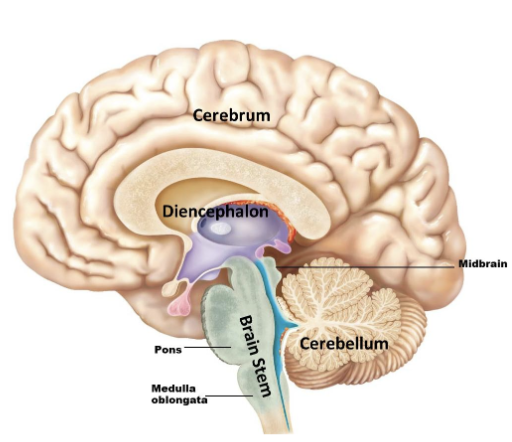
What structures contain the cardiovascular centers, respiratory centers, apneustic and pneumotaxic centers?
Cardiovascular and respiratory centers → Medulla oblongata
Apneustic and pneumotaxic centers → pons


Know the sections of the brain stem from superior to inferior
Superior → Inferior
Midbrain
Pons
Medulla Oblongata

What sections form Diencephalon?
Thalamus
Epithalamus
Pineal Gland
Hypothalamus
Pituitary Gland

What are the locations and general functions of the Thalamus and the hypothalamus?
Thalamus: coordinates motor activities, receives information from sensory fibers and passes it to the cerebrum and brain stem
Hypothalamus: center of homeostasis and behavioral drives (hunger and thirst), involved with emotions and visceral process, links the nervous and endocrine system


Know the names of nuclei and centers located in the Thalamus


Know the names of nuclei and centers located in the Hypothalamus


Where are the longitudinal fissure, the arbor vitae, the vermis, and the primary fissure located?
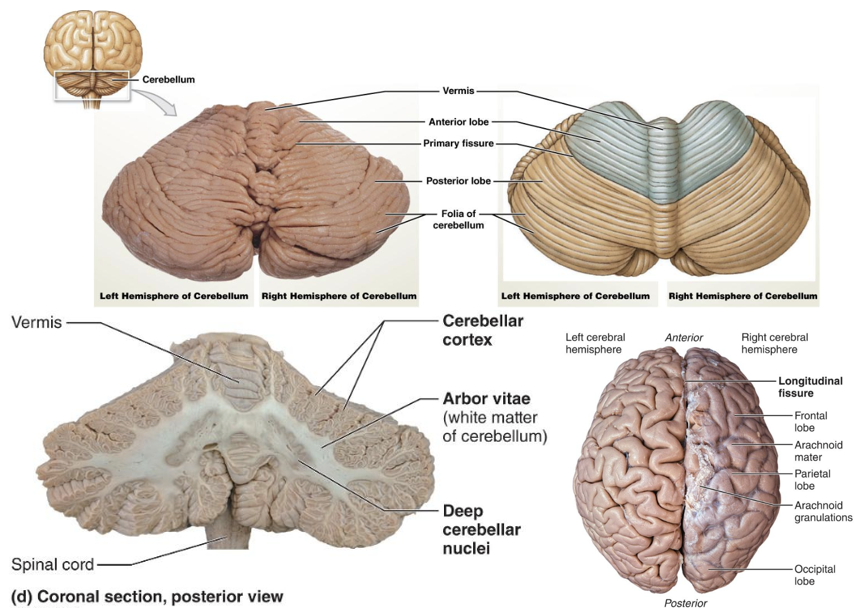
What structures divide the cerebellum into lobes and hemispheres?
Vermis: divides the cerebellum into left and right hemispheres
Primary Fissure: divides the cerebellum into anterior and posterior lobes
Know where the corpora quadrigemina is located and its function
Located at the posterior portion of the midbrain
Functions: relays signals for auditory reflexes (inferior colliculus) and visual reflexes (superior colliculus)
Describe the structures that form the white and grey matter of the medulla oblongata
Gray matter: nuclei that control blood pressure, breathing, swallowing, and vomiting
White matter: somatosensory and corticospinal tracts (from the cerebrum to the spinal cord)

Describe the structures that form the white and grey matter of the cerebrum
Gray matter: cerebral cortex, basal nuclei and limbic system
White matter: inner layers of the cerebrum, corpus callosum

Describe the structures that form the white and grey matter of the cerebellum
Gray matter: cerebellar cortex and deep cerebellar nuclei
White matter: arbor vitae

What are the components of the limbic system?
Cingulate gyrus: plays a role in emotion
Thalamus: processes sensory information and helps with memory/emotion
Hypothalamus: produces hormones for homeostasis
Hippocampus: involved in learning and memory
Amygdala: involved in emotion and memory

What is cerebral lateralization?
Cerebral lateralization: each hemisphere has special function not shared by the other hemisphere
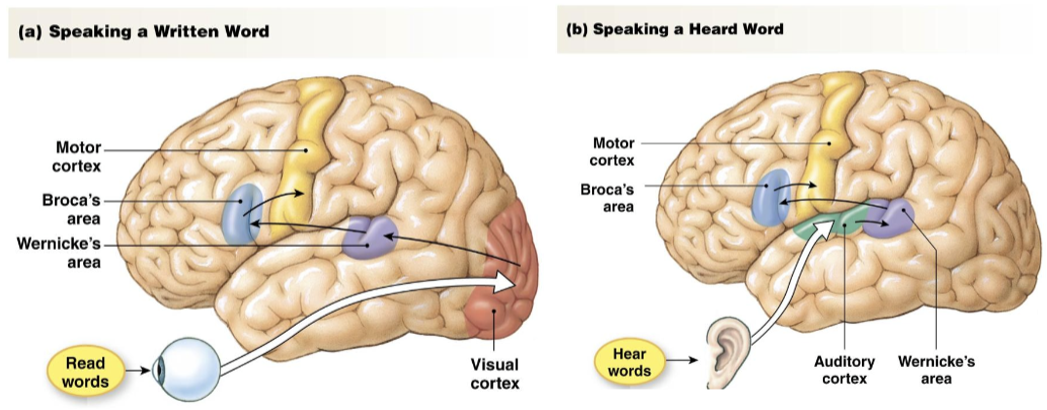
What are the functions and locations of the Wernicke’s and Broca’s areas?
Wernicke’s area: speech production and articulation, processing grammar
Broca’s area: comprehension of spoken and written language
Know the location of the spinal cord
extends from the foramen magnum to the first or second lumbar vertebrae, runs into the vertebral canal
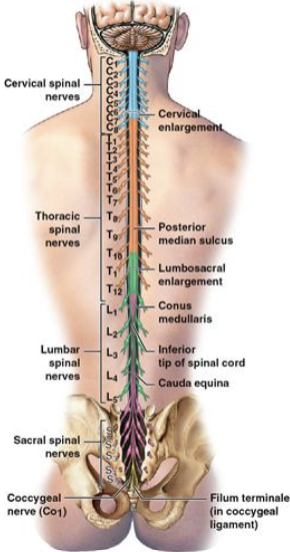
Using a figure, identify the segments of the spinal cord
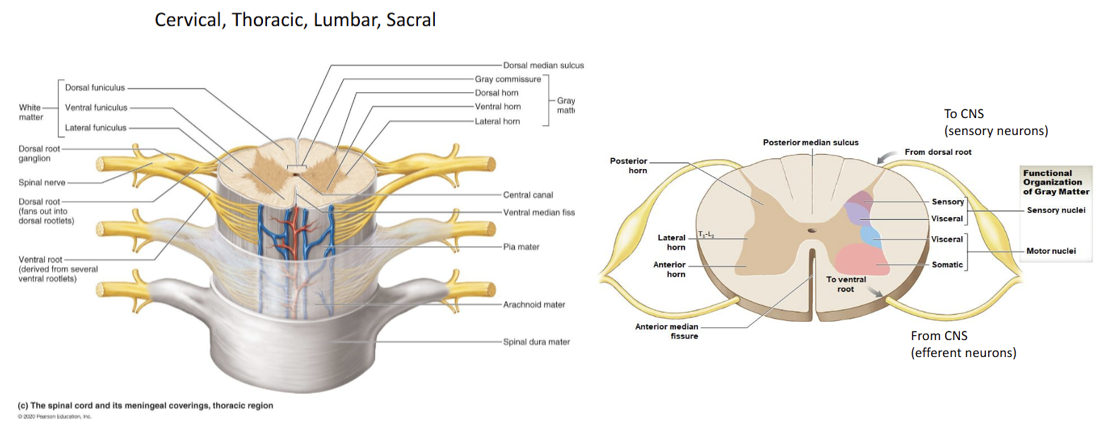
31 segments in 4 regions
cervical
thoracic
lumbar
sacral

What are the components of each
segment of the spinal cord?
Each segment has…
Dorsal root ganglia: cell bodies
Dorsal root: afferent axons (sensory neurons)
Ventral root: efferent visceral motor neurons
Efferent and afferent fibers form a spinal nerve which exits from the intervertebral foramina

What is the organization of gray and white matter in the spinal cord and brain?
Gray matter: nuclei of glia cells and neurons form an “H” shape
surrounds a central canal
called horns due to their shape
White matter: neuronal processes (myelinated and unmyelinated axons)
axons are organized into tracts called funiculi
Describe the following: lumbar enlargement, cervical enlargement, conus medullaris, cauda
equina, and filum teminale?