Lighting quiz 2 in class review
 Call Kai
 Learn
Learn Practice Test
 Spaced Repetition
 Match
Match Flashcards
 Knowt Play
1/25

There's no tags or description
Looks like no tags are added yet.
Name | Mastery | Learn | Test | Matching | Spaced | Call with Kai | Chat |
|---|
No analytics yet
Send a link to your students to track their progress
26 Terms
MacAdam Ellipses demonstrate which of the following?
A. The CIE 1931 xy chromaticity diagram is spectrally uniform
B. The CIE 1931 xy chromaticity diagram is spectrally non-uniform
B. The 1931 CIE xy chromaticity diagram is spectrally non-uniform
T/F: The spectrum locus is the boundary of chromaticities of all monochromatic radiation in the visible spectrum
T
CCT is defined as a _________ in chromaticity space
A. point
B. line
C. triangle
D. trapezoid
E. locus
B. line
Which of the following is correct about CCT and Duv"?
A. CCT describes the “pinkness/greenness” of a light sources emitted light
B. CCT describes the “warmness/coolness” of a light sources emitted light
C. Duv describes the “pinkness/greenness” of a light sources emitted light
D. Duv describes the “warmness/coolness” of a light sources emitted light
E. B and C
F. A and D
E. B and C
T/F: Color is an invariant and intrinsic characteristic of objects
F
T/F: CRI describes the average increase or decrease in saturation relative to the reference illuminant
F
T/F: All measures of color rendition in the CIE system (such as Ra and R9) and TM-30 (such as Rf, Rg, ect.) are relative measures of color rendition
T
A light source has a CIE General Color Rendering Index, Ra of 83. What do we know about this light source
A. It renders color with 83% accuracy
B. It is a perfect match to the reference illuminant
C. On average, there is some color deviation relative to the reference illuminant
D. This light source desaturates most colors
C. On average, there is some color deviation relative to the reference illuminant
Which of the following are limitations of the CIE General Color Rendering Index, Ra
A. Outdated color science
B. Problematic sample set
C. Discontinuous reference illuminant
D. Negative values
E. All of the above
E
What description best matches this measure from IES TM-30: Rcs,hj
A. Average deviation from the reference, for all samples
B. Average deviation from the reference, for hue-angle bin specific samples
C. Sample-specific deviation from the reference
D. Average increase/decrease in chroma/saturation
E. Average increase/decrease in chroma/saturation, for hue angle bin-specific samples
F. Average change in hue, for hue angle bin-specific samples
E. Average increase/decrease in chroma/saturation, for hue angle bin-specific samples
What description best matches this measure from IES TM-30: Rf
A. Average deviation from the reference, for all samples
B. Average deviation from the reference, for hue-angle bin specific samples
C. Sample-specific deviation from the reference
D. Average increase/decrease in chroma/saturation
E. Average increase/decrease in chroma/saturation, for hue angle bin-specific samples
F. Average change in hue, for hue angle bin-specific samples
A. Average deviation from the reference, for all samples
What description best matches this measure from IES TM-30: Rf,CESi
A. Average deviation from the reference, for all samples
B. Average deviation from the reference, for hue-angle bin specific samples
C. Sample-specific deviation from the reference
D. Average increase/decrease in chroma/saturation
E. Average increase/decrease in chroma/saturation, for hue angle bin-specific samples
F. Average change in hue, for hue angle bin-specific samples
C. Sample-specific deviation from the reference
What description best matches this measure from IES TM-30: Rhs,hj
A. Average deviation from the reference, for all samples
B. Average deviation from the reference, for hue-angle bin specific samples
C. Sample-specific deviation from the reference
D. Average increase/decrease in chroma/saturation
E. Average increase/decrease in chroma/saturation, for hue angle bin-specific samples
F. Average change in hue, for hue angle bin-specific samples
F. Average change in hue, for hue angle bin-specific samples
What description best matches this measure from IES TM-30: Rg
A. Average deviation from the reference, for all samples
B. Average deviation from the reference, for hue-angle bin specific samples
C. Sample-specific deviation from the reference
D. Average increase/decrease in chroma/saturation
E. Average increase/decrease in chroma/saturation, for hue angle bin-specific samples
F. Average change in hue, for hue angle bin-specific samples
D. average increase/decrease in chroma/saturation
What description best matches this measure from IES TM-30: Rf,hj
A. Average deviation from the reference, for all samples
B. Average deviation from the reference, for hue-angle bin specific samples
C. Sample-specific deviation from the reference
D. Average increase/decrease in chroma/saturation
E. Average increase/decrease in chroma/saturation, for hue angle bin-specific samples
F. Average change in hue, for hue angle bin-specific samples
B. Average deviation from the reference, for hue-angle bin specific samples
Hue angle bin is nominally what color
A. Red
B. Orange
C. Yellow
D. Green
E. Blue
F. Purple
A. Red
Changes in hue occur
A. Radially
B. Linearly
C. Tangentially
D. Exponentially
C. Tangentially
Changes in chroma occur
A. Radially
B. Linearly
C. Tangentially
D. Exponentially
A. Radially
IES TM-30 has ______ color samples in its sample set
99
IES TM-30 has how many hue-angle bins?
A. 1
B. 4
C. 8
D. 16
E. 32
D. 16

What priority level does this light source achieve for the TM-30 ANNEX E “Preference” Design Intent?
A. 1
B. 2
C. 3
D. None
B. 2

What priority level does this light source achieve for the TM-30 ANNEX E “Fidelity” Design Intent?
A. 1
B. 2
C. 3
D. None
C. 3
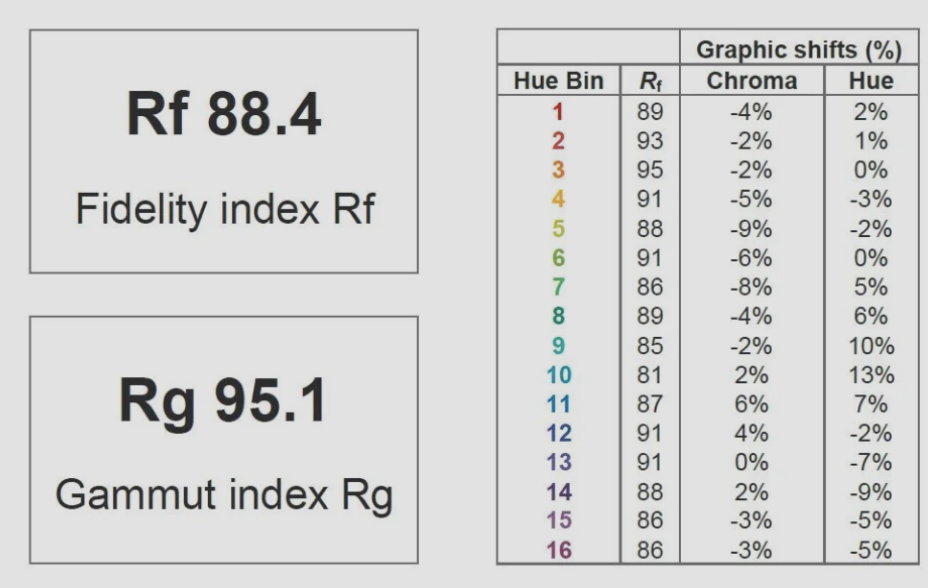
What priority level does this light source achieve for the TM-30 ANNEX E “Vividness” Design Intent?
A. 1
B. 2
C. 3
D. None
D. None
You are designing the lighting in an operating room. Which IES TM-30 ANNEX E specification would you prioritize? Consider unlimited budget
A. P1
B. P2
C. V1
D. V2
E. F1
F. F2
E. F1
You are designing the lighting in a hotel banquet hall. Which IES TM-30 ANNEX E specification would you prioritize. Consider unlimited budget
A. P1
B. P2
C. V1
D. V2
E. F1
F. F2
A. P1
You are designing the lighting for a casino, which is adorned with wood panels, a red carpet, and gold accents. The owner wants the colors to really “pop”. Which IES TM-30 ANNEX E specification would you prioritize. Consider unlimited budget
A. P1
B. P2
C. V1
D. V2
E. F1
F. F2
C. V1