Gen Chem 2 Chapter 15 Concepts
 Call Kai
 Learn
 Practice Test
 Spaced Repetition
 Match
 Flashcards
 Knowt Play
1/23

There's no tags or description
Looks like no tags are added yet.
24 Terms
Chemical Equilibrium
There are two types of reactions:
Reversible and irreversible reactions.
The combustion reaction (burning) is an example of an irreversible reaction.
C + O2 —→ CO2
Formation of carbonic acid is an example of a reversible reaction.
CO2 + H2O <— —> H2CO3
** Actually, all reactions are reversible, but the equilibrium can be shifted greatly to the side of products or reactants.

Arrow Conventions
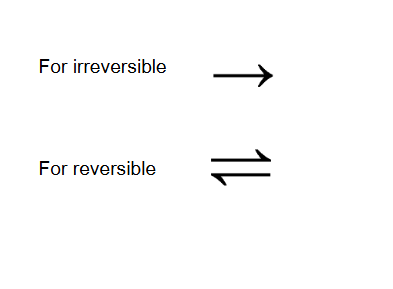

Reversible Reaction
Equilibrium is a dynamic state - both the forward and reverse reactions continue to occur, although there is no net change in reactant and product concentration over time.
You can approach equilibrium from both sides; starting with reactants or starting with products.
It is not necessary that the concentrations of products and reactant are the same at equilibrium. Concentrations could be anything. Important thing is that at the point of equilibrium they don’t change with time.

When is the system in equilbrium?
The system is in equilibrium when the rates of the forward reaction and reverse reaction are the same.

Summary of Chemical equilbrium
Equilibrium is a dynamic state - both the forward and reverse reactions continue to occur, although there is no net change in reactant and product concentration over time.
It is not necessary that concentrations of products and reactant are the same at equilibrium. Concentrations could be anything. Important thing is that at the point of equilibrium they don’t change with time.
At equilibrium, the rates of the forward and reverse reactions are equal.
Equilibrium can be established starting with only reactants, with only products, or with any mixture of reactants and products.
The Equilibrium Constant (Basics Overview)
Rate forward = rate reverse at the equilibrium
kf[N2O4]eq = kr[NO2]²eq
The subscript “eq” denotes a concentration at equilibrium
From eq. above:
kf/kr = [NO2]²/[N2O4]eq
The [NO2]eq and [N2O4]eq are constants, consequentially the ratio of the two constants (kf/kr) is also a constant, called K.
Kc = [NO2]²/[N2O4]eq
When putting the equilibrium concentrations into the equilibrium expression, we leave out the units. It is common practice to express equilibrium constants without units.

The Equilibrium Constant Final Equation
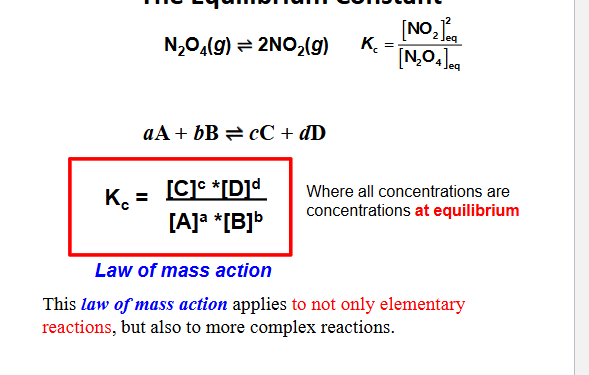
aA + bB ←—- —→ cC + dD
Law of Mass action:
Kc (equilbrium) = [C]^c x [D]^d / [A]^a x [B]^b
***** WHERE ALL CONCENTRATIONS ARE AT EQUILIBRIUM
Also this only applies to molecules in the reaction that are either gases or aqueous. It doesn’t apply to liquids or solids. So if you see them leave them out in the equation. (Also applies for Qc as well)
The law of mass actions applies not only to elementary reactions, but also to more complex reactions.
What does the value of Kc mean?
If Kc is large then equilibrium is shifted to the right (reaction goes to completion, products formed)
When Kc >> 1
If Kc is small then equilibrium is shifted to the left (products decompose to the reactants, reaction doesn’t proceed much forward).
When Kc << 1
If Kc is around unity, the equilibrium is in between reactants and products (some products are formed, there are still a lot of unreacted initial substances)
When Kc = 1
Reaction Quotient Qc
Law of mass action applied to the system NOT at the equilibrium is called Reaction Quotient
aA + bB ←—- —→ cC + dD
Qc = [C]^c x [D]^d / [A]^a x [B]^b
Same equation as Kc
The value of reaction Quotient, changes as the reaction progresses.
At which direction will reaction proceed depending on Qc?
The equilibrium expression may be used to predict the direction of a reaction.
Predictions are made based on the comparisons between Qc and Kc.
There are 3 possibilities:
Q < K, the ratio of initial concentrations of products to reactants is too small. To reach equilibrium, reactants must be converted to products. The system proceeds in the forward direction.
Q = K, the initial concentrations are equilibrium concentrations. The system is at equilibrium.
Q > K, the ratio of initial concentrations of products to reactants is too large. To reach equilibrium products must be converted to reactants. The system proceeds in the reverse direction.
Relationships between K and Chemical Equations (Reverse and Forward Reaction rule)
When the reaction is written in reverse (i.e. backward), the equilibrium constant, K is inverted.
The equilibrium constant expression for the reaction (forward).
aA + bB ←—- —→ cC + dD
Kf = [C]^c x [D]^d / [A]^a x [B]^b
The equilibrium constant expression for the reaction in (reverse)
cC + dD ←—- —→ aA + bB
Kr = [A]^a x [B}^b / [C]^c x [D]^d
Therefore, K forward = 1/K reverse
and the opposite such that, K reverse = 1/K forward
![<p>When the reaction is written in reverse (i.e. backward), the equilibrium constant, K is inverted. </p><ul><li><p>The equilibrium constant expression for the reaction (forward).</p></li></ul><p>aA + bB ←—- —→ cC + dD </p><p>Kf = [C]^c x [D]^d / [A]^a x [B]^b </p><p></p><ul><li><p>The equilibrium constant expression for the reaction in (reverse)</p></li></ul><p> cC + dD ←—- —→ aA + bB </p><p>Kr = [A]^a x [B}^b / [C]^c x [D]^d </p><p></p><p>Therefore, K forward = 1/K reverse</p><p>and the opposite such that, K reverse = 1/K forward</p>](https://assets.knowt.com/user-attachments/db22e02d-4cf4-4d9e-806d-5daf6d3890c8.png)
Relationships between K and Chemical Equations (multiplication factor to chemical equation)
When the coefficients of an equation are multiplied by a factor, the equilibrium constant is raised to that factor.
The equilibrium constant expression for the reaction
aA + bB ←—- —→ cC
K1 = [C]^c / [A]^a x [B]^b
What is the equilibrium constant if the reaction changes to:
2aA + 2bB ←—- —→ 2cC
K2 = [C]^2c / [A]^2a x [B]^2b or
K2 = ( [C]^c/ [A]^a x [B]^b)²
Therefore, K1 = K2^n

Relationships between K and Chemical Equations (adding equations to get new equations)
When you add equations to get a new equation, the equilibrium constant of the new equation is the product of the equilibrium constants of the old equations.
For the reactions (1) aA ←— —→ bB and (2) bB ←—- —→ cC, the equilibrium constant expressions are as follows.
K1 = [B]^b / [A]^a and K2 = [C]^c / [B]^b
But for the reaction aA ←— —→ cC, the equlibrium constant expression is as follows:
K3 = [B]^b/ [A]^a * [C]^c/ [B]^b = [C]^c/ [A]^a
Therefore, K3 = K1 * K2

Manipulation of equilibrium expression summary

Gaseous Equilibria
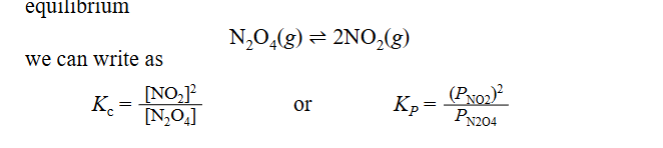
When an equilibrium expression contains only gases, we can write an alternate form of the expression in which the concentrations of gases are expressed as partial pressure (atm). Thus, for the equilibrium.
Kc can be written as Kp = (PNO2)²/(PN2O4)
BUT! Kc is not equal to Kp, because Kc has units of M and Kp has units of atm. (The molar concentration of gas is not equal to the partial pressure in atm.)
It is not necessary to have only gases, there should only be gases in the equilibrium expression. (kinda the same concept as before, only gases)
Qp and Kp work the same as Qc and Kc
Relationship between Kc and Kp
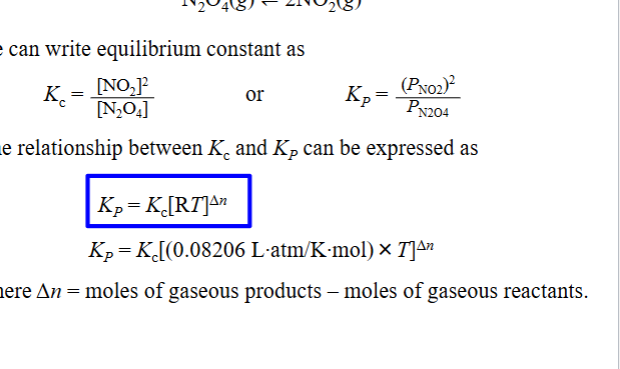
The relationship between Kc and Kp can be expressed as
Kp = Kc[RT]^△n
Where R is 0.08206
T is temperature in kelvin
and △n is moles of gaseous products - moles of gaseous reactants
Calculating for Equilibrium Concentrations (Given initial Concentrations)
Use Quotient to determine which way reaction will proceed.
Use ICE. Define the changes of reactants and products in terms of x. Use stoichiometric coefficient for proportions.
Solve for x.
Btw, if given 2CO2, it is either being plused +2x or minused -2x, but within the formula to find Qc or Kc, it is still being raised to the second power and would be (Inital value ±2x)²
Equilibrium concentrations can be calculated from initial if the equilibrium constant is known.
Small K Approximation
Finding concentrations at equilibrium might require solving a quadratic or cubic. But there some tricks to make a solution easier: Small K approximation.
If the Kc value is very small. Within the Kc equation you can equate the reactants value to be its initial [A], so 1-x, would be 1 in the equation instead. Making it easier to solve.
You still have to manually solve for the concentration of [A], its concentration is not 1.
How small should x be? 5% rule
x < 5% of initial concentration
Only applies to concentrations AT INITIAL, with no concentration of product present
Large K approximation
If the Kc is very very large, you know that the reaction is gonna go to completion.
So set for the limiting reactant, which is mostly likely the one with any #A coefficient, equal to 0. Use that to find x and then find the other concentrations.
To find [A] concentration just use Kc equation.
This can also apply to a Kc value very small but there is some concentration of product in initial, therefore assume that the reverse reaction goes to completion and set instead the product equal to zero instead.
Le Chatelier’s Principle
Le Chatelier’s principle states that when a stress is applied to a system at equilibrium, the system, will respond by shifting in the direction that minimizes the effect of the stress.
If a chemical system at equilibrium experience a change in concentration, temperature, volume or partial pressure, then the equilibrium shifts to counteract the imposed change and a new equilibrium is established.
Any change in status quo prompts an opposing reaction in the responding system.
Stress refers to any of the following:
The addition of a reactant or product
The removal of a reactant or product
A change in volume of the system, resulting in a change in concentration or partial pressure of the reactants and products
A change in temperature
Addition or removal of participants
Addition of a reactant or removal of a product will cause an equilibrium shift to the right.
Addition of a product or removal of a reactant will cause an equilibrium to shift to the left.
This not the case IF ONE OF THE REACTANTS OR PRODUCTS BEING REMOVED OR ADDED IS A SOLID OR LIQUID (so put neither in those questions)

Change of Volume (therefore pressure)
When volume is decreased (or pressure increased), the equilibrium is driven toward the side with the smallest number of moles of gas.
When volume is increased (or pressure decreased), the equilibrium is driven toward the side with the greater number of moles of gas.
Addition of Heat
Changes in volume and concentration do not change the value of equilibrium constant.
But a change in temperature can alter the value of equilibrium constant.
Which depends if the process is exothermic or endothermic.
For endothermic reactions, heat is a reactant:
So adding heat shifts the reaction towards products.
Removing heat shifts the reaction towards reactants.
For any exothermic reaction, heat is a product:
Adding heat shifts the reaction towards reactants
Removing heat shifts the reaction towards products.
Does catalyst shift equilibrium?
Catalysts act by reducing the activation energy of a reaction which occurs to the same extent for both the forward and reverse reactions.
As a result the addition of a catalyst reduces the time required to reach equilibrium but has no effect on equilibrium constants or the position of equilibrium.