Economics U4 AOS 1
 Call Kai
 Learn
Learn Practice Test
 Spaced Repetition
 Match
Match Flashcards
 Knowt Play
1/107

There's no tags or description
Looks like no tags are added yet.
Name | Mastery | Learn | Test | Matching | Spaced | Call with Kai | Chat |
|---|
No analytics yet
Send a link to your students to track their progress
108 Terms
Economic policy
Why does it exist/what’s its purpose?
What two parts is it divided into?
Economic policy refers to the strategies and measures adopted by the government to manage the economy as a means of achieving its economic goals
It exists for many reasons including correcting market failure, improve international competitiveness and stabilise the level of economic activity
These policies can be divided into those that manage AD and those that manage AS
For AD --> monetary policy and budgetary policy
For AS --> also budgetary policy
Budgetary policy/fiscal policy
Budgetary policy (also called fiscal policy) is the making of decisions on government receipts and spending in order to achieve the government's economic and social goals for Australia including through altering the level of aggregate demand in the economy
Budget
When is it typically delivered
T or F? It is based on assumptions/estimates
What happens if the gov needs to change its original plans?
The budget is a document that sets out the government's proposed receipts and spending over the next financial year ending on 30 June
The long term goal of the budget is to improve living standards + welfare of Australians and to achieve the most efficient allocation of resources
The budget also includes estimates for the 3 or 4 financial years after the next year
Typically delivered in May each year
T. It is based on assumptions/estimates --> the actual budget outcome is delivered after the end of the year – it relies on assumptions about e.g. growth in GDP, UE rate, inflation rate, wage growth, TOT
Sometimes the government may need to change some of its original plans --> so they deliver a mini-budget which outlines any updates/changes to the original budget --> this typically occurs following unexpected events (e.g. natural disaster, economic downturn)
Budgetary receipts
Outline the sources of budget receipts in 26/27
Budgetary receipts include all amounts received by the government

Tax mix
Tax burden
Tax base
The tax mix is how the government is using taxes to raise revenue
currently most revenue is raised by direct taxes (eg. income tax and company tax) rather than indirect taxes (eg. GST and tariffs)
The tax burden is the extent to which different groups are paying tax
In Australia the tax burden is much higher on high income individuals
Introducing the GST in 2000 was about widening the tax base which is the number of people or products that are subject to tax
Direct tax
Indirect tax
(include examples)
Direct tax | Tax levied (imposed) based on income or profit (e.g. income tax or company tax) |
Indirect tax | Tax paid through purchases or production of goods and services (e.g. GST, tobacco tax) |
Progressive tax
Regressive tax
Proportional tax
(include examples)
Progressive tax | A tax that collects proportionally more from higher income earners/proportionally less impact on poorer people (e.g. Income tax is a progressive tax as the more you earn the higher the tax rate) |
Regressive tax | A tax that collects proportionally more from lower income earners e.g. GST
|
Proportional tax | A tax that collects the same proportion of tax from high and low income earners/tax at a fixed rate e.g. company tax used to be a proportional tax collecting 30% of income from all companies but now has a discounted rate of 27.5% for smaller companies |
Explain why GST is a regressive tax? Give an example.
GST because lower income earners spend proportionally more of their income on goods and services so pay proportionally more GST than higher income earners

What are some other sources in which the gov receives receipts from:
Profits from government-owned businesses (e.g. Australian post, NBN co)
Selling government-owned businesses (e.g. Medibank Private, Telstra and Qantus) – they receive money from the sale
Earnings on the Future Fund
The Future Fund is an investment fund owned by the Australian Government which was set up to fund superannuation payments --> these investments provide money such as interest, dividends, profits
The RBA also earns money in its trading - some of these profits/money are transferred to Aus government --> note that the RBA is independent from the government (it makes its own decisions about interest rates) but is owned by the government
Budgetary expenditure
Outline the sources of budget expenditure in 26/27
Budgetary expenditure includes all amounts spent by the government
(Social security and welfare means money the government spends to support those who need financial help (e.g. age pensions, jobseeker payments, NDIS, disability support programs) --> the government collects this money mainly through taxes

Spending by the government can be divided into two types - identify and explain each
Current expenditure/government consumption | Spending on things consumed in the current year/period like wages or stationary
|
Capital expenditure/government investment | Spending on things that will have ongoing benefits beyond the current year such as defence equipment or roads or other infrastructure
|
Is transfer payments included in G1 or G2? Explain why.
None.
Transfer payments which are payments made by the government to individuals or households without receiving any goods or services in return (e.g. jobseeker, age pension) are not considered part of G1 and G2 --> since the recipients spend the money as part of C or I or X - don’t want to double-count
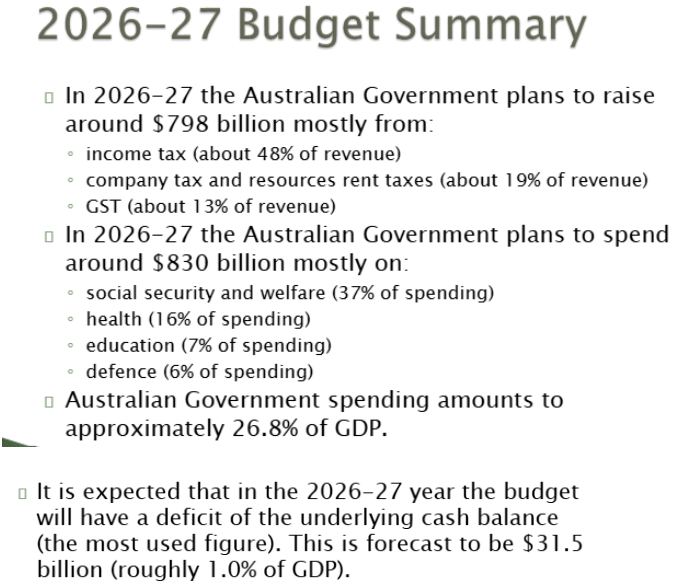
budgetary/fiscal outcome
balanced budget
budget surplus
budget deficit
The budgetary/fiscal outcome is its overall position being balanced, in deficit or a surplus
A balanced budget occurs when government revenue equals government expenses
A budget surplus occurs when government revenue exceeds government expenses
A budget deficit occurs when government expenses exceeds government revenue
T or F?
Since the global financial crisis in 2008 – the Aus government has been running budget deficits (except in 2023/34)
Aus was expected to have a budget deficit in 2020
T
F. Aus was about to get back to a budget surplus in 2020 – but hit by covid

What are some features in the 26-27 budget (this is definitely not all - just small list) + other things announced in budget over recent yrs
Features in 2026-27 Budget
Increase in infrastructure spending
Removal of capital gains tax discount
Increased spending on defence
Other things announced in gov budget over recent years
Further tax cuts for income earners
Increased funding for childcare
Funding to tackle house affordability problem
List the different ways of measuring budget outcome (also list those not in study design)
headline cash balance/outcome
underlying cash balance
cash accounting
accrual accounting
headline cash balance/outcome
underlying cash balance
Which one is more common?
The headline cash balance/outcome is the total cash received by the government minus the total cash spent
The underlying cash balance is the same as the headline cash balance except that it excludes sales of or investment in financial assets (such as shares in businesses or loans)
Most common measure + gets reported in newspapers
It excludes things that don't impact over the long-term --> assets are one-off transactions + loans can be repaid with interest
Cash accounting (NOTE: not in study design)
This measures actual money received and actual money paid during the financial year
Example:
Government receives $100 billion in tax payments this year.
Government pays $90 billion in expenses this year.
Cash surplus = $10 billion.
The problem is that it ignores money that is owed but not yet paid or earned but not yet received
Accrual accounting (NOTE: not in study design)
Accrual accounting records income when it is earned and expenses when they are incurred, even if the money has actually been paid or received yet
Example:
Government provides a service worth $10 million in June.
The government receives the payment in August.
Under cash accounting, it counts in August.
Under accrual accounting, it counts in June because that is when the revenue was earned
The two accrual-based measures
A) Net Operating Balance (NOB)
The net operating balance measures whether government revenue is enough to cover its ongoing (day-to-day) expenses, excluding capital spending.
It focuses on the government's yearly operations.
It includes:
✅ Tax revenue
✅ Welfare payments
✅ Government wages
✅ Interest payments
It excludes:
❌ Building roads
❌ Constructing hospitals
❌ Buying infrastructure
B) Fiscal Balance
The fiscal balance measures the budget position using accrual accounting and includes both operating expenses and capital spending.
It includes everything:
Normal government spending
Infrastructure investment
Why is borrowing for capital spending considered as good debt?
Why is borrowing for current spending considered as bad debt?
Good debt (borrowing for capital spending)
Borrowing to build things like:
roads
hospitals
transport infrastructure
As they can increase productivity and economic growth – making it easier to repay the debt
Bad debt (borrowing for current spending)
Borrowing to pay for everyday expenses, such as:
government wages
welfare payments
routine services
Does not directly increase productive capacity, so it may be harder to repay
Discretionary stabilisers + examples
Which component of the budget are discretionary stabilisers changes to?
Discretionary stabilisers are deliberate policy decisions of the government that change the budget outcome in order to influence economic activity
e.g. If growth is declining, the government may increase spending or cut taxes in order to boost AD
e.g. if growth is accelerating at a unsustainable rate, causing there to be high inflation – the government may cut spending or increase taxes
Discretionary stabilisers are changes to the structural component of the budget - the part of the budget that changes based on deliberate decisions of the government
Automatic stabilisers + examples
Which component of the budget are automatic stabilisers changes to?
Automatic stabilisers are the changes to the budget that happen automatically based on changes in economic activity and where the economy is in the business cycle
e.g. Real wages and company profits are high resulting in higher income and company taxes
e.g. Unemployment is low resulting in lower spending on JobSeeker allowance
e.g. more people are retiring, so pension payments increase
Automatic stabilisers are changes to the cyclical component of the budget - part of the budget that changes automatically based on the business cycle and the impact of automatic stabilisers
Why are automatic stabilisers called ‘stabilisers’?
These are called automatic "stabilisers" as they tend to operate counter-cyclically – meaning that when growth is strong, they slow it down and when growth is weak, they speed it up
e.g.
When growth is low/negative
Tax revenue drops + welfare payments increase --> this would increase the budget deficit and increase AD
When growth is strong
Tax revenue increases + welfare payments fall --> reduces budget deficit/increases surplus and decreases AD
Bracket creep/fiscal drag + how does it affect disposable income and PP + how does it affect the amount of tax collected
Bracket creep/fiscal drag refers to the way in which inflation increases nominal wages and pushes individuals into higher tax brackets where they pay a higher percentage/proportion of tax without any real increase in their income
This means that inflation causes an increase in the tax collected without any action needed by the government
As a result, many will experience a decline in real disposable income and purchasing power
Government expenditure and receipts is roughly __% of Australia's GDP
Taxes are a ___ from the circular flow
Government spending is an ___ into circular flow
Government expenditure and receipts is roughly 27% of Australia's GDP
Taxes are a leakage from the circular flow
Government spending is an injection into circular flow
Balanced budget
Expansionary budget
Contractionary budget
If the government has a balanced budget – this means that receipts equal expenses so leakages equals injections and so there will be no impact on AD
An expansionary budget is a budget that increases economic activity by having a budget deficit, where government receipts (leakages) are less than government spending (injections) which means there is a net boost in aggregate demand
A contractionary budget is a budget that decreases economic activity by having a budget surplus, meaning that the government receipts (leakages) are greater than government spending (injections) which means there is a net decrease in aggregate demand
Describe the following in terms of less/more expansionary/contractionary:
Having a surplus of $10 bn – the government reduces the surplus to $5 bn by the implementation of tax cuts
Reducing a deficit from -$10 bn to -$5bn
Having a surplus of $10 bn – the government reduces the surplus to $5 bn by the implementation of tax cuts --> this would be considered to be less contractionary (as it's still a contractionary budget, but lesser extent)
Reducing a deficit – would be less expansionary
Bonds
Bonds: debt instruments – like a loan where there is a promise to repay and to pay interest in the meantime
What are the different ways the gov can finance a budget deficit (just list them)
Selling bonds to RBA
Selling bonds to Aus investors
Selling bonds to overseas investors
Outline the cons of selling bonds to RBA:
The RBA can create money to buy the bonds
However this is inflationary as it increases the money supply
Outline the cons of selling bonds to Aus investors:
However this means that firms are competing against the government to borrow money and can be "crowded out" - making it harder for firms to borrow thus this will reduce business investment and increase interest rates (due to greater demand for loans) + lessens impact of expansionary budget (due to reduction in investment)
Outline the cons of selling bonds to overseas investors:
However the downside to this is that it will cause increased demand for AUD as investors will need to convert their foreign currency to AUD --> cause AUD to appreciate which slows growth + lessens impact of expansionary budget
Problems with running deficit too much
More of the budget is devoted to interest on the debt – this means less money for things like hospitals, schools, roads, defence
If it gets too high – our credit rating will be reduced, which make overseas investors worried and hence they may make interest rates higher + stop lending Aus money
It is unfair to future generations (inter-temporarily inefficient) especially if it's being used to finance current expenditure --> as future generations will have to repay the debt even though they didn't receive most of the benefits
What can the gov do with a surplus?
Be used to repay existing government debt --> this is good as less debt means less interest to pay in the future
Invest in debt and equity investments (e.g. private bonds, shares)
What is a problem associated with investing a surplus?
Invest in debt and equity investments (e.g. private bonds, shares)
--> However this undermines the effect of a contractionary budget to some extent through crowding in where when the government invests a budget surplus, this increases supply in the Australian loan and equity markets making it easier for businesses to fund investments and reducing interest rates --> this increases investment and so means that the decrease to AD caused by the budget surplus is partly offset by an increase in investment
Fiscal consolidation + advantages
A policy of fiscal consolidation means that the government is seeking to reduce the budget deficit and bring the budget into surplus over a period of years.
The advantages of this policy include:
It helps reduce government debt and keep our credit rating high (which keeps interest costs low)
It also means that if the economy goes into a slowdown or recession the government has more ability to borrow to boost AD and growth as the government has more borrowing capacity/lenders are more willing to lend
It is also inter-temporarily efficient as it means we are not burdening future generations with government debt to repay
T or F?
Until covid hit in 2020, the government was pursuing a policy of fiscal consolidation.
Aus is actively trying to pursue policy of FC
T. Until covid hit in 2020, the government was pursuing a policy of fiscal consolidation --> however covid moved Aus to a very large deficit
F. As of now, Aus is not currently planning to do much on fiscal consolidation:
The chart from the budget suggests that it will be balanced around 2035/36 - but does not provide any actual estimates above 29/30

Internal stability + how do govs achieve this
Internal stability is usually the aim of budgetary policy - a period of stable economic activity with sustainable rates of growth, full employment and low inflation
To achieve this, governments try to apply budget policy counter-cyclically where they try reduce the peaks and troughs in the business cycle by:
Running expansionary budgets when growth is low or negative (during a trough or downturn)
Contractionary budgets when growth is strong (during a surplus or upturn)
Consumption is most impacted by:
Increased transfer payments (e.g. jobseeker, pensions)
Stimulus payments – payments designed to encourage households to spend money
Personal income tax rate cuts
Explain why personal income tax cuts at lower levels increases consumption greatly compared to income tax cuts at higher levels:
As money given to lower income people tends to get spent more on immediate consumption than money given to high income people
--> this is because lower-income households tend to spend most of any extra money they receive on necessities such as food, rent, and bills while since higher-income households can already afford these necessities, so they are more likely to save or invest extra income, resulting in a smaller increase in consumption
Investment is most impacted by:
Company tax rate cuts
Accelerated depreciation
Support to industry such as grants (money provided by government to firms)/research & development tax allowances (tax benefit from the government that reduces the amount of tax a business pays if it spends money on research and development – so this lowers the cost of doing research)
Explain accelerated depreciation:

Explain how budgetary policies help achieve FE:
The counter-cyclical nature of the budgetary policy means that when UE is high – the budget automatically becomes more expansionary (more transfer payments, less tax revenue) --> which reduces cyclical UE (and vice versa when UE is low)
Spending on job retraining schemes help reduce structural UE
Work for dole schemes can help reduce hardcore or long-term unemployment
Work for dole programs require unemployed people to do community or other work-related activities --> this helps participants develop skills + provides recent work experience – makes it easier for them to be employed and thus reduced long-term unemployment
Tax or pension incentives for people at or near retirement can help boost participation rate (e.g. allowing pensioners to work more hours without losing the pension, lower income tax rates for older workers, higher tax-free income thresholds for working seniors, delay access to age pension)
Explain how budgetary policies help achieve LIPS:
A contractionary budget will lessen AD which reduces inflationary pressures and hence makes it easier for the RBA to minimise inflation as they will not have to increase interest rates as rapidly
Spending or tax cuts which have an immediate effect on AD may be postponed if demand inflation seems to be a problem
If cost inflation is an issue – the government could use supply-side initiatives (e.g. increased migration, lower petrol excises or infrastructure spending) to reduce business costs
Gov decisions help LS during a recession/boom
Explain other different ways the gov can improve LS
The amount spend on defence determine whether Aus can continue as an independent democratic nation – maintains national security + economic stability
Taxes on carbon fuels can reduce negative externalities that can reduce LS
Taxes that cover transfer payments can increase LS for some while modestly reducing them for others
Funding for government agencies such as the Australian Consumer and Competition Commission (ACCC) can increase the efficiency of markets
The ACCC prevents firms from behaving anti-competitively, protects consumers from misleading/deceptive conduct and encourages competition --> helps improve the efficiency – improves LS
Identify and explain strengths of budgetary policy:
It can target particular sectors of the economy rather than the whole economy (e.g. if the construction industry is struggling, the gov can spend more on public housing projects)
It can target different parts of Aus where growth may be very weak/strong --> monetary policy cannot do this as it affects every state equally
It can solve different economic problems/goals
It can reduce structural UE (e.g. by paying for training/education)
Reduce inequality in income distribution by increasing welfare payments etc
External pressures – foreign debt (e.g. gov can reduce budget deficit by cutting spending & increasing taxes – gov has to borrow less money – NFD falls/grows more slowly)
It generally works more quickly than monetary policy (e.g. tax cuts affect tend to have a more immediate influence than a interest rate cut)
It occurs automatically to some extent via automatic stabilisers – so the gov at times doesn't have to do anything
e.g. during slow/negative growth – less tax revenue + increased UE benefits
During boom/peak - pay more tax + less UE benefits – slows spending + reduces inflationary pressures
It is democratic and has public involvement
The gov budget is prepared by elected politicians, debated in parliament, voted on by representatives chosen by the public while interest rates are set by the RBA where officials are not elected
Doesn't have the zero lower bound problem – where monetary policy becomes less effective when interest rates are already very close to 0% as they cannot be reduced much further – while fiscal policy can continue to make changes (e.g. build infrastructure, increase welfare payments, provide tax cuts)
Identify and explain weaknesses of budgetary policy:
Many budget changes/measures must be approved by both the house of Representatives and the Senate (not is usually not controlled by the gov) and so policies may be rejected, delayed, changed --> so the government cannot always implement the fiscal policy it believes is necessary
Prone to political bias – many politicians may make decisions based on wanting to win the next election --> so they may make decisions that are popular among voters rather than what is the most efficient/appropriate for the economy
e.g. During high inflation
Economists may advise that taxes should be raised or to cut spending
But voters dislike higher taxes – so they may delay tax increases and increase spending to keep voters happy
This may worsen inflation
Further, political parties need money to campaign – firms, unions and other groups sometimes donate money or lobby (communicating with the gov to try to influence gov decisions) gov --> so governments may make policies to benefit these groups/give outsize influence to these groups
Fiscal policy often takes time/slow to implement as it involves multiple steps (e.g. developing policy, debating it in parliament, voting, place into action and the need for state co-operation)
Got from the textbook:
The government faces financial constraints and cannot spend unlimited amounts of money as excessive spending can increase budget deficits and debt, potentially lowering Australia’s credit rating and increasing borrowing costs/higher interest rates --> as a result, concerns about future debt repayments may limit the size of government spending measures, reducing the effectiveness of budgetary policy
SSEG
The goal of strong and sustainable economic growth (SSEG) is to achieve the highest rate of growth in real GDP possible consistent with strong employment growth but without causing unacceptable inflationary, external or environmental pressures
It is said to be achieved when GDP growth rate is around 3 – 3.5%
FE
The goal of full employment is to reach the highest level of employment consistent with the achievement of non-inflationary sustainable growth and an absence of cyclical unemployment.
It is said to be achieved when the unemployment rate is around 4 – 4.5%
LIPS
The goal of low inflation is a 2 to 3% per annum increase in the general level of prices on average over time as measured by the consumer price index
Describe growth in Aus as of currently and recent years:
Whilst growth is improving, as of March 2026, the goal of 3-3.5% is not currently being achieved

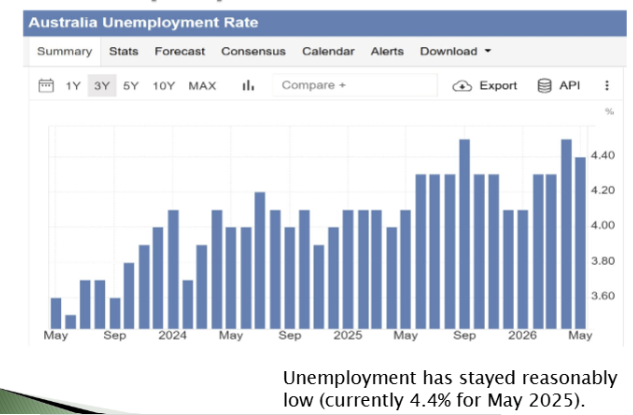
Describe UE in Aus as of currently and recent years:
The UE rate has stayed within the desired range (4-4.5%)
Describe LIPS in Aus as of currently and recent years:
Whilst inflation is slightly falling, it is still above the target range of 2-3%, as it is currently 4.0% as of May 2026

NOTE:
Whenever the gov introduces a new budget they are setting policy:
In the short-term (the coming year) - budget outcome for the coming year + specific changes that will come in for that year
In the medium term (the next 5 or so years) - budget outcomes over the next 5 years + longer term initiatives (things that will happen over a period of years)
Budget outcomes + current medium term budgetary policy and stance
The 2026/27 budget is expected to have a $32 billion (specifically 31.5 bn) deficit – meaning that the stance is expansionary --> pushing up AD
Economists estimate that around $26 bn of this deficit is due to cyclical factors (automatic stabilisers – e.g. lower tax revenue, higher spending on UE benefits)
While government structural policy decisions increased the deficit by a further $6 bn (e.g. increasing spending, cutting taxes) --> therefore, the impact of structural changes to the budget made the budget outcome more expansionary

Fuel excise cut (2026/27)
Description
How it affects AD and thus SSEG and FE
How it affects inflation/LIPS
How long is the cut?
How does it impact LS
In response to the oil price shock caused by the war in the Middle East, the 2026-27 budget cut the fuel excise (tax on fuel) by 26.3 cents per litre and removed the Heavy Road User Charge (fee paid mainly by heavy vehicles) for three months, at a cost of $2.55 billion --> This reduces the cost of a 65 litre tank of petrol by about $19
This increases AD (as more disposable income due to spending less on petrol) --> makes SSEG and FE easier to achieve
The impact on inflation is tricky:
--> it boosts disposable income and AD (helping growth and employment) - increases risk of demand inflation
--> However cutting the fuel excise also directly LOWERS measured inflation in the short term, because automotive fuel is included in the CPI basket and so CPI records lower fuel prices
--> so in the short term it actually helps the goal of low inflation, even though the extra spending it allows adds some demand pressure
--> The cut is also temporary (three months)
Improves LS --> eases cost-of-living pressures from high petrol prices
Local Infrastructure Fund (2026/27)
Description
How it affects AD and thus SSEG and FE
How it affects inflation/LIPS
How does it impact LS
The 2026-27 budget provided an additional $2 billion over four years for a Local Infrastructure Fund --> this gives funding to local councils and state utilities to build the ‘enabling’ infrastructure - roads, water, power and sewerage - needed to unlock up to 65,000 new homes over the decade
States must commit to pro-housing reforms (faster planning approvals and releasing more land) to access the funding
This spending will boost AD (G) --> makes SSEG and FE easier to achieve
It may increase inflationary pressures in the short term (due to increased AD and hence increases risk of demand inflation), but should reduce them in the long term by increasing aggregate supply (more housing eases housing and rent cost pressures)
Improves LS as more housing + infrastructure supply improves affordability + better infrastructure + more employment/incomes
Suburban Rail Loop (2026/27)
Description
How it affects AD and thus SSEG and FE
How it affects inflation/LIPS
How does it impact LS
The 2026-27 budget committed an additional $3.8 billion to the Suburban Rail Loop (SRL) East in Victoria, bringing total federal funding to $6 billion (part of $8.6 billion in new road and rail spending)
The SRL is an orbital underground rail line connecting Melbourne’s suburbs
It is expected to generate up to 3,000 construction jobs and around 8,000 long-term jobs, with trains running by 2035
This spending will boost AD (G2) --> make SSEG and FE easier to achieve
It may increase inflationary pressures in the short term (due to increased AD) but should reduce them in the long term by increasing aggregate supply (reduces congestion and vehicles on the road - improved productivity + increases access to labour resources)
Improve LS – better transport connectivity, reduces congestion and jobs
NDIS spending reforms (2026/27)
Description
How it affects AD and thus SSEG and FE
How it affects inflation/LIPS
How does it impact LS
The 2026-27 budget slows the growth of spending on the National Disability Insurance Scheme (NDIS) through tighter, evidence-based eligibility assessments, stricter plan reviews and a crackdown on provider fraud --> this is expected to save $37.8 billion over four years
Around 160,000 people are expected to leave the scheme by 2030 (a target of about 600,000 participants, down from around 770,000).
Note - do not call this a ‘cut’: NDIS spending still GROWS each year (from about $53.8 billion in 2025-26 to about $56.2 billion in 2029-30) - the budget only slows the rate of growth compared with what was projected --> it makes the budget less expansionary
There would be lower gov spending growth --> AD slows --> may make it harder to achieve SSEG and FE (due to less demand for disability services) in the short-term
Reduces inflationary pressures due to less gov spending
LS
+
More sustainable NDIS – as the gov can continue to afford to keep funding the scheme into the future so spending growth is controlled, fraud is reduced
Better targeting of support --> improves efficiency of gov spending
-
The trade-off is that it reduces support (e.g. funded services, disability support) (and so living standards/quality of life) for people leaving the scheme
Explain what negative gearing is: (Don’t explain the budget initiative is yet)
Negative gearing happens when the costs of an investment (e.g. owning a rental property - expenses) exceed the income it generates (e.g. rental income) --> and so the investor can deduct that loss from their other income, reducing the tax they have to pay
Negative gearing reform (2026/27)
Description
How it increases housing supply and thus housing affordability
From 1 July 2027 the 2026-27 budget limits negative gearing on established (existing) residential property
For established homes bought after budget night (7:30pm, 12 May 2026), losses can only be deducted against rental income or property capital gains - not wages --> so they still have to pay tax on their normal wage income
Note that this only affects investors buying existing homes after budget night and not those who already own investment properties (grandfathered) or those that build new homes
How does it direct investment towards new housing supply?
Before the reform:
An investor could buy an existing house and use negative gearing:
Investor buys existing home
⬇
Makes a rental loss
⬇
Deducts the loss from their wage income
⬇
Pays less tax
This makes buying existing homes more attractive.
After the reform:
For existing homes:
Investors lose the ability to deduct rental losses against wages.
For new builds:
The negative gearing benefit remains.
So investors may think:
"Instead of buying an existing property and losing the tax advantage, I might buy a newly built property where I can still access the tax benefit."
The chain:
Tax advantage for new builds remains
⬇
Investors are encouraged to buy newly constructed homes
⬇
More investment in housing construction
⬇
Housing supply increases
Improves housing affordability
If the policy encourages more new homes:
Housing supply ↑
⬇
Less shortage of housing
⬇
Lower pressure on house prices and rents
This makes it easier for:
first-home buyers,
younger Australians,
lower-income households
to access housing
Intergenerational fairness
The issue:
Older generations are more likely to already own property.
Younger generations often face:
higher house prices,
larger deposits,
more competition from investors
And so this initiative will help younger generations through more affordable housing
Negative gearing reform (2026/27)
How it affects AD in short-term vs long-term and hence achievement of FE and SSEG
How it affects inflation
LS
Note - this is a structural tax increase that raises revenue and improves the budget outcome (as gov received more tax revenue as previously investors could reduce taxable income using rental losses but now some investors cannot reduce their wage income using those losses) --> but its effect on AD is small and delayed (it starts in 2027 and mainly raises revenue from 2028-29)
(Not too sure about SSEG and FE points)
Over the short-term, investors may have slightly lower disposable income which would cause AD to fall --> making SSEG and FE harder to achieve
However in the long-term, by encouraging investment into new housing, the policy increases the I component of AD during construction + increases AS --> makes it easier to achieve the goals
Mildly eases inflation as increases housing supply and hence AS
It improves living standards as it aims to improve housing affordability and intergenerational fairness for younger and first-time home buyers
Income tax cuts (2025/26)
Description
How it affects AD and thus SSEG and FE
How it affects inflation/LIPS
How it affects LS
From 1 July 2026, the 16% tax rate (applying to income between $18,201-$45,000) will be reduced to 15%, then further reduced to 14% from 1 July 2027 --> these cuts cost $17.1 billion over three years and will provide a worker on average earnings ($79,000) with an additional $268 in 2026-27 and $536 annually from 2027-28.
These tax cuts will boost AD (C – higher disposable income) (starting July 2026) --> make SSEG and FE easier to achieve
But will increase inflationary pressures --> due to increased AD (increased likelihood of demand inflation)
Improve LS – more consumption of goods and services, higher employment and incomes
Early Childhood Education Initiative 2025/26
Description
How it affects AD and thus SSEG and FE
How it affects inflation/LIPS
How it affects LS
The 2025-26 Australian budget allocated $5 billion towards building a universal early childhood education and care system
Key initiatives include $3.6 billion to for wage increases for up to 200,000 early childhood educators and teachers and $1 billion to create 160 new or expanded services in underserved areas
This spending will boost AD (G) and make SSEG and FE easier to achieve
It may increase inflationary pressures in the short term (due to higher AD) but in the long term should reduce them increasing AS by allowing more parents to rejoin the workforce due to childcare being easier/cheaper to access and boost productive capacity
Improves LS – better access to childcare = children receive more support, parents have more flexibility --> improves quality of life, higher incomes for childcare workers (improves MLS), improves financial security + household incomes as more parents can return to work
T or F? Monetary policy is implemented by the gov rather than the Reserve Bank of Australia (RBA)
What is the RBA + whose its current governor
F. Monetary policy is implemented by the Reserve Bank of Australia (RBA) rather than the gov
The RBA is a statutory authority of the Commonwealth Government but independent of the gov
Since 2025, its monetary policy is decided by the monetary policy board – whose members are appointed by the gov (usually for 5 year terms)
It's current governor is Michelle Bullock (whose appointment expires in 2030)
RBA has a dual mandate (main goals)/RBA charter:
Maintaining price stability which means a low and stable inflation rate of 2-3% measured by the CPI (headline rate) on average over time.
Maintenance of full employment
Overarching aim: the economic prosperity and welfare of the Australian people
If price stability and FE conflict, which one of these goals would the RBA focus on more?
Is it okay if inflation is above the 2-3% target range?
Price stability and FE usually go together – however when they conflict, the RBA focuses on keeping inflation low --> as it sees this as a precondition for lasting FE
They aim for 2-3% on average – so it is okay if inflation is above 3% at times
However they will not allow persistent inflation above target – they will prevent this by raising the cash rate even if it means slower growth and higher UE due to decreased spending
Wage-price spiral
How does people trusting the RBA help reduce the wage-price spiral?
Occurs when there is an expectation that inflation will increase so workers will demand higher wages, which increases production costs leading to firms to increase selling prices – inflation which causes workers to demand even higher wages which further pushes up inflation
However if people trust the RBA to keep inflation in check, then they won't demand for higher wages as they'd think: "Don't worry RBA is going to keep inflation low, so I don't have to worry about high inflation eroding my purchasing power and thus won't need to demand for higher wages"
RBA affects inflation by impacting the interest rates charged on Aus loans —> so does the RBA control these interest rates?
Overnight money market (OMM)
Cash rate
RBA affects inflation by impacting the interest rates charged on Aus loans – however the RBA does not control these rates, instead it is the borrowers and the lenders which agree on the interest rate in a competitive market
--> However the RBA has a strong influence over interest rates as it has a strong influence over the cash rate
The overnight money market (OMM) is the market for overnight (1 day) loans largely between the banks
Cash rate is the interest rate charged on loans in the overnight money market
Target cash rate (TCR)
List the different ways that the RBA ensures that the CR equals to the TCR:
RBA has a target cash rate (TCR) - which is RBA's target level for the cash rate
--> There are two ways that the RBA ensures that the CR equals to the TCR, these include:
Open market operations
Interest rate band it applies to bank deposits/lending from RBA through exchange settlement accounts
Commonwealth Government securities (CGS)
How does RBA adjust amount of money in financial institutions?
The Commonwealth government borrows money by issuing Commonwealth Government securities (CGS) which include a promise to repay the loan and to pay interest
The RBA can adjust the amount of money in financial institutions by buying or selling CGS or entering into repurchase agreements (don't need to know RA)
Liquidity
How do each of these affect the money supply in the OMM:
RBA buys CGS from banks
RBA sells CGS to banks
In relation to the overnight money market, liquidity means how much cash is available
More liquidity means more cash
Less liquidity means less cash
So when RBA:
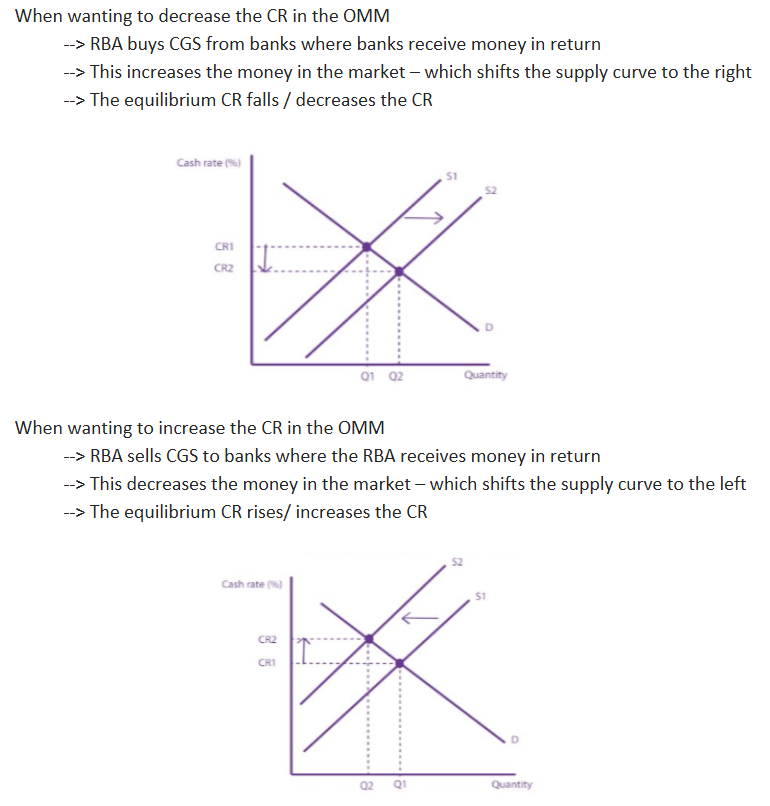
Buys CGS from banks – banks receive money from RBA which increases the money supply/increases liquidity
Sells CGS to banks – RBA receive money from banks which decreases money supply/reduces liquidity
Through the use of open market operations (OMOs), how does RBA:
Decrease the CR in the OMM (include a diagram)
Increase the CR in the OMM (include a diagram)
Exchange settlement accounts (ESA)
Exchange settlement accounts (ESA) are accounts which each bank holds with the RBA which they can borrow from and lend/deposit money with the RBA
Note that banks can also borrow or lend money with each other as well
Explain how the RBA changes CR to reach the TCR in ESA + include an example
When the RBA changes the TCR – they change the interest rates it applies to funds deposited with or borrowed from the RBA by banks
--> Where they will set a deposit interest rate of 0.10% below the TCR
--> And set a lending interest rate that is 0.25% above the TCR
This would confine lending between banks to a band around the TCR
e.g.
If RBA decrease the TCR to 4.10%
They will set a deposit interest rate is 4.0%
And a lending interest rate that is 4.35%
Banks will have no incentive to borrow or lend funds outside this range as:
They would not be willing to pay more than 4.35% to borrow funds from other banks, as they could borrow more cheaply from the RBA instead
Likewise, they would not accept less than 4.10% when lending funds, as they could simply deposit their money with the RBA and earn a greater amount of interest
As a result, this confines lending between banks within 0.25% (0.1% from the deposit side) of the TCR, helping to keep the cash rate around the TCR of 4.10%

Tightening of monetary policy
Loosening of monetary policy
A tightening of monetary policy occurs when the RBA raises the target cash rate – this is intended to reduce AD and economic activity to reduce inflationary pressures
A loosening of monetary policy occurs when the RBA lowers the target cash rate – this is intended to boost AD and economic activity
(TIP: You can remember the above by thinking:
Tightening is like choking/suffocating someone as a rise in TCR is unwanted by consumers
While loosening is like making someone feel free/less suffocated as a decrease in TCR is wanted)
Banks' lending margins
Explain why changes in the TCR and hence CR affect the interest rate charged on banks’ loans:
Banks' lending margins are the difference between the interest rates they pay when they borrow (from depositors and lenders in Australia and globally) and they interest rates they charge when they lend
Changes in the Target Cash Rate (TCR) are generally passed on to the interest rates charged on loans as they affect banks' cost of funds
So when TCR ↑
Banks face a higher cost of obtaining funds
Banks increase lending rates of loans to cover their higher funding costs/maintain profits
Borrowing costs increase – where investment and spending decrease, and hence AD falls
When TCR ↓
Banks face a lower cost of obtaining funds
Banks reduce lending rates on loans
Borrowing costs decrease – where investment and spending increase, and hence AD rises
Transmission mechanisms
Transmission mechanisms are the way in which changes to interest rates impact on economic activity
T or F? For longer borrowing (30, 90 180 days etc) the banks pay higher rates as the longer the term of the loan. Why/why not?
T. As for longer borrowing (30, 90 180 days etc) the banks pay higher rates as the longer the term of the loan, the higher the risk
Explain why the CR and interest rates do not always move in the same direction/exactly together:
Sometimes banks' borrowing costs can increase for other reasons
e.g. overseas lenders think Australian banks have gotten more risky
Suppose the cash rate stays at 4%.
An overseas investor thinks:
"The Australian economy looks riskier now. I want a higher return before I lend money to Australian banks."
Instead of lending at 4%, they now demand 5%.
So now the bank's borrowing cost has increased even though the cash rate didn't change.
The bank may respond by increasing mortgage rates from 6% to 6.5%.
So:
Cash rate = unchanged
Bank borrowing cost = up
Home loan rates = up
Competition between banks
Too much competition – banks will not increase interest rates as much as borrowers can always switch to another bank with a lower interest rate
e.g.
Suppose the cash rate increases from 3% to 3.5%.
Bank A thinks:
"If I increase my mortgage rate by 0.5%, customers might switch to another bank."
Instead of increasing by 0.5%, Bank A only increases by 0.2%.
It accepts a smaller profit to stay competitive
So:
Cash rate ↑ by 0.5%
Mortgage rate ↑ by only 0.2%
Competition keeps rates from rising as much.
Lack of competition - banks will can increase interest rates much more as borrowers cannot easily switch to another bank with a lower interest rate
e.g.
The cash rate falls from 4% to 3.5%.
Banks are paying less to borrow money.
But because there isn't much competition, they think:
"We don't have to reduce our mortgage rates immediately."
Instead of lowering mortgage rates by 0.5%, they only lower them by 0.2%.
They keep more profit.
So:
Cash rate ↓ by 0.5%
Mortgage rate ↓ by only 0.2%
Cashflow channel
Explain how an increase in the interest rate would affect the cashflow channel:
The cashflow channel refers to how changes in interest rates affect the cash flow of households and firms with already existing loans
Households with existing loans (especially housing loans) will be spending more each month on interest payments – limits/restrict cashflow and reduces their discretionary income and thus consumption levels
Firms with existing loans will spend more on interest and have reduced profits and thus reduced funds for investment
(Note that some households and firms with savings will benefit from higher rates but this is outweighed)
Savings & investment channel
Explain how an increase in the interest rate would affect the Savings and investment channel:
The savings and investment channel refers to how changes in interest rates affect the saving and investment decisions of people that do not have already existing loans/the potential of future loans
Higher cost of borrowing will reduce borrowing for consumption and investment by households and firms so consumption and investment fall
Also a higher return for savings due to higher interest rates will increase savings as higher returns acts as a greater incentive to save for households (which reduces consumption and investment)
Explain how an increase in the interest rate would affect the Asset prices and wealth channel:
Higher interest rates make people less willing to borrow to buy assets (e.g. housing loans or margin loans (loans used to buy shares) --> this tends to decrease the value of assets such as housing and shares (as demand for them falls due to increased borrowing costs)
People who already own assets like houses and shares will feel less wealthy as their assets' value falls and so will consume less and save more --> this reduces consumption and so AD and thus economic activity
Explain how an increase in the interest rate would affect the exchange rate channel:
Higher interest rates will cause Aus relative interest rates to rise compared to other countries --> this attracts investment to Aus as investors will receive higher returns + makes Aus less keen to invest overseas
This increase in capital inflows of foreign funds in Aus will increase demand for AUD + reduces supply of AUD --> causes AUD to appreciate --> which reduces exports and lowers AD
Contractionary/restrictive monetary policy
--> where the TCR is greater than the neutral rate of around 4%
--> this policy will tend to restrain the economy and discourage growth in AD and real GDP in order to reduce inflationary pressures
Expansionary/accommodative monetary policy
--> where the TCR is less than the neutral rate of around 4%
--> this policy is intended to stimulate the economy and encourage growth in AD and real GDP and creates inflationary pressures
Neutral monetary policy
--> This stance will be taken by the RBA when Aus is experiencing internal stability (period of stable economic activity with sustainable rates of growth, FE and low inflation) - where RBA is neither trying to stimulate nor contract the economy
--> This is considered to set the TCR of around 4% - can change as relationship between CR and interest rates can change + global interest rates can change which change our relative interest rates
When describing changes in TCR, mention whether it is more/less expansionary/contractionary and whether the policy is tightening/loosening
Describe the following changes in TCR:
If RBA decreases TCR from 4.35% to 4.10%
If RBA increases TCR from 3 to 3.5%
If RBA decreases TCR from 4.35% to 4.10%, say:
RBA loosened monetary policy by decreasing the TCR and is taking a less contractionary stance (as still above 4% but not as restrictive)
If RBA increases TCR from 3 to 3.5%, say:
RBA tightened monetary policy by increasing TCR and is taking a less expansionary stance (as still below 3% but not as accommodative)
Describe recent CR changes:

Strengths of monetary policy
Independence
As the RBA is independent from the gov, it can make monetary policy decisions based on what's best for the economy rather than what's politically popular/without considering political implications
Implementation speed
When the RBA changes the TCR, the cash rate in the OMM adjusts very quickly (same day) and other interest rates are adjusted by banks (over the next few days) thus they influence borrowing costs relatively quickly
Power
As many households and businesses have loans – changes in the CR and hence interest rates would impact the level of discretionary income and thus levels of spending and investment
Influence on expectations
Firms and consumers pay close attention to RBA announcements and hence the RBA is able to influence economic activity simply through communication
So for example, if RBA signals that rates may rise in the future, people start changing their behaviour immediately (less borrowing/spending/investment)
Weaknesses of monetary policy:
Blunt instrument
Impact lag
Blunt instrument
The impact of monetary policy affects the entire economy, and cannot target specific industries, regions or groups
--> Where when the RBA changes the TCR – interest rates change across the economy and households and firms in all regions are affected by the change in borrowing costs
This is unfavourable as some sectors may need slower growth while other need more
Impact lag
While changes in the CR can be implemented quickly – it takes time for these changes to affect the economy (up to 2 years)
Where banks take time to adjust their lending interest rates – around 3 months for all minimum variable rate mortgages to adjust (interest rate that changes)
Households and firms take time to respond to changes
Also lower rates do not always work immediately, where for example:
If CR and thus interest rates fall – households and firms must be willing and confident enough to borrow
--> If they are worried about the economy, they may choose to save rather than spend
--> If firms expect weaker demand, they may delay investment
Weaknesses of monetary policy:
CR cannot affect all/is interest rates
Zero lower bound problem
Cash rate is not all/ can't affect all interest rates
The RBA is able to directly control the CR, while CR does tend to strongly influence other interest rates – other factors including funding costs for banks and the level of competition within lending markets can influence interest rates
--> As a result, banks may not pass on the changes in CR/may instead partially change pass the changes – hence changes in TCR may have smaller or larger effect on AD than desired
e.g.
The RBA raises the CR from 4.10% to 4.35% (+0.25%)
However, intense competition between banks means a bank decides to raise its mortgage rate by only 0.15%
Because borrowers face a smaller increase in borrowing costs than the RBA intended, the effect on spending and inflation may be weaker
Zero lower bound problem
Monetary policy becomes less effective when interest rates are already very low – where when the CR approaches 0% - RBA cannot reduce rates much further and thus will need to apply unconventional monetary policies in order to further increase AD and growth
Weakness of monetary policy:
RBA can only affect demand inflation
RBA can only affect demand inflation
Monetary policy is effective at influencing AD, but does not directly impact supply-side inflationary pressures (cost inflation)
RBA increases TCR and hence interest rates to reduce AD and hence demand inflation – however a rise in interest rates do not solve the supply problem and instead can worsen cost inflation as firms would have to pay higher interest which adds to production costs
And if RBA tries to reduce cost inflation by decreasing interest rates, this would increase likelihood of demand inflation
e.g.
Global oil prices rise sharply.
Fuel and transport costs increase for Australian businesses.
Businesses pass these higher costs onto consumers through higher prices.
Inflation rises.
Even if the RBA raises interest rates, it cannot directly lower global oil prices.
Therefore, inflation may persist
Describe growth in real GDP:
After covid
2024 - currently
GDP growth was very strong after COVID in 2021 – 10.6% for year ending June 2021 --> then slowed as RBA raised interest rates to control inflation
But now it is growing again from very low levels in late 2024, as of year ending March 2026, growth rate is 2.5% - which is lower than SSEG
However RBA has been increasing CR and war in Iran may cause recovery to reverse

Describe UE rate as of currently:
UE got as low as 3.5% on mid-2024
It now as increased up to 4.4% as of June 2026 (within FE range) --> but is increasing slowly

Describe inflation in:
After covid
From Sep 2025 to now
Inflation rose after covid to the peak of 7.8% for year ending Dec 2022
However fell below 3% due to tightened monetary policy
Now it has now been above 3% since Sep 2025 – while it has fallen a bit, it is still above target range: as of year ending June 2026, is 3.8% (headline) / 3.6% (trimmed mean) (slightly up from 3.5%) --> causing RBA to tighten monetary policy

Describe TCR in:
Covid
After covid
Currently
TCR fell to 0.10% during Covid
Then responding to very high inflation 2022, the RBA increased TCR to 4.35% by Nov 2023
By start of 2025, inflation seemed tamed and RBA started cutting TCR to strengthen growth – but it turned out to be premature as inflation rose again outside 2-3% in 2025
In Feb 2026 (before war) - RBA started increasing TCR – now back to 4.35%

What are some other things which the RBA looks at when deciding monetary policy:
Building approvals – as increased building for example will increase the amount of building materials, labour and thus affects AD and inflation
Exchange rate – as this impacts exports and thus AD and inflation
World growth rates – impacts exports and thus AD and inflation