reasoning 1: judgement and decision making
 Call Kai
 Learn
 Practice Test
 Spaced Repetition
 Match
 Flashcards
 Knowt Play
1/27

There's no tags or description
Looks like no tags are added yet.
28 Terms
cost benefit analysis
weighing up the pros and cons
deductive reasoning
making and evaluation of arguments following a logical set of rules or principles
syllogistic reasoning
conditional reasoning
syllogistic reasoning
a process by which a conclusion follows necessarily from a series of premises
if the premises are true then the conclusion must be true as well

conditional reasoning (propositional reasoning)
a process by which a conclusion follows from conditional statements (if/then statements)
propositional statements are those that are either true or false

deductive reasoning approaches: conclusion interpretation approaches
proposes that errors arise from general biases against making particular conclusions
e.g. people may be reluctant to make ‘no valid conclusion’ responses because they feel that this is an uninformative conclusion
deductive reasoning approaches: representation explanation approaches
focus on how we represent the arguments
difficulty of an argument and likelihood of making an error are the result of either incomplete information or incorrect representation of argument
mental logic theories propose that our deductive reasoning proceeds by applying a set of rules
theory of reasoning - Johnson-Laird 2001
proposes that reasoning proceeds through three stages
model construction - building mental models of the word described by the premises
conclusion-formulation - mental models of premises are integrated such that consistent models are conjoined and inconsistent ones are discarded
conclusion-validation stage - look for models that would falsify the conclusion
essentially we reason that an argument is valid unless we identify a mental model that falsifies it
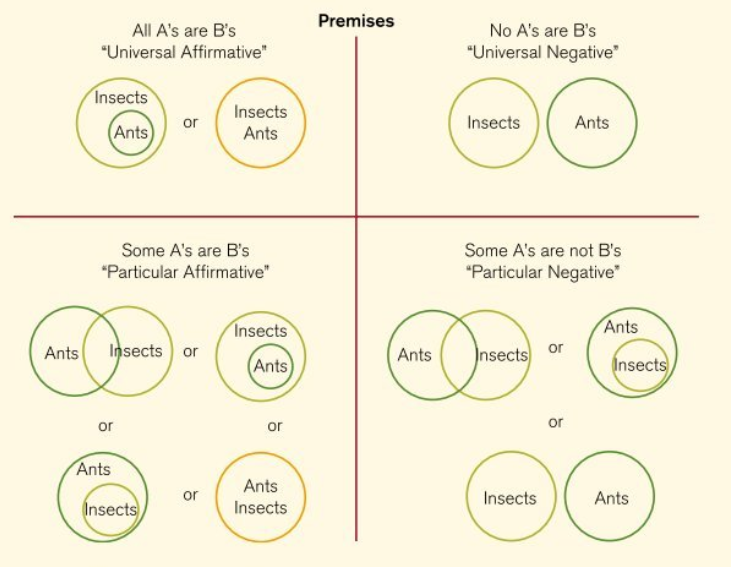
deductive reasoning approaches: surface approaches
propose that reasoning relies on general heuristics focused on the surface properties of the quantifiers in the argument rather on reasoning analytically
e.g. if the argument contains premises about universals (all and no) then the conclusion probably is a universal
or if the argument contains a negative premise (no or some … not) then the conclusion will be negative
Chater and Oaksford (1999) - probability heuristics model - everyday reasoning based on probability rather than logic
analyses probability on premises and strength of argument
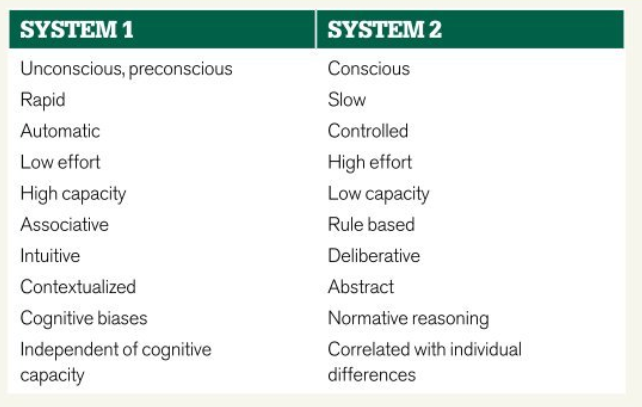
dual-process framework approach
sometimes we reason logically, other occasions we do not - may feel as though we have two different ways of reasoning
heuristics = nonlogically based processes used to evaluate information relevant to the problem = system 1
system 2 = operate with logically based analyses
perfect decisions are impossible
information is limited
information is ambiguous
time for decisions is limited
cognitive resources are limited
solution: heuristics
a heuristic is a rule of thumb
‘principle with broad application that is not intended to be strictly accurate or reliable for every situation’
mental shortcuts to reduce processing demands on our cognitive systems
allow for solutions to be made quickly rather than attending to all information and possibilities
heuristics produce systematic errors (biases)
judgements under uncertainty: heuristics
heuristics which are responsible for a range of biases and errors are:
representatives
availability
adjustment and anchoring
framing
availability heuristic: explanation
probabilities are assessed by the ease with which instances come to mind
can be useful to assess the frequency and probability of an occurrence/event as more frequent events are more likely to come to mind
however, the ease of the information from memory can impact our decision making - availability bias
adjustment and anchoring heuristic
different starting points lead to different estimates which are biased towards the initial value
people will make an estimate and then adjust
- irrelevant information can bias the initial estimate
- adjustments can be insufficient → errors
framing heuristic
prospect theory (Tversky & Kahneman, 1981)
a loss is perceived as more significant and therefore more worthy of avoiding than an equivalent gain
a sure gain is preferred to a probable one and a probable loss is preferred to a sure loss
because we want to avoid sure losses, we look for options and info with certain gain
the way something is framed can influence our certainty that it will bring either gain or loss
biases are not mere errors
mistakes are one-off, systematic errors are consistent
biases are making the wrong choice but for a reason
visual illusions reveal the normal mechanisms of perception
heuristic errors reveal the normal mechanisms of reasoning
what makes a good heuristic
available in many circumstances
doesn’t require lots of information or effort (fast and frugal)
on average it works - works = average benefits > costs
when do we use heuristics
always - perfect decisions are impossible
uncertainty
urgency
limited cognitive resources
where we see biases
decision biases are features of normal cognitive processes (e.g. memory, attention, planning)
can affect experts and laypeople alike
biases are a side effect thinking, not an optional extra
key points
heuristics are necessary shortcuts to good enough decisions
heuristics produce systematic patterns of errors
good heuristics are fast, general, easy
inductive reasoning
unlike deductive reasoning, inductive reasoning examines the likelihood of a conclusion being true rather than its absolute truth
all types involve reasoning from specific data to broader generalisations - result = generation of new info
types of inductive reasoning = analogical reasoning, category induction, casual reasoning
analogical reasoning
the process of using the structure of one conceptual domain to interpret another domain
in this example - recognise part-whole structural relationship between tree and forest
structural relationship is mapped onto second part of argument such that soldier fits the part and the choice is to identify the best option for the ‘whole’

category induction
being able to organise and recognise a group of things as members of the same category
if we see something new we can categorise it and infer properties of that thing
casual reasoning
infers cause and effect relationships between two events that occur together either in space or time
can then make predictions about, or even control, our environments
co-occurrence is necessary for one thing to cause another, however, many things covary together - also need to consider how often events do no co-occur
counterfactual thinking
our ability to reason about things that could have happened but haven’t
‘what if’ and ‘if only’ sentences
everyday reasoning
everyday reasoning is more subtle and complex than most of the formal reasoning tasks studied in the lab
however, subject to biases - many of which arise due to use of heuristics

model of decision making
setting goals
gathering info
structuring decision
making final choice
evaluation
prospect theory - Kahneman and Tversky (1979)
noted that the biases in people’s decision making often resulted from the fact that we do not treat gains and losses equally
treat losses as more important than gains
also assumes diminishing returns - gain/loss of £100 matters more if we have £1000 rather than £100,000
suggests that people overweight low-probability outcomes and underweight high-probability outcomes e.g. more likely to get in car crash than airplane crash but more scared of flying