vascular plants exam 3
 Call Kai
 Learn
 Practice Test
 Spaced Repetition
 Match
 Flashcards
 Knowt Play
1/39

There's no tags or description
Looks like no tags are added yet.
40 Terms
auxins
transmission of chemical signals in plants first systematically described by darwin and son (francis) in 1881
regulates cell elongation, cell division, and directional growth to respond to light and gravity
polar transport (basipetal, acropetal) and non-polar transport
cytokinins
class of growth factors that promote cell division without differentiation
found in plant embryo, sites of plant wounds, fruits, leaves, and root tips
undifferentiated cells can enlarge → divide → enlarge → divide without differentiation
cytokinin: auxin ratio in tissue development
higher auxin than cytokinin → root formation
lower auxin than cytokinin → bud formation (shoots)
equal amounts → mass of undifferentiated cells (callus)
ethylene gas
defoliated trees after gas leak, inhibit or promote cell expansion
most species, increased ethylene gas inhibits cell expansion
aquatic or semi-aquatic species : increased ethylene causes rapid cell expansion in internodes on the stem, helps plant keep up with water levels
ethylene: triple response
1) decrease in longitudinal (up/down) growth
2)increase in radical expansion of root + stem
3)horizontal orientation of epicotyl (stem)
ethylene fruit ripening
1) nonclimateric - gradual decline in cellular respiration during ripening (no climax)
application of ethylene makes these type of fruits easier to harvest
2) climateric - increase in cellular respiration in fruit tissue with ripening, reaching a peak (climax)
ethylene increases ripening process
1- degradation of chlorophyll
2-production of other pigments
3- starches, organic acids, oils → sugars
4- breakdown of pectin → softening of flesh
ethylene: abscission
programmed cell death resulting in separation of a part of a plant from body without leaving an open wound
ethylene promotes synthesis of enzymes that break down cell walls in abscission zone
commercial application: fruits when ripe are easier to break off
interaction with auxin prevents abscission
sex of flowers
cucurbits (squash and cucumbers)
increased ethylene = programmed cell death of stamens, flower is female
increased gibberellins = causes only stamens to be functional, flower is male
Abscisic acid (ABA)
inhibits growth in dormant buds (discovered 1949)
also found in fruits + leaves, may accelerate abscission
inhibits growth of embryo = dormancy in seeds
-usually extended exposure to cold temps. required to break dormancy along with light
-plants experiencing water stress: roots synthesize ABA, transport to leaves through xylem, dehydrates guard cells, stomata close, reduces role of evapotranspiration
Gibberellins (GA) and stem elongation
induces elongation, found in many organisms in all plant parts
1) stem and leaf elongation:
dwarf mutants (GA1 - gene involved in biosynthesis of GA is affected so no GA made) (GAI - insensitive to GA)
2) breaking seed dormancy: can induce germination, in recently germinated seeds can induce biosynthesis of enzymes that metabolize starch in endosperm
3) bolting and fruit development: basal rosette, internode never elongated, those plants bolt (stem grows tall very quickly before flowering), happens after cold (biennials) or increased day length (annuals)
commercial application: induces bolting and flowering early, increases fruit size
Brassinosteroids
growth promoting steroid: increase in cell number and size, found in all plant parts, no evidence of long distance transport
sessile, and tropisms, phototropism
sessile: rooted in one place
tropisms: growth response involving bending/curving of a root or shoot towards or away from a stimulus (positive = toward, negative = away)
positive phototropism (shoots bend/ curve toward light): auxins drive this response via elongation of cells on shaded side of shoot, auxins are more concentrated on the dark side
gravitropism
shoots = negative gravitropism - away from force of gravity
statocytes (shoots) in cortex, adjacent to vascular cylinder, statolith (amyloplast) is an organelle storing starch
increased concentration of auxin on underside of shoots → cell elongation
roots = positive gravitropism - towards the force of gravity
statocytes (roots) in root cap, statoliths settle on bottom of cell in response to gravity
increased concentration of auxin on underside → inhibits cell elongation
hydrotropism
growth of roots in response to a moisture gradient (positive)
root cap is important in either sensing moisture gradient or in transport of hormones, auxin also plays a role
actual growth response to hormones depends on species
thigmostropism
growth response to contact with solid object
roots: grow around obstructions
negative response on conjunction with gravitropism and hydrotropism
cells touching object remain small cells on opposite side of root elongate
shoots: tendrils will wrap around objects for climbing plants (memory of stimulus lasts even after stimulus is removed)
circadian clocks in plants
approximately 24 hour cycle of cellular processes regulating metabolism
all eukaryotes and photosynthetic bacteria
persist in absence of environmental stimulus
endogenous (internal) clock regulates these rhythms
circadian clock characteristics
1) free running but can be synchronized to other organisms, via day/ night cycles
2)temperature compensation - circadian clocks oscillate within a range of temps (12 - 27 c)
3) gating - stimulus of equal strength at different times of day will produce different response
leaf movement (folding, unfolding, raising or lowering), stomatal opening or closing, photosynthesis, enzyme and hormone production, cell division, stem elongation, flowers opening/closing, fragrance emission, seed germination
TOC1 gene
positively regulates LHY & CAAI
at dawn LHY & CAAI are at peak
protein production:
1) negative effect on TOC1 (expression declines during day)
2) upregulate gene expression of light dependent metabolic process, CAB- genes (binding proteins for chlorophyll a + b in photosynthesis) TOC1 products decline, expression of LHY & CAAI declines so TOC1 gets expressed at night when LHY & CAAI products are low
photoperiodism
biological response to changes in proportion of light and dark in 24 hrs
flowering - the length of dark period is what matters
1) short day (long-night) plants: only flower when days are short (early spring, fall)
ex: cocklebur, chrysanthemum, poinsettia, strawberry, primrose
2) long day (short-night) plants: only flower when days are long (summer)
ex: spinach, potatoes, lettuce
3) day neutral: day length has no effect
ex: sunflowers, rice, corn, wheat, cucumbers
phytochrome
photoreceptor proteins in leaves respond to light
Pr = changes in response tp red-light (day light)
Pfr = changes in response to far-red light - Pfr is bioactive and will trigger a response (photomorphogenic response)
photomorphogenic response
dark) stem elongates rapidly, leaves remain small and hook shape
light) leaves unfurl and grow, hook straightens out, stem help plants get taller than
shade avoidance) in shade red for red ratios are low (more far red) - elongated stems, elongated petioles, increased apical, leaves pointing up
florigen-floral stimulus
flower promoting signal produced in leaves and transported to SAM
made in response to light cues - regulated by phytochromes
small protein “FT” produced by flowering locus FT gene
in Arabidopsis 3 main genes involved - 1) circadian clock gene regulated by phytochrome, 2) CO expression regulated by GI, 3) FT- regulated by CO, makes florigen
vernalization
process by which a growth response is induced by a period of cold exposure
1) flowering - common in winter annuals and biennials. gene for Arabidopsis (FLC inhibits FT, FD, SOC1 genes)
seed dormancy
induced by unfavorable growing conditions, growth is inhibited and can only resume when specific environmental cues remove or metabolize endogenous inhibitors
1) exposure to cold, 5 degrees Celsius for 100 days
2) drying (common for fleshy fruits, prevent seedlings from being eaten and digested with fruits)
3) exposure to or lack of light (species specific)
4) seed coat abrasion - in plants with seed coats that prevent inhibition of water and oxygen, mechanical/chemical/microbial digestion/artificially via heat
bud dormancy
leaf primordia, nodes, internodes (not elongated)
bud primordia in leaf primordia axis, mainly flower primordia, SAM - all enclosed in bud scales
bud scales accumulate growth inhibitors in peak of summer - to induce dormancy, insulate against cold and desiccation
decreases in day length initiate process of acclimation (cold hardiness)
dormancy only broken after exposure to cold (peaches, chestnuts, apples - all need winter)
energy synthesis and uptake
energy (sugar) - synthesize from CO2 and water
synthesize all amino acids and vitamins from raw materials absorbed from the soil
“raw materials” = inorganic substances, ions (absorbed through root hairs, or hyphae of mycorrhiza)
not diffusion, usually cellular uptake of these ions happens via active transport against an electrochemical gradient (requires energy)
17 essential elements
1) necessary for completion of life cycle
2) is part of a molecule or other constituent of a plant that performs an essential plant function (ex: magnesium is part of chlorophyll)
macro: C, H, O2, N, K, P, Ca, Mg, S
micro: chlorine, Iron, Boron, Manganese, Zinc, Copper, Nickel, Molybdenum
-some elements are phloem mobile (Mg, P, K, N)
deficiencies detected in older leaves as plant mobilizes these nutrients to support new tissue growth
-immobile elements (cannot be moved once they are part of tissue - Ca, Boron, Iron)
deficiencies will be detected in new leaves
-intermediate mobile (Ca, S, Zn, Mn, Mo)
Soil characteristics
minerals with 2+ elements, generally inorganic (ex. SiO2)
weathering: physical and chemical disintegration of mineral rocks near earths surface (heating/cooling, wind, water, glaciers move & deposit rocks)
living organisms: bacteria, fungi, lichens, algae, bryophytes, small vascular plants (excretions, die and decompose into organic matter )
particulate matter and pore spaces make up soil
1- coarse sand
2- fine sand
3- silt
sandy soils > 45% sand and < 35% clay (water drains readily, not retained much, large pore spaces)
silty soils > 40% silt, < 40% clay (could become water logged and anoxic)
loam = equal silt, clay, and sand
field capacity = % of water soil can hold against gravity
clay + humus are negatively charged (Ca, K, Na, Mg - plants get all of those via cation exchange
biogeochemical cycle
process involving living organisms and the physical environment, conversion of elements from one chemical form to another
ammonification
conversion of N compounds from organic matter (proteins, AA, nucleotides, nucleic acids)
bacteria + fungi (decomposers) digest nitrogenous compounds and release excess N as NH4+
78% of atmosphere is N2 gas but the triple bond is hard to break, so can’t be used in this form
nitrification
conversion of ammonium to nitrate (NO3)
nitrosomonas - oxidize NH4+ (NH4 + O2 → NO2 + H + H2O)
Nitrobacteria - oxidizes nitrate (NO2 + O2 → NO3)
Assimilation
plants absorb nitrogen, convert NO3 + NH4 into organic forms (proteins, AA, etc.)
Denitrification
conversion of No3 to N2 gas
loss of N from soil - anaerobic, water logged soils (swamps and marshes)
fires, harvesting plants, soil erosion, leaching
N fixing bacteria convert N2 gas to inorganic N with enzyme nitrogenase (Rhizobia + plants who give sugar + root nodules )
guard cell wall structure
assisting with pore opening
shared wall whose cells touch at either end, very rigid, no potential for expansion (can only expand laterally)
increased CO2 concentration in cells can lead to stomata closing (happens at mid day, when increased temps increase cell respiration rate)
cellulose microfibrils radially oriented around cell wall
guard cell wall function in hot and dry climates
CAM metabolic pathway to get CO2 into Calvin Cycle
CO2 → organic acid (4-C)
open at night and closed during day
CO2 released from organic acid during day, Calvin cycle photosynthesis proceeds with stomata’s closed
cohesion-tension theory
cohesion (water to water) and adhesion (water to other) create an unbroken column of water
-tension cr3eated by water potential gradient pulls water column up
water potential is the measure of potential energy (pure water = 0 Mpa, atmosphere = -100 Mpa)
water moves from areas of high potential to low
embolism (air bubbles) disrupt flow of water through xylem by breaking tension, roots filter out fine particles to reduce bubbles
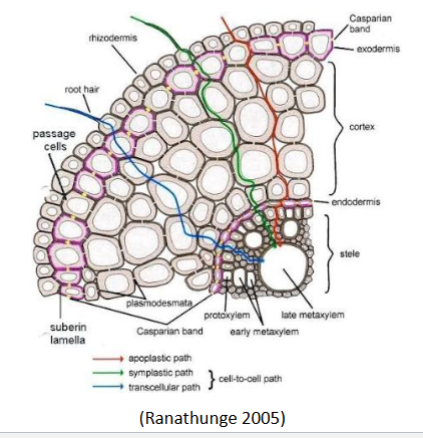
pathways of water movement into root cells
• Apoplastic – via non-living regions (around living cells via cell walls)
• Symplastic – through protoplasts via plasmodesmata
• Transcellular – across cell membranes and vacuoles
translocation of phloem assimilate
1. Loading of sugar from nearby leaf causes uptake of water into phloem
2. Uptake of water creates (+) pressure, causing phloem sap to flow down
3. Pressure relieved when sugar delivered to storage location
4. Water loss once sugar is delivered